
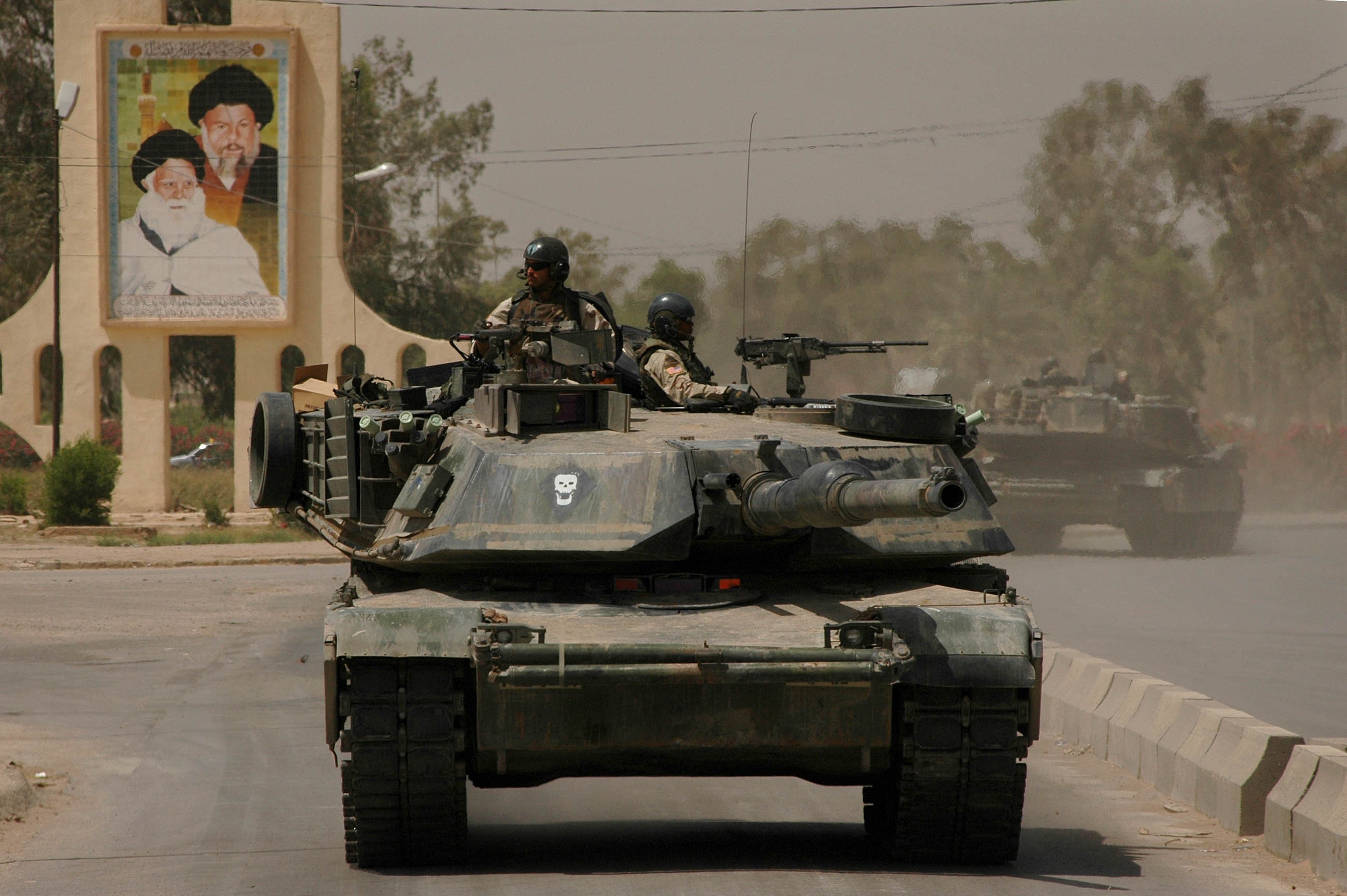
A U.S. Tank in Karbala, Iraq, May 2004. The American experiences in Afghanistan and especially Iraq over the past eight years have forced the U.S. military to rethink how it approaches counterinsurgent warfare. After some successes in Iraq, will the new counterinsurgency doctrine also work in Afghanistan?
Renewed American efforts to 'win' the war in Afghanistan against a resurgent Taliban, as well as the ongoing war in Iraq, have kept the question of counterinsurgency strategy at the forefront of U.S. military and public life. This month, Peter R. Mansoor--a professor of history at Ohio State and a Colonel, U.S. Army (Retired) who served most recently as the executive officer to General David Petraeus, the Commanding General of Multi-National Force-Iraq--examines the historical patterns of counterinsurgency doctrine. He explores the lessons of the Iraq War for Afghanistan and the radical changes to U.S. strategy of the last few years.
Readers interested in this article may also want to see these recent Origins articles: "Conflict Termination: How to End--and Not to End--Insurgencies" and "With a Little Help from Our Friends?: The Costs of Coalition Warfare."
For more on the recent history of Iraq and Afghanistan, please see these Origins articles on Women's Rights in Afghanistan, on Central Asia, and on The Sunni-Shi'i Divide in the Muslim World.
The recent publicity surrounding the U.S. Marine offensive into the Helmand River valley in southern Afghanistan has once again focused the American public's attention on U.S. counterinsurgency doctrine and strategy. "Where we go, we will stay, and where we stay, we will hold, build and work toward transition of all security responsibilities to Afghan forces," Marine Corps Brig. Gen. Larry Nicholson declared at the beginning of the operation.
This phrase is reminiscent of the Bush administration's belated strategy of "clear, hold, and build" in Iraq, a policy announced by President George W. Bush on March 21, 2006 in the midst of a large spike in ethno-sectarian violence that would by the end of the year drive Iraq to the brink of a full scale civil war.
Yet, a general understanding of counterinsurgency doctrine and strategy remains elusive. To many Americans, the wars in Iraq and Afghanistan are confusing conflicts waged by shadowy enemies without the benefit of the clear military or geographic objectives common to more conventional wars.
This lack of knowledge persists despite the fact that our nation gained its independence via an insurgency and has waged a dozen or so counterinsurgency conflicts since its birth. A familiarity with the historical record is essential to understanding the wars our nation is fighting today. What, we should ask, are the historical antecedents of the current wars in Iraq and Afghanistan, and how have they shaped American counterinsurgency doctrine and strategy?
Counterinsurgency Strategy – The Global Historical Context
Insurgencies have been around since the dawn of recorded history, as have the means used to suppress them. Until recently, counterinsurgency strategies have focused on the destruction of guerrilla forces, and/or on the control or devastation of the populations and environments from which insurgents gain their subsistence and support.
Imperial Britain used means such as burning villages, seizing livestock, destroying crops, and other measures to quell insurgencies. During the Second Boer War (1899-1902) the British interned 120,000 Boers, mostly women and children, in concentration camps; over 20,000 died in less than two years of confinement, mostly from improper hygiene and medical care.
When faced with an uprising in Kenya in the early 1950s, Britain again concentrated the population to prevent their support for guerrilla forces. By the end of 1954, the British forced more than 75,000 Kikuyu tribesmen into detention camps; and herded another million-plus tribesmen into protected villages to control their movements and activities. Isolated from their sources of supply and recruits and hunted incessantly in their sanctuaries, the British dealt the Mau Mau guerrilla organization a lethal blow. By 1956 the insurgent movement had collapsed. [Click here for more on recent history in Kenya.]
The United States has its own history of relocating civilian populations to enable the isolation and destruction of guerrilla forces.
During the Philippine War (1899-1902), U.S. forces in Luzon concentrated civilian populations in towns, either through enticements such as improved government services and provision of free education or through forced relocations, to enable military forces to hunt and destroy guerrilla bands in the surrounding hills and jungles.
During the Vietnam War, U.S. and British advisors worked with the South Vietnamese government to establish the strategic hamlet program, the goal of which was to separate the Vietnamese people from the Communist guerrillas by forcing them into protected villages.
Between 1961 and 1963, over 8 million people were relocated into strategic hamlets, but the poor administration of the program enabled insurgents from the National Liberation Front to overrun or infiltrate most of the villages. The program also alienated the Vietnamese peasantry by driving them away from their ancestral homes, and into the waiting arms of the Communist insurgency.
The French in Algeria also used a variety of population control measures in their efforts to defeat the insurgency that gripped the country from 1954-1962.
In Algiers, the French surrounded the most dangerous part of the city, the Casbah, with barbed wire and checkpoints to force the residents to show identification and submit to searches upon entry and exit. French paratroopers eventually gained the intelligence they needed to break up the terrorist cell responsible for the worst of the bombings in Algiers, but only through the use of torture (including waterboarding) that tainted the French effort with ethical misconduct.
French forces in rural areas of Algeria used a system called quadrillage to divide the country into sectors and positioned permanent garrisons in them to control the population and hunt down the insurgents. From 1957-1960, the French removed over two million Algerians from their villages and resettled them in more easily controlled camps to prevent them from supporting the rebels. They also created heavily patrolled barriers along the borders of Tunisia and Morocco that limited insurgent infiltration from their sanctuaries in these countries.
By 1960 the French had largely secured Algeria in a military sense, only to lose the political will to continue the struggle. In July 1962, President Charles de Gaulle granted Algeria independence, ceding territory that had been proclaimed a part of metropolitan France for over a century.
Another counterinsurgency strategy often employed is to focus efforts directly on the destruction of insurgent forces.
Russian forces in Chechnya used massive firepower to destroy guerrilla forces and sanctuaries in the Second Chechen War beginning in 1999, with over of 25,000 dead, mostly Chechen civilians. The United States, European nations, and the United Nations all roundly condemned the conduct of Russian forces, but the ability of Russian President Vladimir Putin to withstand this criticism enabled Russian forces to execute operations to destroy armed Chechen resistance, with minimal concern for the civilian population. [For more on current Russian history, see the Origins article "After Putin".]
The recent destruction of the Tamil Tiger guerrilla base on Sri Lanka and the attendant dislocation of the population in the process is another case in point
Counterinsurgency warfare does not just harm people. Often, the environment sustains major damage from the military operations designed to isolate insurgents and deny them resources and sanctuary.
Rome sowed salt into the remains of Carthage to ensure that vegetation would no longer grow there. Russians in the 19th century chopped down vast swaths of forest to deny Chechen rebels sanctuary. In Vietnam, U.S. forces used herbicides (Agent Orange) to defoliate jungle foliage in order to deny Viet Cong guerrillas cover and concealment.
In the 1990s, Saddam Hussein drained the marshes of southern Iraq to destroy the habitat of the marsh Arabs who had caused his regime so much trouble over the years. The Iraqi government today is in the process of restoring the marshes, but it will take decades for the palm groves and marshes of southern Iraq to recover from this ecocide.
As these examples illustrate, once an insurgent movement is established, its destruction has most often entailed extensive use of firepower, widespread devastation of civilian habitats, and strict control of the population, along with the collateral damage, ecocide, and civilian deaths that often accompany such measures.
However, in the absence of precise intelligence and targeting, a strategy focused on the elimination of insurgent forces is only viable provided a counterinsurgent force is willing to accept massive civilian casualties and environmental degradation, along with the negative publicity that results.
Challenges in Iraq and Afghanistan
Today, people and governments in the West have become increasingly reluctant to condone the massive level of violence and collateral damage needed to suppress an insurgency through force once it has grown beyond the embryonic stage.
Even with precision guided munitions and high technology intelligence and surveillance systems, western militaries will rarely be able to target enough of an insurgency's leaders and infrastructure to collapse an organization once it has firmly embedded among the people.
Collateral damage and civilian casualties, on the other hand, are magnified through insurgent propaganda and skillful use of the Internet, satellite television, and other media resources to sway popular opinion against the counterinsurgent.
The U.S. military campaigns in Iraq from 2003-2006 and in Afghanistan from 2001-2008 bear out these assertions. During the first year of the Iraq War after the fall of Baghdad in the spring of 2003, the shortage of U.S. ground forces, combined with the disbanding of the Iraqi army by Ambassador L. Paul Bremer, meant that there were insufficient troops available to execute a counterinsurgency strategy that focused on the protection of the Iraqi people.
Instead, military forces conducted targeted raids and cordon and search operations to destroy insurgents in their strongholds. Often, U.S. forces vacated areas once they were cleared of an overt insurgent presence, only to discover that the enemy returned to these same areas once military forces withdrew.
Iraqi citizens who had cooperated with the coalition forces were then placed at the mercy of the insurgents, who tortured and killed many civilians for their collaboration with coalition forces.
Multi-National Force-Iraq (MNF-I), under the command of General George Casey, initially continued this strategy to destroy insurgent forces in Iraq. Beginning in the spring of 2004, MNF-I ordered U.S. forces to withdraw from outposts in Iraqi cities and to position on large forward operating bases on the outskirts.
The thinking was that U.S. forces were a virus infecting Iraqi society, and the only way to prevent the forces of liberation turning into a hated occupation was to remove them from among the people. The lack of trained and ready Iraqi police and army units doomed this policy to failure.
Once U.S. forces withdrew from Iraq's cities, Sunni insurgents and Shi'ite militias took control of a large part of Baghdad and other urban areas. U.S. forces, patrolling in armored vehicles into neighborhoods from their bases on the periphery, could not maintain control or protect the population. [See here for more on the history of the Sunni and Shi'a Muslim conflict.]
In the spring of 2004 Sunni insurgents gained control of Fallujah, requiring a massive offensive operation in November to root them out of their urban stronghold—an operation that destroyed a good portion of the city in the process.
General Casey needed an alternative strategy to rescue a failing mission. He seized on the transition of security responsibilities to Iraqi forces as his primary goal, neatly summed up by President Bush in a nationally televised speech, "As the Iraqis stand up, we will stand down."
But the strength and abilities of the insurgency were growing faster than the numbers and capabilities of the Iraqi security forces. The bombing of the Al-Askari Shrine in Samarra by operatives of Al Qaeda-Iraq in February 2006 fatally undermined this strategy. Iraqi forces, sometimes themselves complicit in ethno-sectarian violence, could not contain the resulting sectarian violence as Shi'ite militias swept through Baghdad and other Iraqi cities.
Sunni insurgents, increasingly under the sway of Al Qaeda-Iraq extremists, gained substantial control of Al Anbar province and several neighborhoods in Baghdad, Baqubah, and Mosul. By the end of 2006, the war was nearly lost as sectarian conflict wracked Baghdad and Iraq teetered on the edge of a full-scale civil war.
The early course of the war in Afghanistan since the U.S. invasion in 2001 has also substantiated the inability of western forces to destroy an entrenched insurgency through offensive operations. U.S. ground forces launched a number of large unit operations to destroy Al Qaeda and Taliban forces, with mixed results. Despite suffering significant losses to air strikes and ground combat, Taliban forces grew in numbers and capability.
Complicating matters, the Pashtun areas of western Pakistan provided safe havens for Taliban forces. Occasional strikes by armed unmanned aerial vehicles killed a number of Taliban and Al Qaeda leaders, but also produced a backlash among the Pakistani public, who widely condemned the violation of their sovereignty. By 2008 the Taliban had gained control of significant swaths of Afghan territory and put in doubt the outcome of the conflict.
The Key to Successful Counterinsurgency Warfare – the Population
If destruction of insurgent forces is not today the key to victory in counterinsurgency warfare, then what is?
In a seminal work on counterinsurgency theory written in 1964, French Army Colonel David Galula (who served with French forces in the Algerian conflict in the 1950s) hypothesized the protection of the population as the key to a successful counterinsurgency strategy.
Since insurgents cannot normally win an outright military victory against the conventional forces of a state, they must control and gain the support of the people in order to exercise political power and render the government powerless.
To be successful, the counterinsurgent must contend for the support of the population and protect the people from insurgent violence, intimidation, and coercion. The goal is to make it impossible for the insurgents to live among the people and use them as a base of support; killing or capturing enemy forces is a secondary objective.
If the population is the decisive element in counterinsurgency warfare, then convincing the people that a better life lays ahead is essential to restoring the legitimacy of the governing authority. Often deemed the battle over "hearts and minds"—a phrase used by British General Sir Gerald Templer, Director of Operations and High Commissioner for Malaya, regarding his strategy to defeat the Communist guerrillas in that country in the 1950s—this field of activity is really a contest for the people's trust and confidence.
The people must be convinced that support for the legitimate governing authority is not only preferable to support for the insurgent cause, but also clearly in their best interests. Executed properly, civic action and humanitarian assistance are undertaken to require the people to make an active choice in favor of supporting the legitimate governing authority. This choice has little to do with gratitude, which cannot survive first contact with terrorism and intimidation, and much to do with enlightened self interest.
Many armies, configured both physically and intellectually for conventional, high intensity combat, have difficulty adjusting to these realities.
During the Vietnam War, the U.S. Army for several years persisted in applying a conventional war-fighting doctrine to irregular warfare. The resulting strategy of attrition, exemplified by search and destroy operations focused on body counts of dead guerrilla fighters, failed to lessen significantly the strength of the National Liberation Front.
While combat against North Vietnamese Army regiments may have necessitated a degree of high intensity combat, the need to secure the South Vietnamese population from Communist guerrillas required a different approach. The situation only changed after the Tet offensive in 1968 when the new commander of Military Assistance Command-Vietnam, General Creighton Abrams, embraced a revised strategy focused on protecting the population.
Innovation from Below
Regrettably, for three decades after the end of the Vietnam War, the U.S. professional military education system all but ignored counterinsurgency operations.
Instructors from the Command and General Staff College, trying to create a course on low intensity conflict in the 1980s, looked in vain for help from the Special Operations School at Fort Bragg. They found that the staff there had been ordered to throw away their counterinsurgency files in the 1970s, since presumably the United States would never fight that kind of war again.
As a result, U.S. military commanders struggled from a conceptual shortfall in the first years after 9/11.
There were exceptions, however. In 2005-2006, the 3rd Armored Cavalry Regiment, under the commander of Colonel H. R. McMaster, conducted an inspired operation in the city of Tal Afar in northwestern Iraq that became a model for operations elsewhere in the country.
When McMaster's unit arrived in Tal Afar in the spring of 2005, the city was under the control of foreign jihadists and their Iraqi allies, who used it as a base of operations and a transit point for men and materiel smuggled into the country from neighboring Syria.
The insurgents had intimidated the population into submission to their brutal authority. The Turkmen population, divided along Sunni-Shi'a lines, was engaged in horrific sectarian violence. For all intents and purposes, Tal Afar had become a dead city.
McMaster employed a strategy of "clear and hold" to restore Tal Afar to coalition control. His troops first surrounded the city with a berm to force traffic through security checkpoints and thereby isolated the insurgents and terrorists from outside support.
Leaders then spent countless hours engaging the people, sorting out the local power structures, and lending a sympathetic ear to grievances while slowly turning the narrative from a Sunni-Shi'a civil war to one of all Iraqis against the foreign jihadists who had taken control of and terrorized their city.
Instead of a massive assault to clear the city, as coalition forces had done the previous November in Fallujah, McMaster employed his forces in small combat outposts scattered throughout Tal Afar to provide the people with security against terrorist depredations.
He also worked diligently to recruit both Sunnis and Shi'ites to provide a sectarian balance within the police force. By the time the 3rd ACR departed Iraq in early 2006, Tal Afar was once again under coalition control.
The 1st Brigade, 1st Armored Division (the "Ready First Combat Team"), under the command of Colonel Sean MacFarland, replaced McMaster's forces in Tal Afar and continued the campaign to hold the city while restoring government functions and essential services1.
The desperate situation further south in Al Anbar province, however, forced Multi-National Corps-Iraq (MNC-I) in June 2006 to move most of the brigade combat team to Ramadi, a city designated by Al Qaeda-Iraq as the capital of its future Iraqi caliphate. With the exception of a handful of Marine bases, Sunni insurgents enjoyed almost complete freedom of movement throughout the area. Jihadists had terrorized the population into submission, and their brutal administration of Islamic law left deep-seated scars on the community.
Faced with a problem in Ramadi similar to that encountered by McMaster in Tal Afar, MacFarland employed similar techniques to clear the city and then hold it against terrorists and insurgent forces.
Units of the Ready First Combat Team challenged terrorists and insurgents in their long held sanctuaries within the city by establishing combat outposts in their midst, occupied by U.S. troops, Iraqi security forces, and civil affairs teams.
MacFarland and his leaders engaged local tribal sheiks, fed up with Al Qaeda violence and their loss of prestige and influence, to solicit their cooperation and to recruit their young men into neighborhood watch units or into the Ramadi police force.
Resurgent Iraqi police and tribal elements raided Al Qaeda safe houses and seized hundreds of weapons caches. Slowly but surely, the advance of combat outposts, combined with support from the growing Sunni tribal rebellion against Al Qaeda, squeezed the insurgents out of Ramadi.
The Surge
Population security in Tal Afar and Ramadi exemplified the type of operations envisioned in the new, historically-grounded U.S. Army and Marine Corps counterinsurgency doctrine published in December 2006.
These successes came not a moment too soon; by the end of 2006 the Iraq War was nearly lost as Iraqi society tore itself apart in a spasm of sectarian bloodletting. Political progress toward reconciliation and an equitable distribution of power and resources among competing sectarian and ethnic groups was not possible until violence diminished.
Belatedly sensing the need for a change of course, President Bush in January 2007 ordered a "surge" of 40,000 troops to Iraq. These forces would conduct operations focused on population security under the leadership of General David Petraeus, who assumed command of MNF-I in February 2007, and Lieutenant General Raymond Odierno, who deployed to Iraq in command of MNC-I late in 2006.
The new strategy was more important than the additional forces.
While continuing operations to clear areas of an overt insurgent presence, Petraeus and Odierno ordered U.S. units to deploy off of the large forward operating bases where they had been stationed since the spring of 2004 and to establish smaller joint security stations and combat outposts in Iraqi neighborhoods and communities.
There they would partner with Iraqi security forces, support local neighborhood watch groups (nicknamed the "Sons of Iraq," which grew to over 100,000 strong by mid-2008), and provide much-needed security to the Iraqi people to insulate them from terrorist violence and militia intimidation. From these outposts combat forces would conduct dismounted patrols and thereby benefit from more intimate contact with the people living in their assigned zones.
U.S. commanders introduced other techniques as well. In conjunction with community leaders, coalition forces emplaced cement barriers to wall off neighborhoods and markets to impede the movement of terrorists, insurgents, and militiamen. Iraqi units manned numerous checkpoints that made terrorist and insurgent movement more difficult.
U.S. units conducted comprehensive censuses to identify exactly who lived in each neighborhood, to catalog their sect and ethnicity, and to gather other important identifiers that could help determine local social structures. They also enrolled Iraqis into biometric databases so that soldiers could quickly determine local residents from outsiders.
These measures were a more humane alternative to the use of concentration camps to control civilian movement and make it more difficult for insurgents to live among the people.
The revised counterinsurgency strategy, the improved techniques used by U.S. commanders, and the provision of more security forces served as the catalyst to significantly improve security in Iraq.
The arrival of U.S. reinforcements signaled renewed resolve and assured Sunni tribal leaders that they would not be abandoned once they turned their guns against Al Qaeda-Iraq, as had happened once before in 2005. The tribal rebellion accelerated after the surge forces arrived and U.S. and Iraqi units moved to secure communities by living among the people.
Improved security also led to a loosening of the grip by Shi'ite militias on a number of key areas. Amnesty legislation and local cease fires reduced the number of fighters opposing the government.
Finally, the increase of Iraqi security forces by more than 140,000 troops in 2007 and 2008, along with their improved capabilities, emboldened Prime Minister Nouri al-Maliki to confront the Jaish al-Mahdi militia in its strongholds in Basra, Amarah, and Sadr City, and to bring the vast majority of southern and central Iraq under Iraqi government control.
By the summer of 2008, violence in Iraq had abated by 85 percent from its peak at the end of 2006. [See the latest statistics on the wars in Iraq and Afghanistan at http://www.cnas.org/node/2898] The change in strategy and additional forces provided by the surge made these significant security improvements possible and thereby gave Iraqi leaders the opportunity—if not the certainty—to settle the competition for power and resources through more peaceful political means.
The Future in Afghanistan
It is too early to tell how counterinsurgency operations will play out in Afghanistan. The new commander of U.S. forces, General Stan McChrystal, has stated that protection of the Afghan people will be his top priority, an indication that he intends to implement the population-focused strategy employed successfully by coalition forces in Iraq.
Nevertheless, Afghanistan is a much different country. It lacks Iraq's economic viability, its tribal structure is much more deeply embedded, the Afghan government is even more inept and corrupt than the Iraqi government, and the Taliban insurgents enjoy sanctuary across the border in western Pakistan.
Additionally, the Afghan army and police are woefully undersized and under-resourced for the tasks they must perform. Historically, counterinsurgents are successful when they field 20-25 security personnel for every 1,000 people. The war in Iraq finally turned around when the number of Iraqi, coalition, and tribal security personnel approached this figure.
Today in Afghanistan there are fewer than half the number of security forces needed to reach the desired ratio for population protection. A large increase in the number of Afghan army and police, along with U.S. and NATO advisors to train and assist them, should therefore be one of the most pressing priorities in the near future.
In the meantime, increased numbers of U.S. forces will pick up the slack in the battle against Taliban forces, while American and European civilian advisors assist the Afghan government in improving its governance and capacity to provide for the needs of the people.
All of these factors point to a long slog ahead as U.S., NATO, and Afghan forces battle the Taliban militants in the midst of a substantial and extremely difficult exercise in nation-building.
If history is any guide, in the end the Afghan government and people will play the most important role in determining their own fate. Meanwhile, the struggle for their trust and confidence continues in the river valleys, deserts, and mountains of Central Asia.
The author commanded the Ready First Combat Team in Iraq in 2003-2004, and turned command of the organization over to Colonel MacFarland the following year.
Bernard Fall, Street Without Joy: The French Debacle in Indochina (Stackpole, 2005)
David Galula, Counterinsurgency Warfare: Theory and Practice (Praeger, 2006)
Alistair Horne, A Savage War of Peace: Algeria, 1954-1962 (Macmillan, 1977)
David Kilcullen, The Accidental Guerrilla: Fighting Small Wars in the Midst of a Big One (Oxford, 2009)
Andrew Krepenevich, The Army and Vietnam (Johns Hopkins, 1986)
Brian Linn, The U.S. Army and Counterinsurgency in the Philippine War, 1899-1902 (North Carolina, 2000)
Peter Mansoor, Baghdad at Sunrise: A Brigade Commander’s War in Iraq (Yale, 2008)
Daniel Marston and Carter Malkasian, eds., Counterinsurgency in Modern Warfare (Osprey, 2008)
John Nagl, Learning to Eat Soup with a Knife: Counterinsurgency Lessons from Malaya and Vietnam (Chicago, 2005)
Small Wars Journal, http://smallwarsjournal.com/
Tom Ricks, The Gamble: General David Petraeus and the American Military Adventure in Iraq, 2006-2008 (Penguin, 2009)
Lewis Sorley, A Better War: The Unexamined Victories and Final Tragedy of America's Last Years in Vietnam (Harcourt, 1999)
U.S. Army/USMC Field Manual 3-24, Counterinsurgency (Government Printing Office, 2006)


