
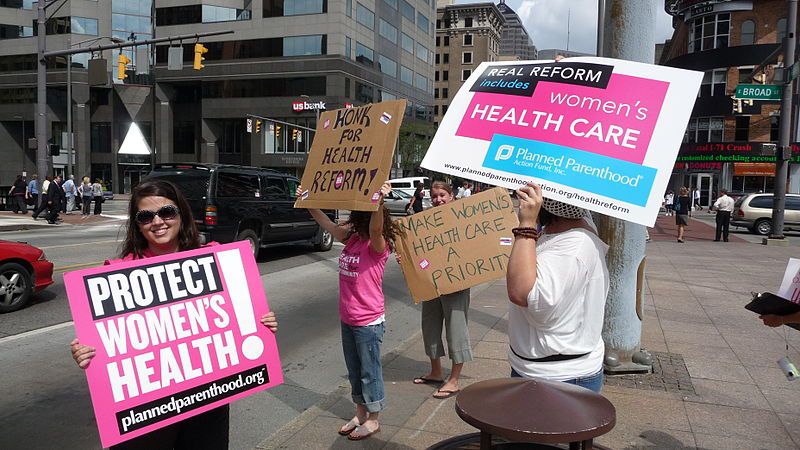
Planned Parenthood supporters demonstrate in Columbus, Ohio, 2012. Over the last hundred years abortion practices and policies have gone in very different directions in Western Europe and the United States, where abortion rights are far more politically polarizing.
As the 40th anniversary of Roe v. Wade, the US Supreme Court case legalizing abortion, approaches, many Americans assume that legalized abortion is only as old as that ruling. In fact, as Anna Peterson discusses this month, abortion had only been made illegal at the turn of the 20th century. The different histories of abortion in Europe and the United States reveal much about the current state of American debates—so prominent in the 2012 elections campaigns—over abortion and women’s health.
*Update: for our podcast, we caught up with Anna Peterson during her research in Oslo, Norway.
For more from Origins on women's history, please read Women’s Rights in Afghanistan; Women's Politics in Zimbabwe; The Real Marriage Revolution; Child Kidnapping in America; and Abortion in Canada (PDF File).
Representative Todd Akin (R-Missouri) caused a political firestorm this August when he told a television reporter that he opposes abortion in all circumstances because "legitimate rape" rarely leads to pregnancy. Republican Presidential candidate Mitt Romney quickly distanced his own pro-life views from Akin's, and President Barack Obama reiterated his commitment to not make "health care decisions on behalf of women."
Politicians frequently use their stances on abortion to elicit electoral support, and this election year is no different. Abortion is again a major point of divisive debate in presidential and congressional races. And state legislative efforts to restrict abortion access are currently under way in twelve states.
The 2012 Republican Party platform calls for a constitutional amendment to outlaw abortions but makes no explicit mention of whether exceptions would be made for cases of rape and incest. Romney has indicated in several interviews that he supports the repeal of Roe v. Wade.
Across the Atlantic, the abortion issue seldom garners such rapt attention. As members of national health insurance plans, most Western European women enjoy access to elective abortion services—also called abortion on demand. While there are significant regional differences in abortion policies and political discourse, abortion is rarely a point of contention during elections.
Abortion practices, debates, and laws initially developed quite similarly in Europe and the U.S., but at the turn of the twentieth century, cultural attitudes began to diverge. While Europeans continued to believe that abortion was a desperate act of unfortunate women, some powerful Americans began to argue that abortion was an immoral act of sinful women. These divergent perceptions of abortion and the women who have them still affect abortion debates and legislation on both sides of the Atlantic.
Historically, abortion policy has revolved around three main players: government officials, women, and medical practitioners.
The historical record also shows that, for thousands of years, women have limited the number of the children they bore through pregnancy prevention, abortion, and infanticide. Abortion was only recently outlawed, and then only for a period of roughly 100 years. When women did not have legal access to abortion services they still found ways (albeit often unsafe ways) to end unwanted pregnancies.
Abortion at the Turn of the Nineteenth Century
For most of Western history, aborting an early pregnancy was considered a private matter controlled by women and was not a crime.
At the turn of the nineteenth century most people in Western Europe and the United States did not believe human life was present until a pregnant woman felt the first fetal movements, a phenomenon referred to as quickening.
Before quickening, women thought about pregnancy in terms of a lack of something (menstruation) rather than the presence of something (a fetus). In an effort to restore their monthly periods, they took herbal abortifacients such as savin, pennyroyal, and ergot, which they often found in their own gardens.
They did not consider such practices abortion. In fact, the word abortion was confined to miscarriages that occurred after quickening. Medical doctors had trouble even verifying a pregnancy until the woman reported that quickening had occurred.
Religious authorities such as the Roman Catholic Church also supported the idea that the soul was not present until a later stage of pregnancy. Although not official church doctrine, this belief was based on St. Augustine's fifth-century interpretation of Aristotle, that the soul enters the body only after the body is fully formed—some 40 days after conception for males and 80 days for females.
Laws reflected this distinction between the quick and the nonquick fetus. In the United States and England, abortion was legal in the early 1800s as long as it was performed prior to quickening. During later stages of pregnancy, abortion was a crime, but distinct from other forms of murder and punished less harshly.
It was very difficult to prove that a woman accused of abortion had ever felt the fetus move. Even in infanticide cases, the court often had to rely on the accused woman's testimony to know whether the child had died in utero or had been born full-term and alive.
When Margaret Rauch was put on trial in Pennsylvania in 1772 for a suspected infanticide, she testified that the baby "used to move before, but did not move after [she fell during the pregnancy]." Rauch was acquitted.
At this time, the pregnant woman had significant power in defining pregnancy and the law was based on her bodily experience.
By the mid-1800s women from all walks of life aborted pregnancies, and abortion services had grown more widely available. As the professionalization and commercialization of medicine began, more abortion options became available to the women who could afford to pay for them.
Poor women—especially unmarried ones—continued to use herbs to abort unwanted pregnancies, and could purchase abortifacients from pharmacists through the mail. If those drugs failed they could go to the growing number of practices that used medical instruments to induce abortions. Costing anywhere between $5 and $500, most women who could pay skilled professionals for such services were married members of the middle and upper classes.
The Road to Criminalization
In the late nineteenth century, American and European doctors, social reformers, clergy members, and politicians made abortion into a social, political, and religious issue. Women's experiences of quickening were discredited as unscientific and medical doctors became the recognized experts on pregnancy and fetal development.
Quickening lost credibility as a valid indication of fetal life when doctors lobbied state governments to change laws to reflect their new way of thinking. By 1900, Western European countries and the United States had outlawed abortion during all stages of pregnancy.
The U.S. and England, where quickening had carried the most legal weight, criminalized abortion during all stages of pregnancy by the late 1880s. British criminalization began with Lord Ellenborough's act of 1803 and was fully realized when Parliament passed the Offenses Against the Person Act in 1861.
Abortion was outlawed state-by-state in the U.S. between 1860 and 1880. Abortion was also considered a criminal act in most of Western Europe, with many of the laws originating in the 1810 Napoleonic legal code.
During the last half of the nineteenth century, social scientists began to publish statistics comparing birth rates among nations. As nationalism and imperialism intensified tensions between European countries, these numbers took on new significance. Statesmen feared that if women chose to have fewer children then this would decrease their nation's ability to compete in modernized warfare.
Anxiety racked French politicians when they learned France's birth rate had fallen nearly a third between 1870 and 1914, while its neighbor (and recent and future enemy) Germany's had barely changed at all. The idea that women needed to give birth to as many children as possible spread contagiously.
Ludwig Quessel captured the dire essence of this worry when he said: "A spectre is haunting Europe: the spectre of a birth-strike." In this climate, women's control of their fertility represented a threat to national interests.
Concerns arose in Europe and the U.S. not only over women's refusal to bear more children, but over which women were limiting their family size. The visible use of abortion by white, middle-class women seemed to threaten the status of their male counterparts and "white" positions of power.
As Theodore Roosevelt put it in 1894, women of "good stock" who refused to have children were "race criminals."
The Criminalization of Abortion
Increased scrutiny of pregnancy and childbirth coincided with a push by medical doctors to increase their professional influence. Because of the variety of abortion methods available to women, trained physicians had little control over this area of what they considered medical science.
In the United States, the newly created American Medical Association (AMA) initiated an antiabortion campaign in 1857 as part of its efforts to professionalize and to restrict competition from homeopaths and midwives. They lobbied for the criminalization of abortion, capitalizing on fears that not enough white, native-born women were having children.
Doctors claimed there was little difference between a quick and a nonquick fetus and that earlier and later stages of pregnancy were not distinct. In doing so, they redefined the meaning of abortion to include early stages of pregnancy.
AMA doctors discredited women's experiences of quickening as unscientific and emotional. Noted AMA physician and antiabortion advocate Dr. Horatio Storer quipped in his 1868 book Why Not?: "Many women never quicken at all, though their children are born living."
American doctors joined forces with religious authorities to pass antiabortion laws. While doctors spearheaded the movement to discredit quickening and criminalize abortion, their ideas about fetal development also led to important changes in Roman Catholic Church doctrine.
Pope Pius IX declared in 1869 that an embryo was a human being with a soul from the time of conception. This declaration challenged existing beliefs that an ensouled, animated fetus was different from an inanimate one. Pius also stated that abortions performed at any stage of pregnancy warranted excommunication. In 1895, a papal decree condemned therapeutic (life-saving) abortions as well.
These changes inspired many Catholics to support the AMA's antiabortion campaign. Protestant churches, with their doctrinal emphasis on individual reason and responsibility, remained more open to abortion and more accepting of therapeutic abortion.
American and most European abortion laws included an exemption allowing doctors to perform abortions if a woman's life was in danger. These exemptions further solidified the alliance between the state and doctors, however, by allowing doctors to adjudicate the legality of abortions. Doctors took the lead in having abortion criminalized, and the state, in turn, recognized them as the only legitimate providers of abortion services.
By 1900, then, abortion had been culturally and politically redefined as the taking of a human life—an immoral and illegal act. The shift in attitudes toward pregnancy and abortion that had been championed by doctors and church officials led politicians in most Western countries to enact antiabortion legislation.
What had once been considered a private matter minimally legislated by the state had become a public concern worthy of punishment. Women's bodily experiences were viewed with distrust and their efforts to control their fertility often deemed criminal.
"When Abortion was a Crime"
Abortion was illegal in Western Europe and the United States for much of the twentieth century. Women did not, however, stop having abortions.
Though the legal status of abortion had changed dramatically, the general public in both the United States and Europe still widely accepted the practice. Most women continued to see abortion as an acceptable method of ridding their bodies of unwanted pregnancies and restoring their menstrual cycles. They did not feel a moral obligation to carry the pregnancy to term until they felt the fetus move
Many medical practitioners actually continued to perform illegal abortions, often charging substantial amounts of money. Doctors, midwives, and others offered abortion services in walk-up offices, clinics, and even hospitals.
Women quietly informed one another who could be counted on to help them. While midwives and homeopaths faced the greatest risk of imprisonment for performing abortions, doctors were largely able to avoid prosecution by claiming they were merely performing the therapeutic abortions allowed by law.
Abortion businesses boomed, mainly because most women stopped using herbs to induce abortions and increasingly sought surgical abortions to terminate unwanted pregnancies.
Medical abortions, especially those performed with surgical tools, had garnered a reputation as a more effective and safer means of inducing miscarriage. Practitioners most often used dilation and curettage—a procedure in which a woman's cervix is dilated and a spoon-shaped instrument is inserted into the uterus to scrape out the fetal and placental tissue—to terminate pregnancies. As a result, abortion in the twentieth century ceased to be a secret kept among women and became a publicly available service.
In the United States, the AMA reacted to the continued widespread acceptance, and use, of abortion in the early twentieth century with a renewal of their antiabortion campaign. Prominent AMA doctors were appalled that women still believed that having an abortion prior to quickening was a perfectly acceptable and moral act.
Dr. Storer's hope in 1868 that "Women in every rank and condition of life may be made sensible of the value of the fætus, and of the high responsibility which rests upon its parents" had not been fulfilled. They blamed a lack of enforcement for the persistence of high rates of illegal abortion.
In order to convince the general public that abortion was wrong, some American doctors, along with moral crusaders like Anthony Comstock, waged a cultural campaign against abortion. The Comstock Act outlawed the circulation of "obscene" materials including contraceptives and information about contraceptives or abortion. Many birth control advocates, including Margaret Sanger, were prosecuted under the law for sending such materials through the mail.
The Parting of Ways
In the late nineteenth century, American attitudes toward abortion began to diverge from those in Europe. People in both Europe and the U.S. had long expressed sympathy for women who had abortions and many believed abortions helped unfortunate women in difficult situations.
American antiabortionists instead put forth an image of women who procured abortions as frivolous and promiscuous.
The AMA argued that abortion was a moral issue and insisted it was doctors' Christian duty to educate others about the immorality of abortion. Chairman of the AMA Section on Obstetrics, J. Milton Duff, described abortion in 1893 as "a pernicious crime against God and society." In 1915, Chicago circuit court Judge John P. McGoorty echoed these views, "A woman who would destroy life in that manner is not fit for decent society."
The idea that only disreputable women sought abortions gained less traction in Europe, where the Social Democratic Party (SDP) was gaining popular support.
The growth of a party focused on socialist goals lent credibility to the notion that women who had abortions were desperate and destitute. So when it became evident that criminalization had not stopped abortion, European Social Democrats and women's rights activists argued that the best way to solve the abortion problem was to resolve socioeconomic issues.
Meanwhile, the global economic crisis of the 1930s led more married women than ever before to demand (illegal) abortion services.
The Seeds of Abortion Law Reform
The Great Depression led to a sharp increase in both legal and illegal abortion rates, further widening the divide between European and American attitudes.
Some doctors stretched their definitions of therapeutic abortion to include social criteria, but many did not. Desperation led many women to accept unsafe abortion methods.
Dr. Frederick J. Taussig and the Kinsey Institute for Sex Research estimated that in the United States alone 17,000 women died each year from abortion-related complications during the 1930s. These deaths became visible evidence of the consequences of illegal abortions and created an opportunity for public debate on abortion reform.
European political efforts to legalize abortion in the 1930s drew upon the already prevailing idea that women were driven to abortion by poverty and desperation. Birth control advocates often led these reform movements and used anecdotal evidence to emphasize women's desperation.
Ordinary women like Astrid Knudsen, a poor Norwegian woman, beseeched birth control advocates to help her end her pregnancy as "our situation is such that we cannot manage the two children we already have … and to bring more children into this horrible world [would be] impossible."
As the SDP achieved more political success in this period, especially in Northwestern Europe, governments were increasingly persuaded by these heart-wrenching stories. Many European countries subsequently expanded the therapeutic conditions for legal abortions, but abortions performed at a woman's request remained illegal.
In the United States, birth control became more widely accepted for married couples in the 1930s, but no popular movement to reform abortion laws emerged in the interwar years due in part to American fears of Soviet communism. While the Soviets had been the first in the world to legalize abortion on demand in 1920, Stalin recriminalized abortion in 1936 to stimulate population growth.
Still, Americans continued to link abortion with Soviet socialism throughout the 1930s, hindering public discussion of decriminalization.
So, while the dramatic increase in abortion-related deaths during the 1930s had inspired decriminalization debates in Europe, Americans responded by intensifying enforcement. Police and prosecutors began to arrest and prosecute abortion providers.
The police also stepped up their interrogations of hospitalized women who were dying from abortion-related complications, sometimes under threat of withholding access to medical treatment.
As a result, hospitals defensively set up committees to legitimate medical reasons for abortions. These efforts served to heighten the focus on the criminality of abortion and the women who sought abortion services. This, coupled with the lack of an abortion reform movement, served to keep abortion a closeted issue in the U.S.
The (Re)Legalization of Abortion
The severe repression of abortion in the United States during the 1930s and 1940s created a discriminatory system with deadly results. Women and physicians who had seen the results of "back alley" abortions grew increasingly frustrated.
Abortion had always carried a high risk. Over time, many women had died from home remedies like ingesting large doses of abortifacients, being kicked in the abdomen, throwing oneself down a flight of stairs, or having unskilled surgical procedures. But by the 1930s, deaths and complications from abortions sought outside the home rendered these dangers public and seemingly epidemic.
When large numbers of women were hospitalized with abortion-related complications, people couldn't help but witness the tragic results of criminalization.
As a result, women and some reform-minded physicians formed abortion reform movements in the 1950s and 1960s that would eventually succeed in legalizing abortion in the United States and stimulate the repeal of abortion laws around the world.
Medical professionals joined forces with lawyers to expand the conditions under which women could legally procure abortions. A few highly publicized abortion cases in the 1960s captured public attention.
When Sherri Finkbine found out her sleeping pills contained thalidomide—a drug that causes birth defects—she scheduled an abortion at an Arizona hospital. After she went public with her story to warn other women about the dangers of thalidomide, the hospital refused to treat her because they were worried about bad publicity. She eventually had to go to Sweden to obtain an abortion.
The public focus on women's abortion needs in the 1960s went hand-in-hand with the emergence of the second-wave feminist movement. Feminists in Europe and the United States began to mobilize around the abortion issue. In Europe, where reform movements had been present since the 1930s, feminists shifted the focus from reform to repeal.
American and European feminists wanted women to be able to freely choose whether to have an abortion instead of having to rely on a doctor's interpretation of legitimate reasons. To these feminists the criminal status of abortion represented men's subordination of women and the medical establishment's control of women's bodies. They claimed that the repeal of all antiabortion laws was a cornerstone of women's liberation.
Feminists in the U.S. and Europe employed different strategies that had the most resonance with existing cultural beliefs.
American feminists often based their arguments on abstract principles of individual rights. American feminists never directly challenged the belief that women obtained abortions frivolously. Instead they emphasized women's right to control their bodies without state interference.
Many European feminists framed their demands for legalized abortion in terms of public health and humanitarianism. They reasoned that until the state ensured that all women could bear children without suffering economic or social consequences, women should have access to legal abortion services.
They drew upon the established belief that most women only had abortions out of legitimate need. Feminists argued that these self-identified welfare states were obliged to protect women, especially poor women, from the burdens of unwanted pregnancy.
The (re)legalization of abortion that occurred in the 1960s and 1970s was informed by the ideas put forward by feminists and physicians.
In 1967, Britain significantly expanded the conditions for legal abortion. The Abortion Act stated that abortions were legal as long as two medical professionals agreed that pregnancy endangered the life, mental or physical health of the woman or her children, and in cases of fetal deformity and handicap. While this law did not completely decriminalize abortion it represented an important step toward the legalization of abortion in Western Europe and the United States.
The American legalization of abortion stemmed from two Supreme Court cases. In 1973 the Supreme Court ruled in Roe v. Wade and Doe v. Bolton that the nineteenth-century antiabortion laws were unconstitutional violations of women's rights and doctors' rights.
The Roe v. Wade decision found that "a woman's decision whether or not to terminate her pregnancy" was constitutionally protected under the right to privacy. This ruling also found that medical doctors had the right to treat patients without undue interference.
In Doe v. Bolton the Supreme Court declared that hospital committees set up to legitimate therapeutic abortions were unconstitutional. They determined that these restrictions on abortion infringed on a woman's right to health care and a physician's right to practice medicine.
Neither Roe v. Wade nor Doe v. Bolton gave women the unconditional right to abort. Instead these decisions built on a fairly new idea that fetal development could be divided into trimesters. A woman's constitutional right to terminate her pregnancy was only protected during the first trimester. This legal recognition of trimesters harkened back to when quickening was a legal marker of fetal viability.
But the Supreme Court did not deem later-stage abortion criminal. Instead individual states could—but did not have to—regulate abortions during the second and third trimesters of a woman's pregnancy as long as such laws did not interfere with maternal health.
Demands for abortion reform gained ground in nearly all Western countries in the 1960s and 1970s. By the late 1980s, abortion was legal in most Western European countries, New Zealand, Australia, and Canada (PDF File).
In general, Protestant countries repealed their abortion laws earlier than predominantly Catholic countries. Ireland is currently the only Western European country to ban abortions in all cases.
Abortion in Europe and the U.S. Today
Following the legalization of abortion, a backlash crystallized on both sides of the Atlantic.
The Catholic Church, evangelical Protestant groups, and the New Right joined forces in the 1980s and 1990s to form antiabortion movements. This intense minority opposition to the legalization of abortion has been able to achieve some success in the United States. In comparison, the size and influence of antiabortion protests in Europe have been negligible.
The American movement mobilized around Roe v. Wade. The Court's finding discredited the belief that human life began at conception and undermined the idea that mothers should put their children's needs ahead of their own.
Since the 1970s, antiabortion activists have worked to create a discourse about abortion that portrays the fetus as innocent and the woman as a murderer. They have frequently quoted Mother Theresa as saying, "By abortion the Mother does not learn to love, but kills her own child to solve her problems." This conjures the image of a self-indulgent woman who rejects her natural calling as a mother and murders her own child.
While many of these ideas had been present in American antiabortion discourse since the late nineteenth century, the fetus has become important in a way that it never was before. Antiabortionists often refer to the fetus as a baby and emphasize its human characteristics. They have been particularly good at using images to try and get their message across to the American public.
"Prolife Across America" billboards on nearly every interstate include a color photo of what this group describes as a "winsome baby" who reveals a fact about fetal development such as, "My heart started beating 24 days after conception."
Antiabortionists also use enlarged pictures of aborted fetuses to argue that abortion is the murder of a human being. These are often pasted on the sides of trucks that drive through university campuses and in shopping malls.
The aim of these campaigns has been to overturn Roe v. Wade. They have not succeeded but have chipped away at the full impact of the law.
The 1977 Hyde Amendment stipulated funding restrictions, waiting periods, parental consent clauses, and counseling requirements. Antiabortion activists have also tried to prevent abortions by picketing clinics, harassing doctors and patients, and in some cases bombing clinics and assassinating physicians.
Since the 1980s, opposition to abortion has become a core tenet of conservative politics. In their struggles to control women's reproductive and sexual freedom, right-wing politicians have tried to restrict women's access to legal abortion services.
Many of their current efforts focus on the idea of fetal life. The Ohio Heartbeat Bill would prohibit abortion from the first detection of a heartbeat. Recently the Arizona state legislature passed a law that counts gestational age as beginning two weeks prior to conception in order to ban abortions after the 18th week of pregnancy.
Paradoxically, this climate of political antagonism toward legal abortion takes place at a time when most Americans (77%) believe abortion should be legal. In fact, a May 2012 Gallup Poll found that more Americans think abortion should be legal for any reason (25%) than illegal in all circumstances (20%).
The political strength of the antiabortion movement and their association with the Republican Party obscures the presence of this acceptance towards abortion. The political conflict over abortion in the United States has had no real equivalent in Western Europe, and as a result abortion laws remain largely intact. Antiabortion movements do exist, but have not succeeded at recasting abortion as an issue of fetal rights.
Religious arguments typically do not have as much sway in secularized Western Europe as they do in the United States and as a result it is more difficult to make moralistic arguments about abortion.
In many European countries legal abortion is restricted to the first trimester of pregnancy, and antiabortion activists have a hard time convincing the public that these abortions constitute murder. For many Europeans abortion is simply another service that the welfare state provides in order to ensure equal access to safe and affordable health care.
European laws have not been diluted by restrictive legislation that limits access to abortion services. In the predominantly Catholic Western European countries—where the strictest abortion restrictions have been in place—efforts to loosen these regulations have recently been under way. Portugal legalized abortion in 2007 and now allows women to have abortions for any reason during the first 10 weeks of pregnancy.
Even in those Catholic countries where abortion access is severely restricted, women still have abortions.
In Ireland, this often means traveling to nearby England. In one case from 2010, Michelle Harte, who was dying of cancer, was told by doctors at Cork University Hospital that she should terminate her pregnancy for medical reasons, but the same doctors refused to perform the illegal procedure. Weak and prone to vomiting, she hired a nurse to fly with her to England so she could obtain the necessary abortion services. Cases like these have been the driving force behind abortion reform discussions in Ireland.
The history of abortion practices and policies reminds us that while people will likely continue to debate the origins of human life and the right a woman has to end her pregnancy, women will continue to have abortions. The legal status of abortion will not determine whether a woman will abort an unwanted pregnancy but rather whether she will have access to safe abortion services.
Beisel, Nicola Kay. Imperiled Innocents: Anthony Comstock and Family Reproduction in Victorian America. Princeton, N.J.: Princeton University Press, 1997.
Duff, J. Milton. "Chairman's Address." American Gynecological Journal I-III, no. 9 (1893).
Ferree, Myra Marx. Shaping Abortion Discourse: Democracy and the Public Sphere in Germany and the United States. New York: Cambridge University Press, 2002.
Garrow, David J. Liberty and Sexuality: the Right to Privacy and the Making of Roe v. Wade. New York: Macmillan Pub. Co., 1994.
Herzog, Dagmar. Sexuality in Europe: a Twentieth-Century History. Cambridge, UK: Cambridge University Press, 2011.
Jelen, Ted G, John O'Donnell, and Clyde Wilcox. "A Contextual Analysis of Catholicism and Abortion Attitudes in Western Europe."Sociology of Religion 54, no. 4 (1993): 375–383.
Kline, Wendy. Building a Better Race: Gender, Sexuality, and Eugenics from the Turn of the Century to the Baby Boom. University of California Press, 2005.
Linders, Annulla. "Victory and Beyond: A Historical Comparative Analysis of the Outcomes of the Abortion Movements in Sweden and the United States." Sociological Forum 19, no. 3 (2004): 371–404.
Lyons, Clare A. Sex Among the Rabble: an Intimate History of Gender & Power in the Age of Revolution, Philadelphia, 1730-1830. Chapel Hill: University of North Carolina Press, 2006.
Maguire, Daniel C. Sacred Rights: The Case for Contraception and Abortion in World Religions. Oxford, UK: Oxford University Press, 2003.
McBride, Dorothy E. Abortion in the United States: a Reference Handbook. Santa Barbara, CA.: ABC-CLIO, 2008.
Mohr, James C. Abortion in America: the Origins and Evolution of National Policy, 1800-1900. New York: Oxford University Press, 1978.
Reagan, Leslie J. When Abortion was a Crime: Women, Medicine, and Law in the United States, 1867-1973. Berkeley: University of California Press, 1997.
Riddle, John M. Eve's Herbs: a History of Contraception and Abortion in the West. Cambridge, MA: Harvard University Press, 1997.


