
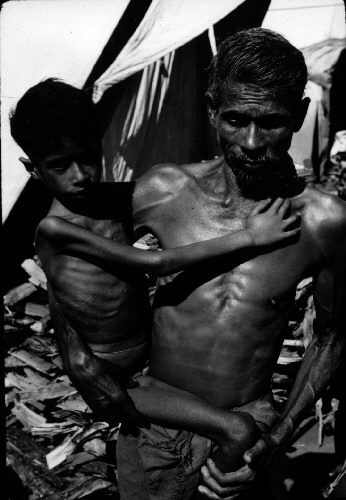
As the population of the globe surges past 6 billion, India is on the verge of surpassing China as the world's most populous nation. For at least two centuries India has struck many Westerners as a place that is over-populated, famine-prone, and, as a result, a threat to global stability. In fact, as historian Mytheli Sreenivas details, the question of 'over-population' is a relative one: is India producing too many people or too few resources? Does a growing population represent an opportunity or a danger? These questions take on a new urgency and relevance as India emerges as a major economic power and consumer society, and as the world confronts an ongoing food crisis. This month, Sreenivas puts these pressing concerns about population in historical perspective.
Readers interested to know more about current Indian history, please see this 1993 Origins article India's Dream State and these three essays on AIDS prevention, rickshaw wallahs, and Devadasi culture in India.
In the weeks and months prior to the current financial crisis, much of the world media was reporting on a global crisis in food. A seemingly inexorable rise in the price of basic food supplies in 2007-2008 threatened poor populations around the world, and government leaders scrambled to contain the social unrest that followed.
To explain this food crisis to an audience in St. Louis in May 2008, then-President George W. Bush pointed to the size of the Indian population. Claiming that India's "middle class is larger than our entire population," Bush argued that the demand for "better nutrition and better food" among this massive group had caused food price increases worldwide.
Bush's remarks provoked an uproar among Indians, who refused to accept blame for the global food crisis. Many Indian journalists and government officials instead linked the spike in food prices to American policies that favored using grains for ethanol fuel and subsidized U.S. farmers.
Others, like analyst Pradeep Mehta, argued that if Americans would just reduce their weights to the Indian middle class average, "many hungry people in sub-Saharan Africa would find food on their plates."
This heated exchange marked another episode in a longstanding debate about whether India is an "overpopulated" place. Since the early nineteenth century, some observers—Indians and others—have remarked that India's population is too large for the country's resources to sustain.
In more recent years, some in the United States and Europe have argued that this large population poses a global threat, as Indians consume an ever-increasing portion of the world's resources in a bid to satisfy an ever-growing population.
Population numbers seem to support these concerns. The population of India has grown rapidly over the last sixty years, from about 350 million in 1947 to approximately 1.16 billion today. Although the rate of growth has now slowed, India's population size is still increasing, and demographers expect it to reach 1.65 billion people by 2050, making India the most populous country on earth.
The numbers alone cannot tell us the full story, however. The debates about Indian population size have also focused on the related question of under-production—that is, the problem is not so much too many people as too little food. For more than two centuries, the question — is India really "overpopulated" at all?—has been hotly contested and bound up with broader tensions about political power, economic development, and access to global resources.
Population and Prosperity in the Nineteenth Century
In early modern India, a large population was typically taken to be a sign of prosperity and progress. A densely populated area signified fertile land, the availability of labor, good governance, and peaceful conditions. Small populations, by contrast, were seen as a sign of decline.
A Maratha official touring the war-torn Mughal territories near Delhi and Agra in 1784 remarked with concern that "there were no ripening fields to be seen anywhere… The local administration was already oppressive—on top of that came the failure of the rains and the peasants died en masse, so that entire villages were left uninhabited."
In the early nineteenth century, when the British East India Company controlled an increasing swath of territory across the subcontinent, Company officials pronounced that large and expanding populations demonstrated the superiority of British governance. In the words of one company publicist in 1815, "It is pleasing to view the cheerful bustle and crowded population … evincing a sense of security, and appearance of happiness, seen in no part of India beyond the Company's territories."
This longstanding equation of large populations with prosperity and good government began to change by the mid-nineteenth century, when British officials confronted a series of famines across the subcontinent. These famines, which occurred with shocking regularity from the 1860s onwards, led some administrators to question whether India was a land depleted of resources straining to support an excessively large population.
Previous Indian rulers had also confronted famines, and the subcontinent was vulnerable to such crises because of its dependence upon monsoon rains. However, the British were the first to develop an official policy that mandated specific responses to famine conditions.
To frame this policy, some administrators turned to Thomas Robert Malthus's Essay on the Principle of Population. First published in 1798, Malthus's Essay argued that population growth, if unchecked, would always exceed capacities of food production.
According to Malthus, population growth could be limited either by preventive checks, which lowered the birth rate, or positive checks, which raised the death rate. Preventive checks included such measures as postponement of marriage, celibacy, or contraception, whereas positive checks involved war, disease, or starvation.
The Essay proved enormously influential, and nowhere more so than in India. For some British administrators, Malthus's "positive checks" seemed to explain recurrent famines. They suggested that British rule had created the conditions for rapid population growth across India by ending civil strife and curbing disease.
Under the benign conditions of Pax Britannica, the population grew beyond the capacity of agricultural production. In true Malthusian fashion, famines ensued, resulting in a "positive check" on population growth. From this perspective, famines occurred in India because the British had "freed a tropical population from the tropical checks on its increase, without yet teaching it to submit to prudential restraints."
Even with this rosy view of the success of British rule, the question of how the government ought to respond to famine remained. Followers of Malthusian ideas suggested that famine relief be minimal. While this might lead to starvation deaths in the short run, the fatalities would be from the poorest class of laborers and beggars, a "class of men—so low in intellect, morality, and possessions" that their continued survival and reproduction would only worsen the situation of India.
Official famine policy put some of these principles into practice. Famine relief was held to the bare minimum, and to receive aid, all but the most enfeebled were required to labor for wages below market rates. The goal, from a Malthusian perspective, was simple: to discourage famine victims from seeking any relief, with the long term consequence of reducing their rates of reproduction and holding off the threat of overpopulation.
In the nineteenth century, British fears of Indian overpopulation were not prompted by an increase in population size, but by a crisis—famine—that threatened to reduce population numbers. When the recurrence of famine threatened to undermine British claims that their rule brought prosperity to the Indian colony, the British government responded by blaming Indians themselves for failing to control population growth.
The Viceroy, Lord Dufferin, took this approach when he noted that in 1888, Indian agricultural productivity was low, and famines loomed, because of the "overflow of the population of large districts and territories whose inhabitants are yearly multiplying beyond the number which the soil is capable of sustaining."
Yet despite this dire pronouncement, there is no evidence to suggest that India was undergoing any rapid increase of population in comparison with the rest of the world. Between 1871 and 1941, the average increase in India's population was approximately 0.60% per year, slightly lower than the worldwide average (from 1850-1940) of 0.69%.
Consequently, by blaming "population" rather than colonial exploitation or mismanagement of production, the British colonial rulers essentially dodged any questions about the effects of their rule on Indian society.
Overpopulation or Underproduction?
Beginning in the late nineteenth century, several Indian nationalist intellectuals began to develop a critique of colonial rule that rejected the premises of British thought about the Indian political economy, including its assumptions of overpopulation. They argued that the problem in India was not "overpopulation" but "underproduction."
British rule had destroyed Indian manufacturing, but had failed to replace these sources of production with new modes of industry. This led to a situation in which, according to P.C. Joshi, "production falls off while population is advancing at its normal rate," leading to "the evil of underproduction."
As a corollary to this thesis, Indian nationalists advanced the notion that famines were preventable through better governance. In the short term, they demanded that the British government offer more generous aid to famine-threatened areas, and in the long term, encourage industrial development.
For further proof of their argument, the nationalists looked to Europe itself. In England and France, the population grew significantly during the nineteenth century, but the national income multiplied by even greater amounts. Perhaps most importantly, even when these countries suffered from drought, they "invariably escape from the terrible grip" of famine.
Consequently, the "increase of numbers is per se not necessarily or always an evil," Joshi argued, and in any case, Indian numbers were not increasing very greatly. Colonial mismanagement—or worse—indifference to its colonized subjects was the problem, not overpopulation.
Independent India and a Growing Population
The first two decades of the twentieth century witnessed a relatively slow rate of population growth. As a result, the census of 1931 came as a shock to demographers and the public at large; it revealed a much more rapid growth rate, of one percent annually, between 1921 and 1931. More worrisome to some, the rate of growth continued to accelerate, and after 1951, reached approximately two percent per year.
In the midst of this population increase, colonial India gained its independence from the British Empire in 1947, and was partitioned into the separate states of India and Pakistan. Both nations expressed concerns about population size, but the Indian government took up the issue with greater urgency.
Under Prime Minister Jawaharlal Nehru, India developed a bureaucratic infrastructure to monitor, and potentially reduce, rates of population growth. During the 1950s, these efforts were joined enthusiastically by private sources of funding, most notably from American philanthropic organizations such as the Ford Foundation.
Yet even while agreeing that Indian population growth be moderated, Nehru remained steeped in the ideas of earlier Indian nationalists, and focused more on increasing production than on decreasing population.
Speaking to the United Nations Economic Commission for Asia and the Far East in 1948, for example, Nehru noted that he was "all in favor of the population being checked, but I think there is a great misapprehension when so much stress is laid on this aspect… We are overpopulated, if you like, because our productive capacity is low. If we increase our production, agricultural and other, [and] if this population is put to work for production, then we are not overpopulated."
In other words, for Nehru, "No country can be overpopulated, if there is work for everyone."
Economic development, more than population control, became the new mantra of Nehru's regime, and with the aim of rapidly increasing agricultural and industrial production, the government launched the first of a series of Five Year Plans in 1951. The plans resulted in some notable successes. For instance, in 1966 Indian farmers produced 1.7 times the amount of grain as they had in 1951.
Skeptics, however, warned that any such increase was rapidly eroded by India's growing population, which increased by a factor of nearly 1.5 between 1950 and 1969. Thus, throughout the Nehru era, from 1947 until the Prime Minister's death in 1964, India attempted to balance "underproduction" and "overpopulation."
1960s: When the Rains Failed
In 1965 the monsoon rains never came. India's food production plunged, and reports emerged that in the worst-affected areas, people were living on the edge of starvation.
Faced with a worsening crisis, the new Prime Minister, Indira Gandhi, appealed to the United States for food aid. The Americans had food to give, but President Lyndon B. Johnson kept a tight rein on shipments to India. As he noted to an aide, "I'm not going to piss away foreign aid in nations where they refuse to deal with their own population problems."
When the American president met with Mrs. Gandhi, he was reportedly satisfied by her assurances on population control. Soon after this meeting, Johnson sent a memorandum to Congress requesting approval of food aid to India, noting that "The Indian government believes there can be no effective solution of the Indian food problem that does not include population control. The choice is now between a comprehensive and humane program for limiting births and the brutal curb that is imposed by famine."
With US aid, India managed to avoid this "brutal curb," and improved climate conditions in the late 1960s supported important changes in Indian agriculture known as the "Green Revolution." Working with new high-yield varieties of wheat and rice, and supported by intensive capital investments in fertilizer and irrigation, some Indian farmers succeeded in rapidly increasing food grain production, which reached almost 100 million tons in 1969.
India and the "Population Bomb"
By the early 1970s, India appeared to be well on its way to solving the problem of rising population through increased food production. If, following Nehru and earlier nationalists, the true Indian problem was "underproduction" rather than "overpopulation," then at least in agriculture, production was potentially meeting the needs of the people.
One might expect, then, that concerns about Indian overpopulation would diminish, but the late 1960s and early 1970s witnessed renewed debate about population growth.
The lag-time on the benefits of the "Green Revolution" and the memory of the near-famine of 1965 help explain this renewed concern. Perhaps more importantly, however, anxieties about overpopulation developed in response to the changing balance of power in the post-colonial world.
In 1969, Paul Ehrlich brought these concerns to the fore in his best-selling book The Population Bomb, which opens with this memorable passage describing a "stinking hot night in Delhi."
"The streets," he wrote, "seemed alive with people. People eating, people washing, people sleeping. People visiting, arguing, and screaming. People thrusting their hands through the taxi window, begging… People, people, people, people. As we moved slowly through the mob… the dust, noise, heat, and cooking fires gave the scene a hellish aspect."
Ehrlich wrote the book for the Sierra Club, and for a generation of environmental activists India thus became a metaphor for the global population explosion.
Many of Ehrlich's claims may have sounded familiar to nineteenth century British administrators grappling with Indian famines. However, The Population Bomb—alongside other texts of the Cold War era—introduced something new as well.
Ehrlich insisted that the "bomb" of overpopulation not only posed a risk to the overcrowded countries, but also threatened the entire planet. In the globalizing world of the mid-twentieth century, Indians could not be expected to "starve silently" on their overcrowded land, but to venture outward in search of more—with untold consequences for the "American way of life."
Ehrlich thus linked Indian "overpopulation" to American security and consumption standards to argue that "advanced nations" take responsibility for encouraging population control among the "overpopulated countries."
Ehrlich's message was well-received in the United States, and by 1974, the book had sold over four million copies and gone through twenty-two printings. The Population Bomb—coming as it did in the context of Cold War tensions (especially fears that India would follow China to communism), decolonization in Asia and Africa, and broader social unrest both in the US and the "third world"—convinced Americans that India's growing population, with its demand for a greater share of world resources, represented a threat to U.S. global influence.
While American leaders and ordinary citizens worried about the ever-growing number of Indians inhabiting the planet, the Indian government took its own unprecedented steps towards curbing population growth.
The government of Indira Gandhi was already under substantial American and international pressure to engage in programs of population control. Mrs. Gandhi herself had a deep personal interest in the issue, and just one day after her election as Prime Minister, she signaled her commitment by changing the name of the "Ministry of Health" to the "Ministry of Health and Family Planning."
Beyond Mrs. Gandhi's personal interest, the broader socio-economic conditions of the 1970s help explain the government's redoubled interest in controlling population. A quarter-century after independence, not all Indians had yet seen tangible gains from decolonization.
Although the Green Revolution had brought prosperity to some farmers, other rural areas still languished—passed over by the new technologies and infrastructure that supported agricultural production in the core bread-basket regions. Unemployment, including among high school and college-educated individuals, continued to be a concern, and the economy was not creating enough new jobs to meet the people's needs.
Faced with these problems, Mrs. Gandhi adopted the slogan, "Garibi Hatao!" (Eradicate Poverty!) as part of her populist agenda. However, her administration's economic reforms did not meet the rising expectations of ordinary Indian citizens who sought higher living standards and better opportunities in the wake of decolonization.
The longstanding nationalist thesis—that underproduction was the core problem for India—may have sounded increasingly hollow to those who had waited decades for more to be produced—more jobs, more food, more consumer goods.
Turning from underproduction to overpopulation, Mrs. Gandhi looked to population control as a way to bring the promises of economic development to India.
The government's support for "family planning" programs escalated dramatically in 1975, when Mrs. Gandhi declared a state of "Emergency" and suspended the Indian Constitution. In April 1976, the government adopted an "integrated" approach to family planning that used incentives to encourage contraception and sterilization.
In response to the new program, state health officials offered cash payments to men and women who accepted forms of long-term contraception (primarily IUD insertion) or surgical sterilization. Although officials insisted that such payments were non-coercive, in conditions of poverty, the offer of cash or food in exchange for participation certainly took on coercive aspects. Indeed, poor and lower caste groups were disproportionately targeted for "family planning."
Despite media censorship, reports began to trickle out of terrible abuses—of young men being dragged forcefully to vasectomy "camps," and of police violence against those who protested the new family planning regime. All government employees—from teachers to train conductors—were given "quotas" of people they were required to "motivate" for long-term contraception or sterilization. A sterilization certificate became a requirement for all kinds of resources—ration cards, land allotments, new housing for slum dwellers, and even electricity connections, in some cases.
In 1977, with the end of the Emergency, Indira Gandhi and her Congress Party lost the Parliamentary elections. These elections also signaled the defeat of her family planning programs. As the newly uncensored media reported story after story about the abuses of the Emergency years, increasing numbers of Indians rejected the very idea of government-sponsored "family planning."
Claims that India was "overpopulated" came in for new questioning as well. During the 1980s and 1990s, the Indian government was forced to moderate its aggressive policies of population control, and fewer leaders and bureaucrats focused on "overpopulation" as a critical problem for India.
Population: Asset or Liability?
With the liberalization of the Indian economy in the 1990s, attention shifted again to the problem of "underproduction." India began to provide "backroom" operations for multinational corporations, and its information technology (IT) sector boomed. In this environment, business leaders touted India's large number of college-educated speakers of English as an asset. In the words of Azim Premji, the chairman of Wipro Technologies in 2003, "India will be the powerhouse of the most important resource—the productive human spirit."
Economists and demographers have tended to agree with this point of view, noting that India's age structure—in which a high percentage of the population is in the productive age group of 15-59—could give India a competitive advantage over the aging populations of Europe, the United States, and China. According to economist C.P. Chandrasekhar, "The window of opportunity offered by a population bulge has clearly opened for India."
From this perspective, the task now is not to control population size—which is expected to continue rising in India until 2050—but to provide adequate resources to make this growing population productive.
Once again, these new, more optimistic, assessments of Indian population size are not just about numbers. Although rates of population growth have slowed in some parts of the country, what fuels the current optimism among business leaders and economists is the broader context of globalization and liberalization of the Indian economy.
This celebration of globalization has not been without its critics in India, who point to environmental degradation and rising levels of income inequality.
Yet even while debate about the costs and benefits of India's globalizing economy continues, one consensus does seem to have emerged. Neither supporters nor critics of India's globalization suggest that overpopulation is a significant problem for the country. They look instead towards increasing production, and perhaps redistributing resources, to address problems of poverty and unemployment.
In the United States, by contrast, the specter of overpopulation still hovers over any discussion of India. As President Bush's St. Louis speech reminds us, the sheer numbers continue to inspire concern. Talk of a new "Asian century," fueled by the production of millions of Indians and Chinese, provokes questions about American consumption standards, and the place of the U.S. in the global economy.
As in the past, American leaders and commentators have again suggested that perhaps the problem lies with India's over-large population, and its ever-growing claims to the world's resources.
In the midst of these concerns, we would do well to remember that the history of India's population has never been solely about numbers, but about the meaning these numbers acquire in specific political and economic contexts. How we answer the question—of whether India really is overpopulated—depends a lot upon how we understand contemporary global politics, and the place of India within it.
Arnold, David. (1988). Famine: Social Crisis and Historical Change. Basil Blackwell.
Census of India, Office of the Registrar General and Census Commissioner of India http://www.censusindia.gov.in/
Connelly, Matthew. (2008). Fatal Misconception: The Struggle to Control World Population. Harvard University Press.
Ehrlich, Paul. The Population Bomb, Sierra Club/Ballantine Books, 1968.
Guha, Sumit. (2001). Health and Population in South Asia from the earliest times to the present. Permanent Black.
Hartmann, Betsy. (1995). Reproductive Rights and Wrongs: The Global Politics of Population Control, 2nd ed.South End Press.
Know India [Indian government site] http://india.gov.in/knowindia/population.php
Mamdani, Mahmud. (1972). The Myth of Population Control. Monthly Review Press.
Rao, Mohan. (2004). From Population Control to Reproductive Health: Malthusian Arithmetic. Sage Publications.
Sen, Amartya. (1981). Poverty and Famines: An Essay on Entitlement and Deprivation. Clarendon Press.
Simon-Kumar, Rachel. (2006). Marketing Reproduction: Political Rhetoric and Gender Policy in India. Zubaan Publications.


