
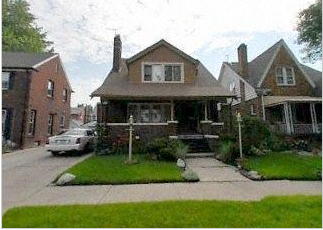
The Wilds' former home in Detroit, MI. As Kevin Boyle suggests, the effects of white flight and a worsening economy have hit Detroit particularly hard, but the human stories behind the urban decay of this formerly flourishing city have been largely ignored.
No city in America has had its fortunes tied to the rise and fall of the manufacturing economy more than Detroit. Home to the American auto industry, symbol of post-war prosperity, Detroit now stands as a synonym for urban decline. This month historian and Detroit native Kevin Boyle gives us a very personal meditation on the city and puts his own experience of growing up in Detroit in historical perspective.
For more on the history of the current economic crisis and American cities, see the April 2008 Origins article, (Fore)Closing on the American Dream. On the history of the Ford motor company, see this 1994 Origins article (PDF File).
I saw the ad on a real estate web site a week ago. For sale: 3952 Chatsworth Street, Detroit, Michigan. A five bedroom, three bath brick home, built in 1926. Eighteen hundred square feet of living space. Now empty. Yours for $17,900.
$17,900. That house—that home—for the price of a cheap car.
Pick up a paper these days and you almost invariably see some mention of Detroit's great crisis. But the stories aren't about the city. They're about the auto industry: how General Motors and Chrysler and Ford are hemorrhaging money; how they're lurching toward catastrophe; how disaster must be averted.
The crisis in the streets of Detroit—the vortex of poverty that is consuming what once was the nation's fifth largest city—that's not news at all.
A memory
It's a summer day sometime in the late 1960s, though precisely when I couldn't say. I'm in the backyard of that house on Chatsworth Street, the Wilds' place, two doors down from my own.
The five Wilds' kids had some sort of fight, as they often did. In the heat of battle the two oldest boys, Mike and Pat, had decided to hog-tie their little brother Kevin, my age. There he is: seven, eight, maybe nine years old, writhing on the cement beneath the battered basketball hoop, his arms and legs bound behind him by a length of clothesline, his mouth gagged so couldn't scream for help, his eyes wide and brimming with tears.
It was cruel and frightening and more than a little exciting. That's why the neighborhood kids spent more time at the Wilds' house than just about anywhere else. Because our families were staid and proper, while the Wilds' kids were – well, wild. And we wanted to share in the freedom, the confidence, the limitlessness that coursed through that house. Truth be told, we envied the Wilds.
We were too young, too sheltered to understand the burdens our parents carried. All we knew was that we were safe. Like so many Detroiters, our families had wound their way to the city in circuitous, sometimes serendipitous ways. But in the end most of them had chosen Detroit for only one reason: work.
In the first half of the twentieth century the city was America's great boomtown, pulsing with the fearsome energy of the world's most innovative industry. Fordism (see the 1994 Origins article on Henry Ford (PDF File), the social critics called it: the perfection of mass production, carried out in the vast auto factories that sprawled across the landscape, from the legendary Ford Rouge on Detroit's western edge to the warren of grim-faced parts plants on the east side.
A machine of a city, oiled by an army of working people. In 1950 there were 330,000 manufacturing jobs in Detroit, enough to sustain a population of 1.8 million people. Enough to sustain a neighborhood like ours.
By the late 1960s the machine was already slowing down, the jobs starting to slip away. Gradually the auto makers moved their factories to the suburbs and the Sun Belt, where there was plenty of land for sleek new facilities, plenty of workers who weren't steeped in the union tradition, and plenty of ways to improve profit margins.
But those problems didn't reach our slice of the city. Our fathers had seniority in the plant, security in the office; a good, stable paycheck handed over like clockwork each and every Friday. Most of our mothers stayed home, though a few worked as secretaries or bookkeepers.
And they gave us everything a kid could want. We had televisions sitting proudly in our living rooms, toys strewn across our basement floors, trikes and bikes and cars filling our garages, swing sets rusting in our narrow backyards.
No one ever mentioned the phalanx of government programs that made our world comfortable: the labor laws that gave our fathers the ability to earn union wages; the Federal Housing Authority (FHA) mortgages that our parents had used to buy our homes; the Social Security checks that paid our grandparents' bills; the college loans that made it possible for older brothers and sisters to get the educations our parents never had.
The Batts girls, from the far end of the block, headed off to Calvin College, met and married ministers, and settled into the suburbs to do God's will. The Luchtans' daughter went to the city school, Wayne State, fell in love with one of its many campus radicals, fled with him to Canada, and returned with a little blonde son named Ché.
Watching them, we knew that in time we'd have similar, agreeable choices to make; futures to shape however we saw fit. We were remarkably lucky. But we thought it our due.
Race
We knew about race, of course. Though we lived in a completely white neighborhood, there was no way to avoid race. In the late 1960s it was a festering wound cutting across the city.
African Americans had come to Detroit in the first half of the century for the same reason our families had. But the factories didn't open to them, not the way they opened to white people, while most of the city's neighborhoods closed against them, the color line drawn by government fiat and physical force.
Realtors and developers set the standard, using their leverage over the housing market to shut blacks out of huge swaths of the city. New Dealers brought segregation into its housing policy: the FHA, the VA, even the projects embraced racial separation.
And if, by some chance, an African-American family slipped past all the discriminatory practices and provisions and moved into a white area, they faced the very real risk of violence from their new neighbors: a threatening note in the mailbox, a shattered window, a racist slur scrawled across a wall, a rabid mob out on the street—the terror replayed time and again, until Detroit had become one of the most segregated cities in America.
Once the ghetto was in place, City Hall starved it of public services: as late as 1950, a quarter of the homes in the sprawling east side slum didn't have running water; and garbage collection was so sporadic the neighborhood became overrun with rats. Its housing stock—already the worst in Detroit—inexorably decayed. Its schools struggled with systematic underfunding. The all-white police department patrolled its streets as if the cops were an occupying army. And for more than thirty years—from the 1920s through the 1950s—the black community seethed with the frustration, the injustice of it all.
Then, in the late 1950s and early 1960s, the boundaries of the ghetto were broken; shattered by a surging civil rights movement and the power of demography. In 1960 there were half a million African Americans living in Detroit, 28 percent of the population. No matter how hard whites tried, they couldn't contain so many people in the ghetto's narrow band of streets. Bit by bit African-American families began buying homes in sections of the city that had long been reserved for whites.
There was trouble, of course. Threatening notes stuffed into mailboxes; racial slurs scrawled across walls and doors; mob attacks; schoolyard brawls; massive white flight. And even as the black population spread, the official oppression—the relentless oppression—never lifted. Then it triggered the worst urban disorder of the 1960s.
It began a hot summer night in July 1967. The cops raided an after-hours bar in an African-American neighborhood on the west side. A crowd gathered to watch. In the heat tempers flared. Someone threw a brick through a window of a police cruiser idling at the curb. And the conflagration began.
Six days of rioting. A rebellion, some said. Swaths of the city burned to the ground. Forty three people killed. The streets retaken by the 82nd Airborne. Peace at the barrel of a gun.
On Chatsworth, we never experienced the horrific events of that week. We were scared—all of Detroit was scared—but there was no violence. I swear we heard it off in the distance; sirens wailing over the sound of cicadas, the occasional gunshot in someone else's part of town.
When race filtered into our neighborhood, it came not in the fevered days of 1967 but in the years that followed. And we heard it in our parent's whispers, in the quiet counting of streets. A black couple had moved into a house a mile from us, half a mile, six blocks. No one assaulted the newcomers. No one even threatened them, as far as I know.
Instead whites in those neighborhoods simply started to move to the suburbs, back across the color line. As they ran, house values plummeted, driven down by their owner's panicked selling. But we didn't see it that way. Whites weren't to blame for what was happening. Whites were never to blame.
Another moment
This time I know the date. Late autumn 1974: the grimmest of seasons in the grimmest of years. For the first time since the 1930s the American auto industry is under assault, its once unassailable position shattered by a spike in inflation, a disastrous oil embargo, and a sudden surge in Japanese imports. As the auto makers fall, Detroit is tumbling through recession into depression.
I'm in the kitchen of the Wilds' house, brilliantly yellow the way the kitchens are supposed to be. I'm waiting for one of the younger kids—Kevin or the twins, Danny and Terri. In walks Mike Wilds, the oldest boy. Sinewy, surly Mike, the one who could always throw the fear of God into you, made all the more intimidating by the fact that I'm a fragile fourteen year old and he's an imposing eighteen.
He was supposed to go to college that September: Michigan State, we all heard. But rumor has it that Mr. and Mrs. Wilds couldn't come up with the money. So Mike is joining the Army instead—in the autumn of 1974, when only the most desperate go into the Army. And as he passes me by in that kitchen, I'm not intimidated at all.
There was another change that year, bigger, in the end, than all the others. The first black family moved onto our block. They were a young couple; school teachers, I think, though no one ever bothered to ask them. Instead our parents talked among themselves. There were a handful of neighborhood meetings, many more kitchen-table conferences. There they made their calculations.
Most of the younger white families on Chatsworth had paid for their houses about what my parents had paid for our home in 1960: $13,000. With the city's economy spiraling downward, they wouldn't get much more than that, if they could sell at all. So they all agreed to stay put. No race to the realtors. No "for sale" signs sprouting up on our trim front lawns. No catastrophic competition to get our houses sold. We'd work together to make sure that, in our little corner of Detroit, there'd be no white flight. It was the only smart thing to do.
A final memory
A summer evening in 1977, late enough for the sky to have darkened, the street lights to have flickered on. All day long the movers have been carrying the Wilds' belongings—boxes of clothes, the old iron bed frames that the kids used, the fancy stereo cabinet everyone envied—out to the massive moving van.
The Wilds are leaving, heading to their new home in a small town an hour north of Detroit. We're gathered in their driveway to say goodbye. I'm sure our parents are there. But all I can see are the kids I grew up with, the kids I've known forever—no longer children, not quite adults—drawn into a tight knot, the boys standing awkwardly on the edge, the girls in the center, hugging and crying. We'll still talk, we tell each other. We'll come to visit. Nothing will change. And we believe what we're saying. We really do.
The next day an African-American family moved into the Wilds' house. I never went there again.
By that summer the promises our parents had made to each other had completely unraveled. It's tempting to say that we just got swept up in the massive exodus of those years. In the course of the 1970s, 400,000 whites left Detroit. Who were we to resist? But that isn't true. Our parents' promises collapsed under the crushing weight of a system that fused racism, self-interest, and the inexorable logic of the real estate marketplace.
So those who could afford it put their homes up for sale, their prices cut as close to the bone as straining budgets would allow. One by one we found buyers, always African Americans, since whites were no longer interested in living on Chatsworth. My family moved to the suburbs in October 1977, a few days before my seventeenth birthday. We left behind a city of 1.2 million people, two thirds of them black.
I saw the Wilds just once, a year or so after they moved, when the neighborhood kids piled into somebody's car and made the long drive out to their new house. For a while after that I'd hear an occasional update. Then the news petered out. I don't think any of the kids went to college, at least not straight out of high school. If they tried to make their way in the blue-collar world, it must have been tough.
Industrial America never really recovered from the economic crisis of the mid-1970s. Some industries—steel, for instance—essentially shut down. The domestic auto makers survived, of course, but they shrank their operations or moved them overseas, shedding jobs in the process.
The Reagan revolution made matters worse. During the 1980s it became more difficult to unionize as the government withdrew its support for workers' rights. The consolidation of corporate power made it harder for working people to get health care, harder to build a pension, harder to make ends meet. All the while, the federal safety net grew thinner and thinner, shredded by the government's promise that money would somehow trickle down to those in need.
The Wilds undoubtedly got by—many people did—but they would have struggled to match the world their parents had made for them on Chatsworth.
If life was difficult out in small-town Michigan, it turned brutal back in Detroit. The precipitous slide in the city's manufacturing base that began in the mid-1970s turned into a death spiral: between 1972 and 1982 Detroit lost a third of its factory jobs; almost two thirds between 1972 and 1992.
As industry disappeared, the city's tax base crumbled. Cuts in public housing, education, and welfare programs compounded the burden. Poverty intensified. The drug trade flourished. And the streets grew ever more dangerous: in the course of the 1990s there were 5032 murders in Detroit. The worse circumstances became, the more people fled: first whites, then an increasing number of middle-class African Americans, who moved into suburbs that also quickly became all-black.
By 2000 Detroit's population had fallen below the million mark, half what it had been at its peak. Once-thriving neighborhoods were pockmarked by the charred remains of burned-out houses. The main streets were lined with boarded up store fronts. Factories stood empty, their rows of windows smashed, their buckling walls painted with riots of graffiti. The city was hollowing out.
Today
Detroit's population has now tumbled to 860,000. A third of its people—half of its children—live below the poverty line. It has an infant mortality rate just slightly better than the Palestinian territories. Its educational system has essentially collapsed: only 21.7 percent of the students who start Detroit's high schools manage to graduate. Its political system is in disarray, its effectiveness destroyed by a scandal that sent its dynamic young mayor, Kwame Kilpatrick, to prison.
White flight is almost complete. According to official measurements, the Detroit metropolitan area is now the most segregated in America, a necklace of overwhelmingly white suburbs surrounding an all but completely African-American city.
Detroit's misery is shared by much of urban America. Cleveland's poverty rate is almost as high. Memphis' infant mortality rate is worse. Milwaukee, Newark, Chicago and New York are almost as segregated. And four years after Hurricane Katrina, whole sections of New Orleans remain in ruins. The current national economic meltdown is making the situation even more desperate, as foreclosures and factory shutdowns devastate city after city.
Nowhere is the crisis more severe, though, than in Detroit. Last month, the unemployment rate reached a catastrophic 22 percent—and is only likely to grow worse through the rest of the year. With joblessness at such a level, the city's already crumbling tax base threatens to collapse, hamstringing its ability to deal with the crippling array of problems it faces. Detroit is, quite simply, a devastated place; ignored and forgotten by a nation that, until these past few months, didn't give a damn for the dispossessed.
A dream
I'm sitting on the front porch that runs the length of the Wilds' house, where we used to sit when we had nothing better to do. It's spring, so the cement railing is cold to the touch. But the spindly trees that line the sidewalk have begun to bud, the forsythias have bloomed, and the tiny front lawns—the neighborhood's pride—are starting to green.
I look down the block, along the solid row of houses, I don't see a place sliding into desolation, a place so poor, so desperate you can buy a home for $18,000.
Instead I see that street the way it once was. Not the hatred, not the fear, not the narrowness of our vision, but the hope that used to thrive here. The boundless hope of childhood, given as a birthright to the kids who now call this neighborhood their home.
Special Thanks
Origins thanks the Kirwin Institute's Vacant Property Project in Detroit, Detroit Yes!, and Wayne State University's Walter P. Reuther Library for the use of images.
Bernstein, Michael and David Adler, eds., Understanding American Economic Decline (New York: Cambridge University Press, 1993)
Boyle, Kevin. Arc of Justice: A Saga of Race, Civil Rights, and Murder in the Jazz Age (New York: Henry Holt and Company, 2004)
Eugenides, Jeffrey. Middlesex (New York: Farrar, Straus and Giroux, 2002)
Farley, Reynolds, Sheldon Danzinger, and Harry J. Holzer, Detroit Divided (New York: Russell Sage, 2000)
Fine, Sidney. Violence in the Model City: The Cavanagh Administration, Race Relations, and the Detroit Riot of 1967 (Ann Arbor: University of Michigan Press, 1988)
Hartigan, John. Racial Situations: Class Predicaments of Whiteness in Detroit (Princeton: Princeton University Press, 1999)
Levine, Philip. What Work Is: Poems (New York: Alfred Knopf, 1991)
Massey, Douglas and Nancy Denton. American Apartheid: Segregation and the Making of the Underclass (Cambridge, MA: Harvard University Press, 1993)
Meyer, Stephen Grant. As Long as They Don’t Move Next Door: Segregation and Racial Conflict in American Neighborhoods (Lanham: Rowman & Littlefield, 2000)
Sugrue, Thomas. The Origins of the Urban Crisis: Race and Inequality in Postwar Detroit (Princeton: Princeton University Press, 1996)
Thompson, Heather Ann. Whose Detroit? Politic s, Labor and Race in a Modern American City (Ithaca: Cornell University Press, 2001)


