
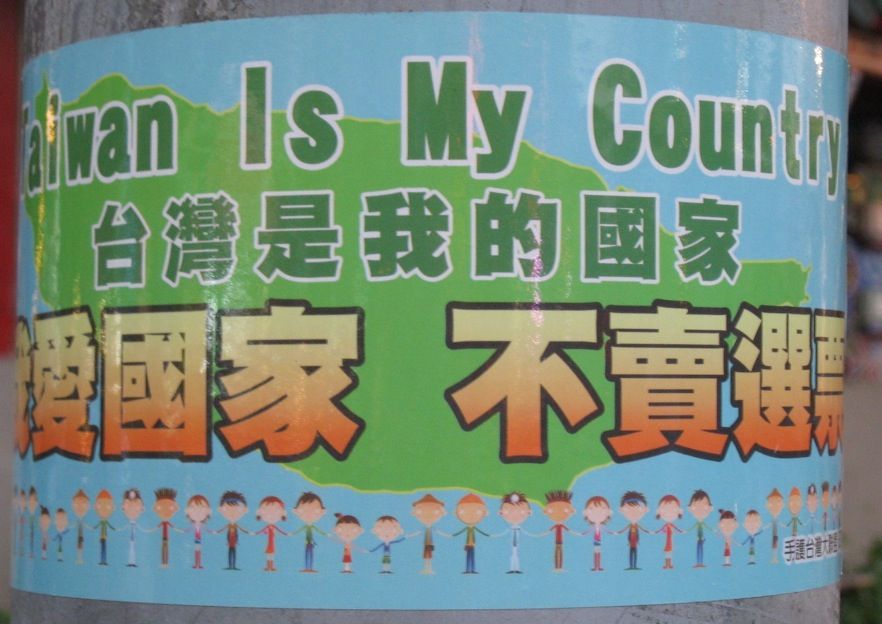
'Taiwan is My Country' Sticker. The advertisement reflects the DPP's Taiwan-centric mentality that conflicts with current US government, PRC, and KMT positions on Taiwan's place in the world. Voters rejected this mentality in 2008, when they elected the KMT back into power on the island.
2008 transformed the political landscape in the fledgling democracy of Taiwan. In both legislative and Presidential elections the Taiwanese people overwhelmingly voted to bring the Kuomintang Party back to power after almost a decade. Disgust over corruption helped fuel this change. Yet, underneath the results lie the long-standing, fundamental questions of what it means to be Taiwanese and what Taiwan’s relationship to China should be. This month, historian Christopher A. Reed, currently in residence in Taipei, puts these elections in context.
In the week prior to Taiwan's March 22, 2008 presidential election, lame-duck President Chen Shuibian of the ruling Democratic Progressive Party (Minjindang or DPP) declared that he might refuse to hand over control of the Presidential Office to the holder of a U.S. Green Card, a jab at then-KMT presidential candidate Ma Ying-Jeou. In an election watched anxiously in both Beijing and Washington, as well as in other regional centers in Asia, Taiwanese voters then delivered the DPP its second electoral disaster of the year.
In January, the opposition KMT (Kuomintang or Nationalist Party) had won the year's first crushing victory over the DPP in the legislative elections. By March 23, it became clear that Taiwanese voters had chosen to abandon the DPP after eight years in office. In the process, they returned Taiwan's administration to a single-party system (yidang duda or "one party rule") similar to the sort that had preceded the DPP for decades.
The presidential election, held as always on a Saturday to encourage widespread voter participation, marked the climax of months of noisy, often petty and ad hominen disputation at barnstorming rallies held up and down the island. Smaller than any of the twenty-two mainland provinces that make up the People's Republic of China (PRC), Taiwan is not quite as large as Massachusetts and Rhode Island combined. It is also the second-most densely populated society on earth (after Bangladesh).
Reporting paper ballots counted by hand, the Central Elections Commission (CEC) announced that evening that KMT candidate Ma Ying-Jeou, arguably the most pro-China candidate in Taiwan's history, had won the election with a 2-million vote margin drawn from the 13 million votes cast (with 76% voter turnout). At a celebratory public gathering held on the evening of March 22, President-Elect Ma issued the statesmanlike comment "This election result is not a personal result, or a victory for the KMT, it is a victory for all Taiwanese people."
That simple statement hides a complex question: Who are the Taiwanese to whom Ma referred?
Lee Teng-hui, the Taiwan-born, Japanese- and American-educated former KMT president as well as the spiritual father of "Taiwanese consciousness" (Taiwan zhuti yishi) endorsed Ma's campaign for Taipei mayor in 1994 with the comment that, despite being a Mainlander, he is a "New Taiwanese." Not everyone accepts this definition of "Taiwanese," to be sure. I remember the days when "Taiwanese" only meant those whose ancestors were already on the island when the KMT refugees arrived with Chiang Kai-shek from the mainland in 1949, and whose mother-language is either Min'nan (Taiwanese) or Hakka. In addition to his native Mandarin Chinese, Ma speaks fluent American English and a belabored Taiwanese as second languages.
The question itself underscores the very significant recent changes in Taiwanese politics. Although democracy in Taiwan remains in its infancy, over the last decade and a half the island state has experienced more formalized, high-level, electoral and constitutional political change than either neighbor Japan or China has had in five decades or more.
The question also points to the equally substantial continuities in Taiwanese society that threaten to undo these changes. The question of Taiwan's relationship to the PRC informs all political discussions, as do the historically fraught relations between the native Taiwanese and the 1949 mainland Chinese arrivals.
Ma Ying-Jeou, Presidential Politics, and China
In this fourth presidential multiparty election in Taiwan's modern—that is, post-1949 history (the first was held in 1996)—Ma ran on a platform long on perceptions but short on specifics. Born in Hong Kong in 1951, the son of a well-placed KMT official who soon migrated to Taiwan (where Ma grew up and went to college), Ma has never visited the Chinese mainland. After graduating at the top of his class at National Taiwan University, he earned advanced law degrees at NYU and Harvard. Ma worked briefly on Wall Street and then returned to Taiwan where he rose quickly through the KMT ranks, eventually becoming the party chairman.
Taiwan's relations with China were central to this campaign, and Ma has proposed to set Taiwan on a path of much closer economic and political ties with the mainland. Ma and the KMT have consistently rejected the Chinese Communists' successful "One China, Two Systems" framework that currently governs Hong Kong and Macao (each now officially named a Special Administrative Region). Unlike both SARs, of course, Taiwan has a sizable, well-funded, conscript army. Ma and the KMT have also rejected the possibility of unification with China, a significant departure from the KMT's historic emphasis on "recovery of the mainland" (guangfu dalu) from the "Communist bandits."
However, Ma has championed an increase of cross-Taiwan Straits investment—leading the DPP to charge the KMT with "selling out" Taiwan in exchange for economic growth. The KMT has long promoted a policy known as the "Three Direct Transportation Links" (san tong) that emphasizes mutual business and investment exchange, direct postal and telephone links, and direct flights in both directions across the Taiwan Straits; only the last has yet to be realized.
More specifically, Ma favors further liberalization of Taiwan's overseas investment laws of the sort that have already encouraged one million of Taiwan's 23 million residents to seek their fortunes in China, with 500,000 of them living in Shanghai alone. (At the same time, there are 50,000 to 100,000 PRC citizens living in Taiwan, most of them relatives of Taiwan residents). In a related move, Ma's running mate Vice President-Elect Vincent Siew Wan-chang visited China in mid-April for an "unofficial" meeting with China's highest leaders. Ma himself called for the creation of a formula with the mainland government that would acknowledge the legitimacy of Taiwan's government.
At the same time, Ma has also made clear that a precondition for peace talks—suspended by China in 2000 to signal its disapproval of the election of the DPP's pro-Taiwan-independence President Chen—is removal of the 1,400 or so missiles aimed at the island, up from 200 in the year 2000. (During the week of April 17, 2008, China was rumored in Taipei to have agreed to remove half prior to Ma's May 20 inauguration).
DPP, KMT, and the History of Taiwan's Political Landscape
The DPP is just over twenty years old. It was one of the first parties formed during the relaxation of the KMT's one-party political control permitted in 1986 by now-deceased President Chiang Ching-kuo, son of KMT strongman Chiang Kai-shek. The DPP was formed by a group of anti-KMT, anti-Mandarin-speaking, Taiwan-born patriots and lawyers, many from southern Taiwan.
The founders had been involved in the seminal Kaohsiung Incident of 1979, which occurred toward the end of the period known in Taiwan as the White Terror (baise kongbu, 1947 to 1987). In what is also known as the Formosa Magazine Incident—to emphasize Taiwan's separateness from mainland China, the editors invoked the old name of Taiwan given it by 16th century Portuguese explorers—police shut down the independent, non-KMT magazine in Kaohsiung, the island's second-largest city and its industrial core. The timing of the incident was no accident, coming as it did less than a year after the United States shifted its diplomatic recognition of the official "China" from the KMT regime in Taipei to the Communist one in Beijing.
Defending the so-called Kaohsiung Eight through multiple court appearances, current President Chen, Vice-President Annette Lü Hsiu-lian (also the founder of Taiwan's independent, non-KMT feminist movement) and 2008 presidential candidate Frank Hsieh Chang-ting formed the nucleus of what became the new political party.
The DPP fielded its first political candidates in 1988 and by 2000 Chen claimed the Presidential Office. It was the first time a non-KMT executive had occupied the building since Taiwan was part of the Japanese Empire (1895-1945). Accusations and anger over corruption helped to split the KMT vote in that election and gave the DPP its big break.
Those who hoped the DPP would leave behind the corrupt past found themselves sorely disappointed. In 2008, by some estimates, at least a third of DPP supporters voted against the DPP "with tears in their eyes" because of irrefutable evidence that the DPP has succumbed to the same culture of corruption and malfeasance that turned voters against the KMT in 2000.
In contrast to the relative brevity of the DPP's historical heritage, the KMT is Asia's oldest political party and traces its convoluted lineage to Sun Yat-sen's overseas anti-Manchu terrorist organization, the Revive China Society (Xingzhonghui). That organization was founded in Hawaii in 1894 when Hawaii was still an independent republic with a sizable overseas Chinese community.
Adopting Sun's "Three People's Principles" (nationalism, democracy, and socialism or people's livelihood) as its ideological guide and a Leninist party structure in 1924 (the year before Sun died), the KMT under Chiang Kai-shek's leadership ran a nominally Republican government at Nanjing (Nanking) from 1927 to 1937. The KMT survived the Second World War while Chiang directed China's resistance effort against Imperial Japan's occupation from Chongqing in Sichuan Province. Upon Chiang's return to Nanjing in 1945, the KMT accepted the Japanese surrender.
Over the next three years, Chiang and the KMT conducted and lost a brutal civil war with the Communists while also bankrupting coastal China's industrial and commercial middle class. By the end of the 1940s, the KMT's revolutionary heritage seemed to have disappeared along with the millions of dollars of support that the Roosevelt and Truman administrations had handed over to Republican China's Big Four families (Chiangs, Soongs, Kungs, and Chens). Guaranteed the Japanese-occupied island of Taiwan by Roosevelt and Churchill at Cairo in 1943, Chiang Kai-shek and the KMT eventually fled to the island in 1949, coming under American protection only with the outbreak of war in Korea.
After 1949, locked into a military, diplomatic, and economic stare-down with its historic foes, the Chinese Communist Party and the People's Republic of China, the KMT ruled only Taiwan Province—all that remained of the former Republic of China. Populated chiefly by the non-Taiwanese who would become known as "Mainlanders," the KMT spent its first few years in Taiwan taking stock of itself and the island's economy. The goal was the eventual recovery of the mainland.
The KMT arrived in Taiwan with about a million military and political hangers-on. (Contrary to popular belief, most big pre-1949 Chinese industrialists did not go to Taiwan but opted to stay in China or flee to Hong Kong; major financiers went either to Hong Kong or the United States, where they were joined by many leading KMT officials, the Soongs, Kungs, and Chens among them.) They also arrived in Taiwan with what some commentators have termed "the world's largest domestic secret police force" of the era.
The KMT came to dominate the island with an iron fist, brooking no organized (or disorganized) opposition. The KMT began to infiltrate Taiwanese urban and rural society using the "political cell" methods of the Communists. At the same time, the secret police, known as the Garrison Command (Taiwan Jingbei zong silingbu, 1945 to 1995), kept a lid on opposition until 1986 when opposition parties were allowed to organize.
After crushing an attempted coup d'etat led by a dissident KMT general in 1955, the KMT began to equate itself with stable leadership, economic modernization, and domination of politics, the military, education, and improved medical care (which by 1994 included universal national health insurance).
Throughout this time, the relations between the KMT "Mainlanders" and the local Taiwanese population were deeply troubled and frequently marred with violence. From the 1950s, Mandarin Chinese was forcibly taught in schools and became the key to career success while the Taiwanese language was actively discouraged. Until very recently, military commissars were stationed in university dormitories to monitor students; military service is still compulsory for males. Although the KMT party was the only one available for people to join, no Taiwanese rose to the highest levels of the party directorship until the late 1970s, a reflection of systematic discrimination.
Worse yet was the White Terror, which began on February 28, 1947 in response to KMT abuse of the local Taiwanese population, then numbering perhaps eight million. Officials of the KMT's Alcohol and Tobacco Monopoly abused a Taipei curbside cigarette vendor, accusing her of selling smuggled tax-free cigarettes. A riot broke out between the KMT officials and the local Taiwanese and, before it had ended, an estimated 10,000 people had been killed.
Over the next forty years, a further estimated 100,000 people—usually native Taiwanese—were imprisoned, executed, or "disappeared." Many languished for years in political prisons or in mental hospitals. (Green Island, off Taiwan's East Coast and ironically now a resort destination, was the center of this gulag archipelago.) Until the late 1980s, public discussion of the 2/28 Incident typically led to political prison.
Meanwhile, what was sardonically referred to as "Taiwan's single greatest export," its graduate students who streamed to American universities, mostly remained abroad (96% in the 1970s), often under surveillance from fellow students working for the KMT. Taiwanese who returned from abroad, such as Carnegie-Mellon professor Chen Wen-cheng in 1981, sometimes mysteriously "fell to their deaths" from high places.
Leaderless and dispirited, Taiwanese appeared to have become apolitical.
Thus, despite ruling for forty years in Taiwan, the KMT had never contested a multi-party island-wide election until 1989. Instead, Taiwanese taxpayers were forced to support the illusion of an all-China National Assembly, with KMT representatives chosen in 1947 occupying their seats until death. Constitutional revision begun in 1991 finally caught up with these surviving gerontocrats, many of whom actually lived in the United States.
Taiwan, the United States, and Japan
Taiwan's authoritarian reality was obscured abroad by Taiwan's allies, particularly the United States. Given the exigencies of the Cold War, the KMT's leading American backers—after the 1950s usually right-wing hawks such as Henry Luce of Time/Life, Inc. and film stars John Wayne and Ronald Reagan—insisted that Chiang's government, the Republic of China on Taiwan, was "Free China" and the only legal Chinese government.
Against Americans' views of themselves as "hard-headed realists" free of ideological blinders, the Taiwan Lobby in Washington exerted so much influence that the United States became the last major power formally to recognize the PRC when the two exchanged ambassadors on January 1, 1979.
Economically, American corporations (such as US Steel) had long favored collaboration with the big state-run firms of the KMT (China Steel), while Japanese investors preferred the more nimble pro-Japanese Taiwanese firms. Different from developing nations of that era in Africa or South America, Taiwan's leaders did not oppose Taiwan's client-state status or economic dependency on either the US or Japan.
The result of this collaboration was what has become known as Taiwan's Economic Miracle. The Miracle notwithstanding, the retarding effect of the American partnership with the KMT on the development of democracy in Taiwan was profound.
The US, which assumed that Taiwan would become the new Hong Kong after 1997, eventually found in Chen an erratic leader whose Taiwan-centric policies will presumably be reworked in a pro-American direction by Ma.
American politicians continue to find Taiwan a useful foil in issuing right-wing, anti-China, but not necessarily pro-Taiwanese rhetoric, however. Most recently, Representative Dana Rohrabacher (R-California), head of the Congressional Taiwan Caucus, visited the island and issued a statement on the elections so out of touch with reality that KMT honorary chairman Lien Chan, born in China and himself a former presidential contender, felt obliged to comment that "even America has fools" in elected positions, an observation that played well in the Taiwanese media.
Wealth, Corruption, and Politics
In the 1980s and 1990s, the KMT was termed "the world's wealthiest political party" thanks to its decades of party-state rule that had allowed it to acquire holdings both locally and overseas in banking, real estate, manufacturing, the media, etc. More recently, however, the party cried "poverty" after the DPP, elected to the presidency (but not to control of the legislature) in the year 2000, tried to separate state, party, and economy.
The combination of the DPP's ham-handed "pay-back" policies against the KMT, persistent charges of corruption that were easily traced to Chen and the party's highest levels, and a faltering economy—producing, for Taiwan, an unprecedented 5% unemployment—almost lost them the elections in 2004 and all but guaranteed that Taiwanese voters would opt for the KMT in 2008. The DPP was returned to the presidency in 2004 by an election so hotly contested that a recount was necessitated, confirming a margin of merely 29,000 votes.
Aside from an unproven claim that Ma spied on his fellow students while at Harvard and the now discredited DPP charge that he continues to hold a U.S. Green Card, Ma himself seems to be clean. However, the KMT, historically a Leninist-style "vanguard" party, is said by political scientists to have undergone virtually no significant internal reform since its loss in 2000.
In 2008, part of the KMT's success came from younger voters who had no memory of the "old" KMT. They were nauseated by perceived DPP malfeasance, pandering, lackluster economic policies, and controversial educational and cultural decisions. Many educated, pro-DPP voters indicate that they voted for the KMT in the 2008 elections in the hope that a crushing defeat would finally push the DPP toward far-reaching reform. If so, their effort might yield a genuine two-party system sometime in the future.
A Fledgling Democracy
Taiwanese democracy is still in its infancy, not surprising given the KMT's legacy of Leninism, White Terror, secret police control, successful economic planning, and Great-Power alliance.
Formally governed by a constitutional and bureaucratic framework inherited from Sun Yat-sen and a hybridized Taiwanese, Japanese, and American public culture, a mature democratic mind-set was not the shaping influence in these recent election campaigns. True, party-run campaigns do suggest to the outside observers who jet in for brief visits that a "political-party" (zhengdang) sensibility dominates public life in Taiwan—but, that is true in only the most superficial sense.
Many mature parliamentary democracies are characterized by depoliticized voters who cast their votes and then go back to their everyday lives, leaving politics to the "professionals." In contrast, Taiwan remains a highly charged pre-democratic society with a legacy of vanguard-parties (like the KMT, the DPP is said to be organized according to the principles of democratic centralism) that unceasingly mobilize resources and "true believers" but retard grassroots politics. It is one in which political "movements" inflected by communal interests still outweigh political campaigns.
Rather than a zhengdang approach, a "cliquish" (banghui) mentality that emphasized the traditional definition of "Taiwanese" versus "Mainlanders" (with Mainlanders now including the PRC) resurfaced in the campaigns this winter. Not surprisingly, the campaign calculus was set by what is called "communalism" in Southeast Asian and Indian politics ("we native-born Taiwanese" versus "those foreign-derived Mainlanders"). This view emphasizing contrasting loyalties was reinforced by the fact that, like many KMT supporters, Ma's daughters returned from the US to cast their votes while Hsieh's draftee son returned from his military base in the Taiwan Straits.
Today, almost all KMT members, with the conspicuous exception of President-Elect Ma, are actually Taiwan-born. However, the historical basis of the "grudge" of native Taiwanese dating back to the 2/28 Incident in 1947 still unites the DPP's main constituencies. Until this most recent election, they included northeastern, southern, and rural Taiwan but have now been restricted to southern and rural districts far from Taipei, the center of government patronage, the military, higher education, etc. Conversely, the KMT's main constituency remains overwhelmingly northern, urban, educated, and/or technocratic.
The DPP was ultimately trumped by Ma's promise to reopen mainland markets to Taiwanese investors so that ordinary businessmen, along with high-flying KMT supporters, can cash in. Attempting to explain the DPP's disastrous loss not once but twice in 2008, failed DPP presidential hopeful Frank Hsieh conceded that his party—conceived in the crucible of relatively recent anti-KMT struggles toward the end of the White Terror—no longer holds a monopoly on "Taiwanese identity" politics.
Despite democracy's shallow roots on the island, Taiwan remains a stable political entity in world affairs. It does so thanks to the fact that most residents agree in continuing to define themselves in localist, Taiwan-centric terms in opposition to both the PRC government and to the KMT's historical emphasis on Taiwan as a Chinese province.
In the end, as almost all pundits agree, voters returned to the KMT by origins.osu.edu, not because of the party's superior campaign strategy. Its record of guiding the economy and keeping at bay the communal issues that plague many other Asian nations, including the PRC, were also a plus. With immense resources and a historical legacy that involves patronage of Taiwan's best and brightest, the "old but new" KMT has learned how to court voters by conducting a clean campaign.
It should also be said, many voters are now seduced by an advanced consumer culture and repulsed by the DPP's raucous, religion-stoked "love Taiwan patriotism." They no longer care about, or even understand, the history of the old KMT. And maybe that's a good thing for Taiwan.
Important Figures
Sun Yat-sen
12 November 1866 – 12 March, 1925.
Known as the "Father of Modern China," Sun became the provisional President of the Republic of China (ROC) in 1912, and later co-founded the Kuomintang political party (KMT)—the political party that recently regained control in Taiwan, where the KMT and ROC leaders fled after the rise of Mao Tse-Tung and the Communists in the 1940s. His leadership is marked by cooperation between the Chinese Communist Party (CCP) and the KMT, because Sun believed in some of the tenets of socialism. After his death, that relationship soured quickly.
Chiang Kai-shek
31 October 1887 – 5 April 1975.
Chiang worked on consolidating the Chinese government and empowering the KMT at the expense of the Communists, whom Chiang saw as political enemies. During the Second Sino-Japanese War (1937-45), Chiang led the Republic of China against the invasion of both the Japanese army and the Communist threat.
Chiang Ching-kuo
27 April 1910 – 13 January 1988.
As a teenager, he studied communism and engineering in the Soviet Union, and married a native Belarusian, who the Chinese called Chiang Fang-liang. He initially chafed against his father's anti-communism, but relented in the late 1930s and 1940s when Stalin allowed him to return to China and take his place in his father's government, first in Shanghai and then as director of the secret police once the ROC moved to Taiwan.


