
American flag on fire.
When George Bush took office, Mexico and the rest of Latin America looked to be a major focus of his foreign policy. Bush was already quite friendly with Mexican President Fox and was particularly interested in labor and immigration questions. That changed with the events of September 11 and the war in Iraq, and Latin America became a secondary concern for the Bush Administration. Yet while Americans have been focused on events in the Middle East, politics in several Latin American countries, including Venezuela, Brazil, and Bolivia, has changed dramatically, moving sharply to the left. This month, Justin Lance, a graduate student in the Political Science Department at Ohio State, explains the origins of these developments and helps us understand what is happening in countries to the south.
During President Bush's most recent trip to Latin America (in March of 2007), Venezuelan President Hugo Chávez launched what many called a counter-trip. Following President Bush's route in the region almost exactly, Chávez, an anti-American populist, called on Latin America to stand-up to what he sees as imperial U.S. policy towards the region and adopt what he calls his socialist alternative. Peppering his speeches with anti-American rhetoric, including condescending expletive phrases directed at U.S. government officials, Chávez is emblematic of a new type of leader in the region; the anti-American populist, that has attracted the attention of an increasing number of policymakers, scholars, and journalists (even Barbara Walters of ABC News interviewed Chávez recently).
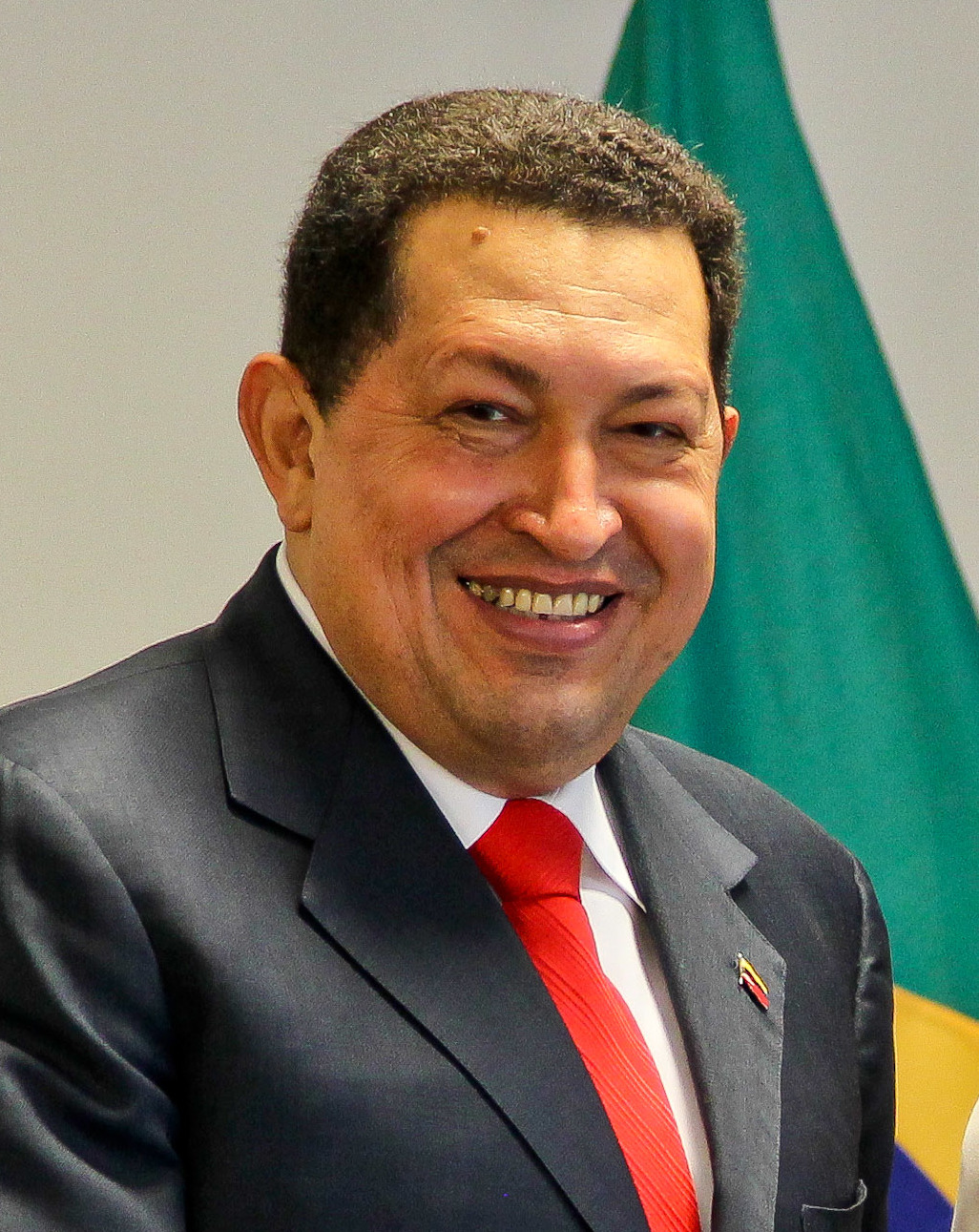
While Chávez is the most emblematic of these leaders, and receives the bulk of media attention, the phenomenon is not unique to Venezuela. The presidents of Bolivia and Ecuador as well as the leading left-wing candidate in Mexico's most recent presidential election have run populist campaigns, and the former have governed in a populist style. This article briefly outlines why populism and anti-Americanism are important, what they are specifically, and what conditions have led to their reemergence today.
To begin it is important to note what populism is, what anti-Americanism is, and how the two terms are related. Populism is a very broad term and, often evokes negative connotations. It suggests a pre-democratic way of governing, though its meaning in practice is often fuzzy and contested. For example, populism is often associated with economic redistribution and socialism, social equality, and some forms of nationalism. While this may be the case in practice, as discussed below, not all socialists or leftists, social activists, or nationalists are populists. For instance, many politicians on the left in Latin America today, such as the current Presidents of Brazil and Chile, are not populists.
Consequently, the most common definition of populism in political science today considers populism as a distinct political strategy where a personalistic leader tries to capture the vote of previously unorganized voters by shunning and/or outright disparaging existing institutions, by speaking directly to "the people."
In other words, populism is a way of competing in elections and governing once in office that largely eschews traditional forms of organization, particularly political parties, in favor of direct contact with a newly organized political mass.
Unlike populism, anti-Americanism is better understood. Anti-Americanism refers primarily to negative feelings or attitudes towards the United States government and, in rare occasions, its citizens. Therefore, By definition populism and anti-Americanism are somewhat unrelated. In practice, however, they are often closely linked, a relationship which began with the first wave of populism in Latin America from the 1930s until the 1950s, as discussed below.
Traditional Populism: A Return to the Past
Traditional populists – such as Juan Peron in Argentina (1946-1955, 1973-1974), Getulio Vargas in Brazil (1930-1945, 1950-1954), and Lázaro Cárdenas in Mexico (1934-1940) - were nationalists who bypassed the traditional ruling elite and formed new movements of previously nonexistent voters. They captured a large part of the vote by appealing to new masses of urban industrial workers – a societal group that had formed in response to state intervention in the economy. The roots of populist anti-Americanism grew during this period as the state created government-run industries that resulted in a large industrial and unionized middle class.
The programs of state intervention were particularly key to building domestic economic independence since, until this time, Latin American economies had been reliant upon American companies, and international economic activity was based almost entirely on exporting raw material goods (such as fruit, coffee, and beef) to the United States and Europe.
The populist politicians were able to capture the votes of this new social group in three ways: by distancing themselves from the old parties associated with the elite, wealthy classes of society; by acting as if they were speaking directly to voters; and by promising to implement social security, wage, and food programs that would benefit the new urban, industrial worker. Part of the reason for the popularity of populist politicians stemmed from the perceived need for these programs from many in this group. Anti-Americanism also grew during this period since most of these leaders were nationalists.
Traditional populism came to end when the military took over in many Latin American countries starting in the 1960s. Although many older populists were part of the military (Juan Peron, for example, was a military officer), the new military leaders drew from more conservative elements of society.
They also enjoyed the support of the United States, which attempted to counter increasing communist and Soviet influence in the region by backing brutal military regimes, including that of Augosto Pinochet, discussed below. This support would later become a leading source of anti-Americanism in the region upon which modern populists have been able to build (in conjunction with other factors). Many dictators, like Pinochet, came to power with the assistance of the United States, and the U.S. helped to fund a number of dictatorships through aid programs.
Two factors led to the end of the traditional populist period. First, the military had eliminated many of the traditional supporters of populism, either through exile or violent means. For example, during military rule in Argentina, the military crackdown targeted some Peron supporters, including trade union leaders, students, and others on the left in what was known as "the Dirty War." Estimates are that over 30,000 people "disappeared" during this period (most likely killed by the military that dropped their bodies in the shark infested ocean). Furthermore, declassified US documents suggest, as many suspected, that the US was well aware of what was going on and even encouraged the Argentine military action.
Second, it was assumed that during the re-democratization process that began in the 1980s, countries would begin to develop political institutions (and, in turn, political leaders) that resembled the developed world. Many policymakers thought that Latin American countries would develop political institutions that would prevent populism from reappearing. However, this was not the case, and in conjunction with market-oriented economic reform, the seeds of resurgent populism and anti-Americanism were sown.
The Historical Basis for Anti-Americanism
Anti-Americanism has its roots not necessarily in populism, but rather the United States' intervention in the Latin American region. Since the Monroe Doctrine, particularly before 9/11, the United States considered the Western Hemisphere to be its domaine reserve, meaning that no other country should mess in the United States' "backyard." The U.S. had routinely intervened in Mexico during the late 1800 and early 1900s, and the U.S. led invasion of Cuba in 1898 (the Spanish-American War) set up a proxy state sympathetic to U.S. interests.
The purpose of these interventions was during the post-colonial period (from the 1830s until the 1930s), was often to secure access to raw materials for U.S. companies. U.S. companies had unparalleled access to the region and often operated with impunity with regard to the local population. Large U.S.-based corporations – such as Folgers and the United Fruit Company (now Chiquita) – operated much like independent states throughout the region while exporting raw materials to the United States and Europe. These corporations' actions, sometimes violent, were among those that helped the nationalist populists who advocated more state control of the economy and a domestically oriented perspective on economic development.
Instead of exporting raw materials and importing manufactured goods, these countries focused their attention on their own economies to limit the amount of foreign goods imported into their countries by creating domestic industries to produce manufactured goods.
The United States also supported military leaders, discussed above, who were vehemently anti-communist. The Cold War dimension pitted many on the left against the United States and conservative military elements of society.
U.S. overt and covert support for these regimes was a leading cause of anti-Americanism for those on the left. Concerned about Soviet advances in the region after the Cuban Revolution, U.S. interventions in Guatemala, Cuba and the Dominican Republic were viewed with hostility among many in the region. Plans like Operation Condor, where the U.S. and allied Latin American governments sought to kill Marxists and leftists in the region, and U.S. covert support for the military coup of Augosto Pinochet against the only democratically elected Marxist head of state, Salvador Allende, led many on the left toward an increasingly anti-American position.
Pinochet's regime is often considered to have been more brutal than the Argentine military regime discussed above; at one point in time, the Soviet Union (not known for its respect for human rights) even refused to play a World Cup qualifying game in the National Stadium since it was used as a detention and torture center for dissidents of the Pinochet regime!
A final dimension leading to anti-Americanism appeared in the mid-1980s and 1990s in the form of U.S. support for economic reform programs. As mentioned earlier, Latin American countries had from the 1930's on industrialized products by relying on economic intervention by the government, a process known as "import substitution industrialization." ISI did indeed help to industrialize many Latin American economies, but it came with a price: mounting debt caused by high borrowing.
By the 1980s, the situation had reached a climax, resulting in the 1982 debt crisis in which a number of Latin American countries defaulted on their loans and entered a period of economic distress. In fact, these economic woes earned the 1980s the title of "the Lost Decade" by many Latin Americans.
The solution to these problems proposed (and considered by some to be imposed) by the U.S., International Monetary Fund (IMF), and World Bank was a series of reforms to remove state intervention from the economy and adopt market economic principles. State-run companies were sold, tariff barriers dropped, and foreign investment encouraged among other reform measures. Strong U.S. support for these reforms (often called neo-liberalism) has become a primary source of anti-Americanism today.
Proximate Sources of Anti-Americanism and Populism Today
While military interventions, economic exploitation, and covert U.S. political and economic support for brutal military regimes provide the historical foundations for anti-Americanism and populism, a confluence of more recent events explains why the resurgence has happened now. We can point to five which have fueled the rise of anti-American populism:
1) The failure of neoliberal economic reform to benefit large sectors of these societies and worsening economic inequality
2) Weak, corrupt political institutions
3) U.S. immigration policy, especially toward Mexico and Central America
4) U.S.-led intervention of Iraq in 2003
5) The continuing hegemonic position of the United States in relation to the region culturally, economically, and politically
These conditions have led a larger number of people, particularly poor voters who feel disenfranchised by the current political system, to begin supporting politicians such as Hugo Chávez in Venezuela, Evo Morales in Bolivia, Rafael Correa in Ecuador, and Andrés Manuel López Obrador in Mexico. These politicians often used populist political strategies when campaigning, and routinely critiqued U.S. supported economic policies, immigration policy, and U.S. unilateralism when campaigning.
The first condition has been a proximate cause for both anti-Americanism and populist politicians who promise economic redistribution of wealth. Neoliberalism has often been perceived as one of the causes for increasing economic inequality in the region. Latin America generally has one of the most lopsided wealth distributions in the world. The richest 10% of the population earns 47% of the income in the region, while the poorest 10% accounts for just 2-4% of the income, making Latin America vastly more unequal than the developed nations, eastern Europe, most of Asia, and even parts of Africa.
Politicians have been able to capitalize on this economic divide by promising to rapidly redistribute wealth to the poor. This has thus been a primary source of anti-Americanism because the U.S. strongly supported these neoliberal economic reforms that many feel has failed to remedy long-term economic problems.
The second condition is related to the ability of populists to win political office. Weak and ineffective political institutions, in particular political parties, give populist politicians the chance to effectively win office in Latin America. While populists exist elsewhere (in the U.S. Ross Perot and Ralph Nader could be considered populist politicians), the possibility for winning office is greatly diminished by the political institutions of these countries. The U.S. system, in particular, has a number of laws that prevent new parties from winning elections.
In Latin America, however, corrupt parties and weak political structures that make populist parties and politicians viable candidates, gives populists the opportunity not only to compete in elections, but also the ability to win them. Many of the poor feel slighted by the traditional ruling elites, who are often accused of corruption and nepotism.
Populists, distancing themselves from the traditional ruling elite, have been able to capture a large number of poor voters who feel disenfranchised by the other political parties. What concerns most scholars and policymakers is the anti-system approach taken by many populists.
The third, fourth and fifth conditions also help to account for a rise in anti-Americanism in the region. The third condition is a prominent reason for anti-Americanism in Mexico and Central America, which have higher emigration rates to the U.S. in comparison to countries in South America. The increasing salience of immigration policy in the U.S. – as well as the perception that immigrants from Latin America are illegal and treated as second class citizens (or non-citizens altogether) in the U.S. – has led many citizens in countries with high emigration rates to be concerned (and critical) about U.S. immigration policies.
The fourth condition has led to decreasing support for U.S. foreign policy, especially in South American countries. As Table 1 demonstrates, recent survey research suggests that perceptions of the United States have declined since the start of the Iraq War. These attitudes can be attributed to increasing concern about the U.S. policy to "go it alone" in Iraq and its unwillingness to consult allies during times of turmoil. Latin Americans also perceive (and, often rightly so) that their region has declined in importance to U.S. foreign policy in the post-9/11 world. Traditionally the most important region for the United States abroad, Latin America has seen a steady decline in importance in a world in which terrorism takes center-stage.
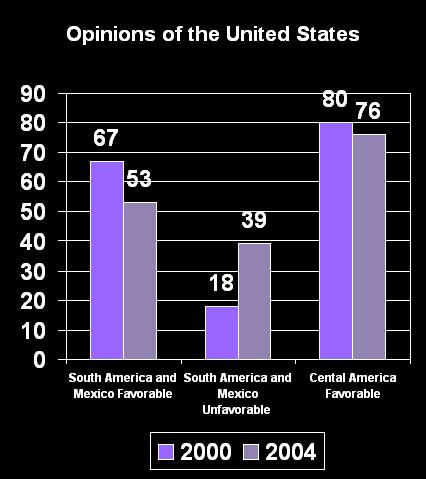
TABLE: Data from Latinobarometer
It should be noted, however, that anti-American hostility is directed largely at the U.S. government – not toward U.S. citizens more generally. As Tables 2 and 3 show, many hold an unfavorable opinion of President Bush at both the elite and mass level. But many Latin Americans across the region also hold a similarly unfavorable opinion of Hugo Chávez, the most anti-American populist in region.
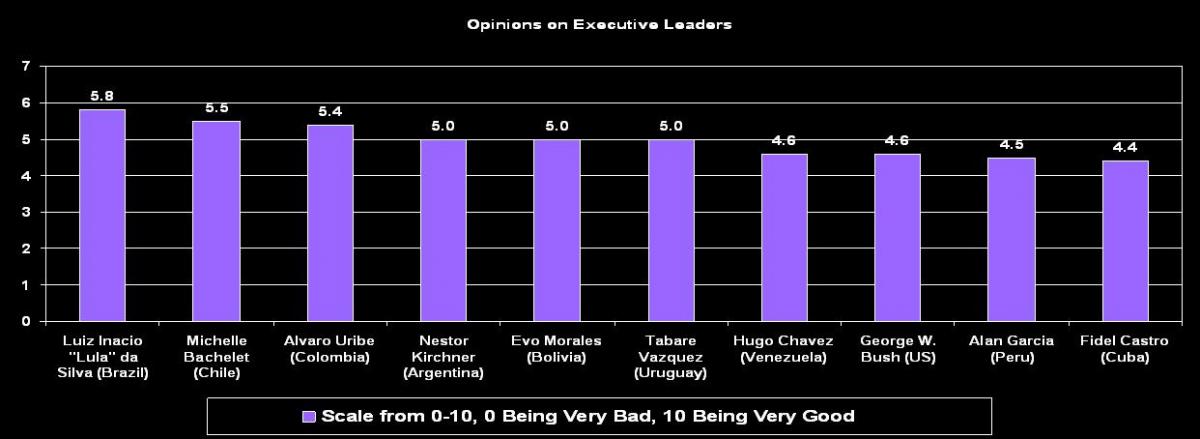
TABLE: Data from Latinobarometer 2003
Importantly, survey research on the final condition disaggregates opinions on anti-Americanism between elites and the masses. In fact, many citizens draw a distinction between the U.S. government and American culture. As Table 4 shows, many in the region admire aspects of American culture but are still concerned about their spread. Interestingly, the country most supportive of U.S. culture is also the country with the most anti-American populist in power (Venezuela). Other countries, such as Argentina, are considerably more skeptical of U.S. cultural influence.
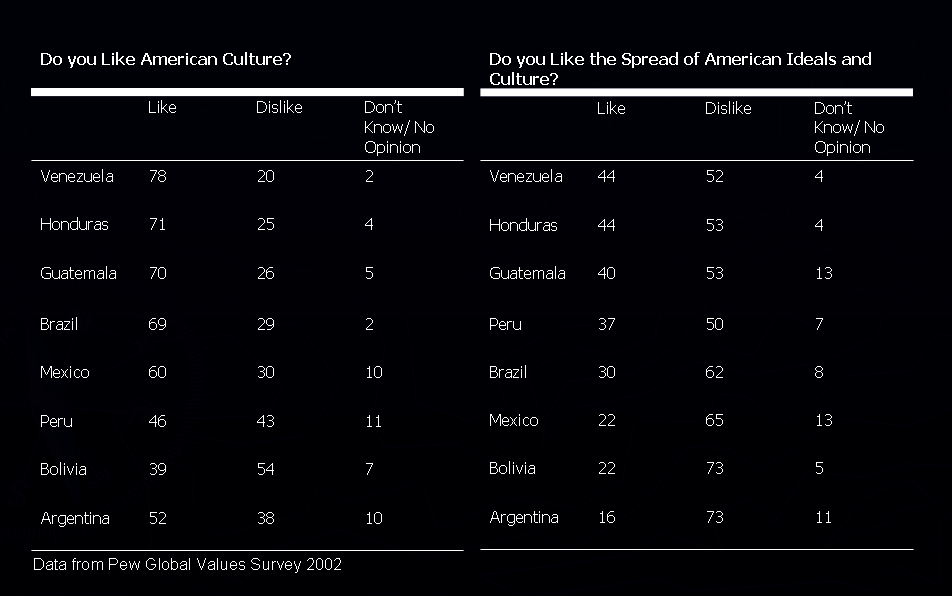
TABLE: Data from Pew Global Values Survey
Conclusion: The Anti-American Populist Today
The conditions that have led to anti-Americanism and populism today are best seen in the career of Venezuelan President Hugo Chávez. Chávez regularly condones U.S. actions abroad and is very critical, even derogatory at times, toward the Bush administration. Chávez' support tends to be drawn from the lower classes, academics, and leftists, and he has promised to radically redistribute Venezuela's vast oil wealth to the poorer segments of society.
Chávez often follows the path of the populist politician, holding a regularly scheduled, three-hour presidential news broadcast (called Aló Presidente) during which he "speaks directly with the people." Recent wins by his party of all the seats in Congress (due to the opposition parties pulling out) and Congressional approval for Chávez to pass legislation by decree without congressional approval has led to increasing criticism that he is a dictator and not a democrat. Only time will tell whether Chávez will become more of a democrat or more of a dictator.
The nationalist foundation of populism and anti-Americanism directed toward market reforms has also led to new ways of organizing the economy. In Venezuela and Bolivia (under populist politician Evo Morales), a new round of nationalization (or the purchase of private companies by the state) has occurred. While both countries have paid for their acquisitions, many – particularly those in the U.S. business community, U.S. government, and IMF – have been concerned about these recent trends.
There have also been political changes associated this new type of politician. Most, including Chávez, Morales, and Ecuador's populist president Rafael Correa, have sought to reorganize the constitutions of their respective countries to grant the poor or indigenous inhabitants (in the cases of Ecuador and Bolivia) more political powers. These groups, traditionally slighted by the ruling elite, certainly have cause for optimism in the region.
There have also been setbacks. Populist politicians recently lost elections in Peru and Mexico, and there have been signs that some populists in office are following a more "regular" path than initially anticipated. The historical dimension is clear, however: it is often only with violence that the populist politician can be thrown out. What this holds for the future of democracy in Latin America is unclear; as Latin America enters what is often a difficult period for new democracies, only time will tell about the impact of populism on Latin American political systems.
President Bush's most recent trip to the region sought to increase ties between the U.S. and regimes that the U.S. feels it can work with. The most important visit by President Bush was to Brazil. Brazilian President Luiz Inácio "Lula" da Silva is a former trade union leader from a reformed Marxist party. Now a moderate leftist, Lula (as he is known) is an example of the type of politician the U.S. feels it can work with. Although the Brazilian and U.S. governments' disagree on a number issues (most importantly free trade and agriculture subsidies), the two nations have found issues to cooperate on despite their political differences (such as ethanol, since Brazil is the world leader in both technology and production).
Such an approach may be the best way forward; the U.S. must learn to live and work with the new Latin American left and the only way to develop a fruitful relationship with the region may be to engage leaders and issues where common ground can be found.
David de Ferranti , Guillermo E. Perry , Francisco Ferreira , Michael Walton. 2004. Inequality in Latin America: Breaking with History? Washington, DC; World Bank Publications.
Peter Kornbluh (ed.) 2003. The Pinochet File: A Declassified Dossier on Atrocity and Accountability. New Press.


