
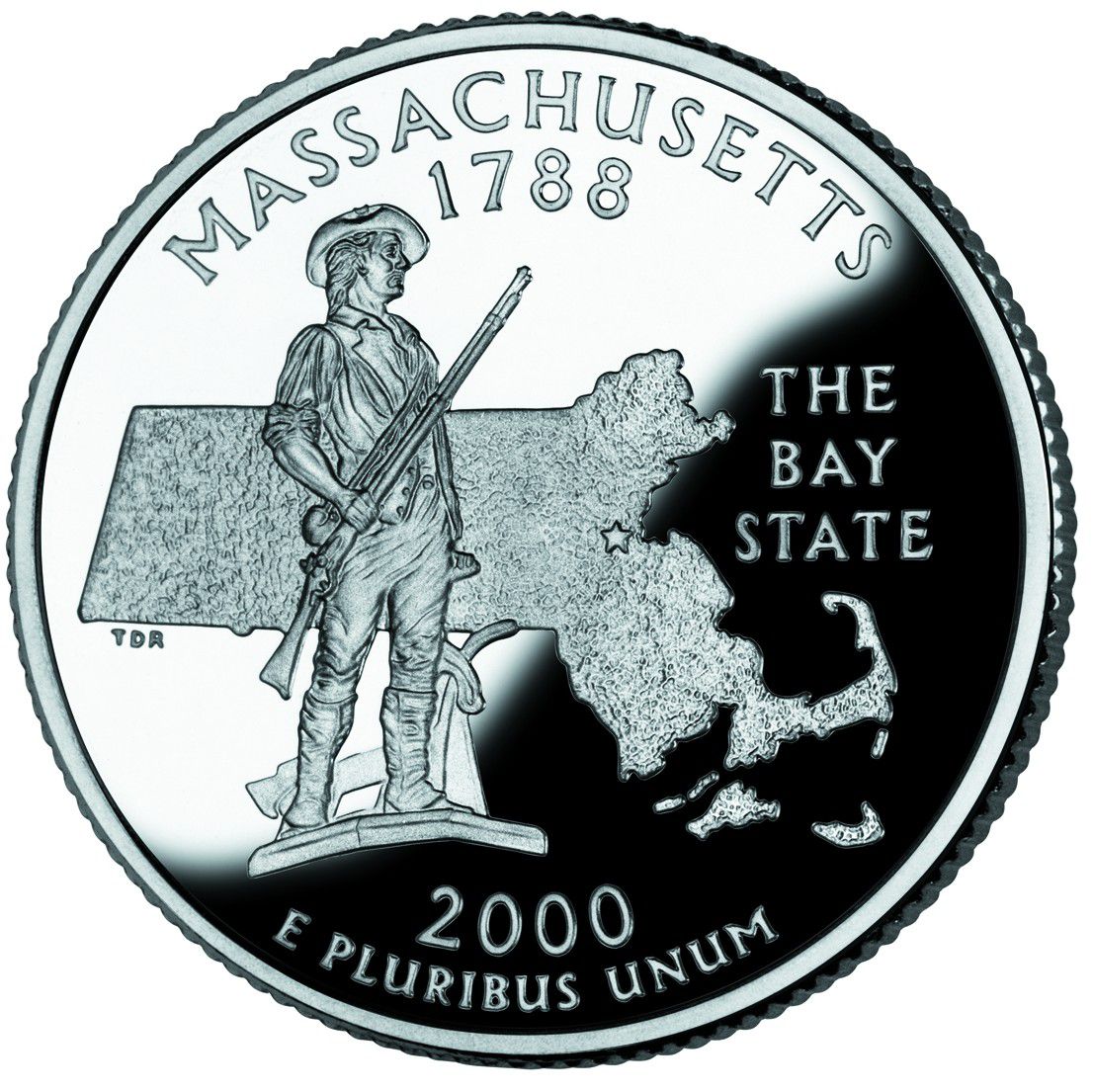
A minuteman statue depicted on the Massachusetts state quarter
For the first time in nearly three quarters of a century, the Supreme Court has agreed to hear arguments in a case involving gun control and the 2nd amendment. The case comes amidst swirling scholarly debates over the history and meaning of the 2nd amendment. In this month's essay, Constitutional historian Saul Cornell describes the shifting nature of 2nd amendment scholarship over the last several years, and grounds the 2nd amendment more fully in its historical context.
UPDATE: This article was updated on November 7 2008 (click here to read the update)
Few issues in America public life are more emotionally charged than guns and no subject within this political maelstrom is more bitterly contested than the Second Amendment. Although it is hard to imagine this issue heating up any further, it is about to get red-hot.
Earlier this year, the Court of Appeals for the District of Columbia struck down the District of Columbia's local gun-control law on Second Amendment grounds. The D.C. Court is only the second Appeals Court to affirm that the Second Amendment protects an individual (as opposed to collective) right to bear arms, and the first one to actually strike down an existing gun control law on this basis. The case is now heading to the Supreme Court, which has not taken a Second Amendment case in almost seventy years. District of Columbia v Heller will likely shape the contours of future discussions of gun control for decades to come. It might even have an impact on the dynamics of the 2008 presidential election. For better or worse, history—the history of the 2nd amendment and the history of how Americans have interpreted it—is also likely to be at the heart of the case.
Two Interpretations
The Second Amendment reads: "A well regulated militia, being necessary to the security of a free state, the right of the people to keep and bear arms, shall not be infringed." What do these words mean? Well, the answer to this question depends on who you ask. Supporters of the so-called collective rights interpretation believe that the Second Amendment only protects the right to bear arms within the context of well regulated militias. Supporters of the so-called "individual right" interpretation view the right to bear arms as a right vested in individuals, much like the 1st Amendment right to freedom of speech.
The fact that there are two such divergent interpretations is the result of significant changes in how Americans view the 2nd Amendment that occurred during the latter part of the twentieth century. For most of the last century, the meaning of the Second Amendment was not particularly controversial: the courts, legal scholars, politicians, and historians endorsed some version of the collective rights interpretation. As late as 1991, Chief Justice Warren Burger described the individual rights view as an intellectual fraud. Yet, the growth of a revisionist individual rights theory of the Second Amendment in the years since Burger made his comment has been nothing short of astonishing.
This view was originally propagated by gun rights activists such as Stephen Halbrook, Don Kates, and David Kopel whose research was funded by libertarian think tanks and the National Rifle Association (NRA).
In the decade before Burger's attack, these activists had published law review articles at a dizzying rate arguing for an individual rights view. The NRA even endowed a chair in Second Amendment studies at George Mason Law School with the express purpose of supporting this viewpoint. As the paper trail supporting this view grew longer, the individualist perspective started to gain some traction among prominent liberals.
When Harvard Law School's Lawrence Tribe, a renowned liberal, acknowledged the legitimacy of this view in 2005, the long road from Burger's "intellectual fraud" to constitutional mainstream had ended. There is no doubt that the individual rights view is now eminently respectable.
For several reasons, opponents of this interpretation were slow to respond: confidence that the individual rights view would never attract judicial notice, a general decline in interest in constitutional history outside law schools, and a general lack of funds to support research on this topic all hampered scholarship. Despite these obstacles, historians began to turn their attention to the Second Amendment and new funding for research on this topic led to a revival of scholarly interest and a more robust debate.
Scholarship on the Second Amendment is now is deeply divided. Indeed, there is currently a broad spectrum of views on the meaning of the Second Amendment running from an expansive individual rights view to the traditional collective rights view, and a host of new positions somewhere in the middle. While many law professors support the individual rights view, most historians reject this interpretation as an anachronistic reading of the amendment and its history.
To render a decision in DC v Heller, the Supreme Court will need to wade through this immense body of scholarship, and it will not be an easy task. The Justices will be forced to make decisions about 2nd Amendment history: to choose between a version of the past presented by historians and a rather different version of history presented by gun rights advocates.
From Miller to Heller: Guns and the Supreme Court
The current case before the Court tests the District of Columbia's gun control law—one of the strictest in the nation. The District's law was enacted in 1976 in an effort to reduce the city's terrible rates of violent crime. It makes it virtually impossible legally to own a handgun and requires that all firearms be locked up.
The last time a Second Amendment case came before the Court, the issue was not a local law but a federal gun control law that dealt with so called "gangster weapons" such as machine guns. In United States v. Miller (1939), the court ruled (in convoluted language) that the Second Amendment had to be interpreted with regard to the "obvious purpose to assure the continuation and render possible the effectiveness of such forces [well regulated militias], the declaration and guarantee of the Second Amendment were made. It must be interpreted and applied with that end in view."
The defendants in that case were charged with the crime of transporting and possessing an unregistered sawed off shotgun, in violation of the National Firearms Act, 26 U.S.C. § 1132. One of the factors weighing in Miller was that the weapon was clearly not typically associated with use in the militia and therefore was not protected by the 2nd Amendment. (Since the Court's ruling in Miller gun rights advocates have argued that shot guns were military weapons useful in trench warfare, but it is doubtful that a sawed off shotgun owned by two criminals would really pass the Miller test.)
In Heller, the Court must decide if the Second Amendment protects the right to own a hand gun. Given the popularity of hand guns this issue touches a larger segment of the gun owning population (somewhere around 20 percent of US households have handguns.) Gun control supporters read Miller to require that a weapon be of a type associated with the militia and be used in some militia related activity. Gun rights advocates argue that Miller only requires that the weapon be of a type associated with militia activity. Thus, Heller's lawyer's claim that the 2nd Amendment bars a ban on hand guns because it is a type of gun used by some members of the militia (the modern National Guard).
The Individualist Interpretation and the Great American Gun Debate
No First Amendment scholar would argue that we ought to interpret freedom of the press exactly as the Founders understood it. Yet, claims like this are common in Second Amendment scholarship where the original meaning of the Amendment seems to figure more centrally than in other areas of constitutional law. In part the propensity toward originalism—the theory that we ought to interpret the Constitution according to its original meaning—mirrors the ideology of modern conservative thought. Originalism fits with conservatism because it provides a strong critique of the modern regulatory state created after the New Deal. Second Amendment originalism also draws on a potent set of myths associated with America's past, particularly the idea of the Minuteman. Thus, gun rights sites on the internet invariably carry images of the Minuteman. (Although these images are generally drawn from the individualistic and romantic 19th century memorials to the Minuteman and have little to do with the real Minutemen who were part of the Founding era's well regulated militia.)
Ironically, the originalist arguments in favor of an individual rights view of the Second Amendment are probably the intellectually weakest arguments to support this position. One could make a much stronger and intellectually more interesting argument in support of an individual rights view if one adopted a living constitution argument. Supporters of a living constitution believe we ought to interpret the Constitution according to modern concerns and beliefs, recognizing that America has changed radically since the 18th century. Polling data over the last few decades have consistently shown that most Americans believe the Second Amendment protects an individual right.
It would be easy to imagine a theory of the 2nd Amendment that defended this right as part of a living Constitution that has evolved toward a more individualistic conception of rights. Yet, most gun rights advocates eschew this line of argument in favor of originalist historical claims about the Second Amendment. In part this decision reflects the underlying political ideologies behind gun rights. Libertarians and social conservatives, the two groups most closely identified with the individual rights view, are generally uncomfortable with living constitutional arguments because the idea of an evolving constitution has been closely associated with modern liberalism over the past century.
There are problems, however, with this reliance on an originalist interpretation: it rests on a distorted view of the past. Consider some of the claims made by gun rights supporters. No figure has been more abused by Second Amendment originalists than Thomas Jefferson. As one gun rights advocate noted: "It is clear Jefferson was strongly in favor of personal arms. In June of 1796, Thomas Jefferson wrote to George Washington, 'one loves to possess arms.'" This quote has been cited by four different pro-individual rights scholars in law reviews. The quote is accurate, but it is clearly taken out of context. In a forthcoming article in the Albany Government Law Journal, historian David Konig points out that this quote had nothing to do with firearms. Jefferson was actually talking metaphorically, about having all of the facts one needed in an argument—going into an argument with all the right "ammunition."
Individual rights supporters also invoke the authority of the 1776 Pennsylvania Constitution, the first state constitution to protect the right to bear arms, to support the notion that bearing arms was not typically understood at the time of its writing to refer to arms used in conjunction with military purposes. The Pennsylvania declaration of Rights asserted that:
"That the people have a right to bear arms for the defence of themselves and the state; and as standing armies in the time of peace are dangerous to liberty, they ought not to be kept up; And that the military should be kept under strict subordination to, and governed by, the civil power."
Invariably, quotes of this provision by gun rights supporters do not include anything after the semi-colon. If one reads the entire provision, however, it is clear that the right to bear arms in defense of the state and themselves, was tied to the eighteenth century opposition to standing armies. This provision was unconnected to the question of private guns used for private purposes. Indeed, the Pennsylvania Constitution treats the use of firearms for hunting in a separate provision.
Additional evidence that the Pennsylvania provision did not mean what gun rights advocates think it means comes from the work of the historian Nathan Kozuskanich. His study of the origins of the Pennsylvania Constitution conclusively shows that the state's arms bearing provision was framed by backcountry Pennsylvanians who had been in a protracted battle with the Quaker dominated legislature before the War of Independence. Quakers were religious pacifists who opposed using violence to settle conflicts. (Quakers even opposed hunting for sport, but accepted that one might hunt for sustenance.) The Quakers refused to enact a militia law and backcountry residents complained bitterly that without a militia they lacked the arms to defend the state and themselves against hostile Indians. Pennsylvanians wished to be able to protect their communities and wanted the state to pass a militia law. The individual right of self defense, something well established under English common law, was simply not an issue in Pennsylvania during the Revolutionary era.
Finally, one often hears the puzzling claim that none of the great nineteenth century commentators on the Constitution accepted the militia-based reading of the Second Amendment. This would have come as a shock to the most influential 19th century commentator, Justice Joseph Story. In his landmark Commentaries on the Constitution, Story not only described the Second Amendment as the "palladium of liberty" but he went on to note:
"And yet, though this truth would seem so clear, and the importance of a well regulated militia would seem so undeniable, it cannot be disguised, that among the American people there is a growing indifference to any system of militia discipline, and a strong disposition, from a sense of its burthens, to be rid of all regulations. How it is practicable to keep the people duly armed without some organization, it is difficult to see. There is certainly no small danger, that indifference may lead to disgust, and disgust to contempt; and thus gradually undermine all the protection intended by this clause of our national bill of rights."
Story's invocation of the grand palladium of liberty concerned the right to bear arms in a well regulated militia, and had nothing to do with hand guns or other weapons owned primarily for individual self defense. It was the absence of regulation, not too much regulation that Story feared. All too often, when gun rights advocates and their scholarly allies quote Story they truncate his quote.
Whatever the Supreme Court decides to do in the Heller case it is important that the history they use is complete and accurate.
Simplicity vs. Complexity
One of the biggest problems with the Second Amendment debate is that a genuinely historical understanding of this issue requires one to accept that historical truth is seldom simple: so many overlapping shades of grey rather than stark blacks and whites. The effectiveness of the gun rights argument rests on its utter simplicity and refusal to engage with historical complexity. If one reads the comments sections on any of a dozen gun rights blogs one sees the same quotes and arguments recycled time and again. (There is a remarkably strong gun rights presence in cyberspace. Gun control supporters seem to have other hobbies.) For gun rights advocates, there is one interpretation and all the evidence points in that one direction. If this were actually true, then the Second Amendment would be unique in American constitutional history since it would be the only part of the constitution whose meaning was never contested and never changed in the time between the Founding era and the modern period.
Given that the language of individual rights is now everywhere in modern America, it is hard to explain the historical meaning of the Second Amendment, which is the product of a different era when the language of rights was not nearly as individualistic as it has become. This difference in the meaning of "rights" from the 18th to the 21st centuries is crucial to making sense of the 2nd Amendment today. Consider the language of the original draft of the first five amendments to the Constitution that Congress proposed in 1791. (The term "Bill of Rights" is itself a later name that was only applied to the first ten amendments in the nineteenth century.)
Article the First.
After the first enumeration, required by the first Article of the Constitution, there shall be one Representative for every thirty thousand, until the number shall amount to one hundred, after which the proportion shall be so regulated by Congress, that there shall be not less than one hundred Representatives, nor less than one Representative for every forty thousand persons, until the number of Representatives shall amount to two hundred, after which the proportion shall be so regulated by Congress, that there shall not be less than two hundred Representatives, nor less than one Representative for every fifty thousand persons.Article the Second.
No law varying the compensation to the members of Congress, shall take effect, until an election of Representatives shall have intervened.Article the Third.
Article the Fourth.
Congress shall make no law establishing religion or prohibiting the free exercise thereof, nor shall the rights of Conscience be infringed.
The Freedom of Speech, and of the Press, and the right of the People peaceably to assemble, and consult for their common good, and to apply to the Government for a redress of grievances, shall not be infringed.Article the Fifth.
A well regulated militia, composed of the body of the People, being the best security of a free State, the right of the People to keep and bear arms, shall not be infringed, but no one religiously scrupulous of bearing arms, shall be compelled to render military service in person.
The most obvious fact about this list is that what we know as the Second Amendment was originally the Fifth. Also, the first two Amendments do not have anything to do with individual rights.
The language of the original assembly clause, which shares with our Second Amendment the phrase "right of the people" bears close scrutiny. Rather than frame the right to assemble in individualistic terms, the right is framed in civic terms. It is a right of the people to assemble for a particular public purpose, "to consult for the common good, and apply to the government for a redress of grievances." The phrasing of this right captures the importance of civic republican ideas to the founding generation.
The civic republican political philosophy of the Founding era stressed the need for individuals to sacrifice some measure of their liberty for the common good. As one writer in an eighteenth century newspaper observed, "If, indeed, government were really strengthened by such surrender" of rights, and "if the body of the people were made more secure, or more happy by the means, we ought to make the sacrifice." Moreover, "if the good of his country should require it; and every individual in the community ought to strip himself of some convenience for the sake of the public good."
The original language of the assembly clause of what became the First Amendment embodied this civic republican ideal. The right of assembly was originally understood in civic terms. The emphasis is not on individual rights, but rather the rights of citizens acting together for a common public purpose. Individuals acting in isolation do not assemble; nor do individuals acting in isolation bear arms. In this sense, assembly and bearing arms were closer to jury service, than freedom of religion or speech. Both activities were originally understood to be closely tied to a distinctive republican conception of constitutionalism.
It is also worth noting that the original provision on arms bearing had an exemption for those who opposed bearing arms on religious grounds. The inclusion of this language indicates that the original Second Amendment had nothing to do with an individual right to use guns for private purposes. The state cannot force you to hunt or defend yourself; you can only be "scrupulous" about bearing arms in some military context. Indeed, the entire discussion of the right to bear arms in Congress at that time focused on militia-related activity. Indeed, recent scholarship has demonstrated that the Congress during the Founding era used the term "bear arms" to refer exclusively to military matters. {Dorf in the Chicago-Kent link listed above}
The idea of bearing arms in the Second Amendment was not part of a libertarian anti-government ideology, but rather it was an essential part of what the Founders called "well regulated liberty." This was the world of the Minutemen, not the Michigan militia. As historian David Hackett Fischer notes, the Minuteman ethos was one in which collective rights and individual responsibility predominated. Our world has become quite the opposite: one in which individual rights and collective responsibilities predominate. This shift in values and approach makes it especially hard to make sense of the Second Amendment in contemporary America.
The Second Amendment fits neither the modern individual nor collective rights models, making it hard to interpret. The best way to describe the original conception of this right would be to think of it as a civic right. It was a distinctive fusion of a right and civic obligation. In contrast to genuinely individual rights, such as freedom of speech, the state could force you to bear arms. It was for this reason that the first state constitutions also provided religious exemptions for Quakers and other religious groups opposed to bearing arms.
The important question before the Supreme Court is how to translate the Second Amendment in modern terms that remains faithful to the nuances of the original text, without turning it into a nullity or anachronism. The Court's task is neither enviable nor easy.
Guns and American Exceptionalism
The American gun debate looks puzzling to the rest of the world. Indeed, guns may be the one area where American politics is truly exceptional. There is simply nothing like America's gun culture in any other part of the western world. America has more guns, higher levels of gun violence, and is the only western constitution where anyone would compare the right to have firearms with freedom of speech and not be considered daft or politically marginal.
Although guns appear to have become as American as apple pie, the rancor of America's debate over firearms policy is wholly out of proportion to the actual level of gun regulation in America. Reading gun rights web sites or listening to the Republican candidates for President talk, you would think that America was on the verge of some type of mass gun confiscation. Whatever you might think about gun control – put that notion out of your mind. With over two hundred millions guns in America there is no plausible scenario to turn America into a gun free zone, even if such a goal was politically possible or desirable from a public policy perspective. Indeed, America has the weakest gun regulatory regime in the industrialized west (and the highest levels of gun violence—although the cause and effect relationship between these two facts is almost as hotly debated as the Second Amendment issue.)
The District of Columbia's gun control law is a notable exception to this rule. It is one of the few gun control regulations in the U.S. similar in scope to those found in almost every other industrial democracy in the world. The District of Columbia is at the center of American political life so its gun laws have tremendous symbolic importance to both gun control and gun rights advocates. In this way, the symbolism of Heller may ultimately outweigh its potential impact on gun control in America. Whatever happens in Heller, some types of restrictions on gun ownership are likely to survive constitutional scrutiny. Similarly, whatever happens in Heller, gun rights advocates and gun control supporters are likely to continue their struggles with renewed vigor.
The great loser in the American gun debate is the American people. Neither side in the modern debate over the Second Amendment has developed either a solid constitutional theory or a corresponding public policy agenda that speaks to the two inescapable realities about modern America: guns are deeply woven into the fabric of modern American society and America has an intolerably high level of gun violence. Until public debate addresses these two inter-related problems we will make little progress on the gun issue.
What Will the Court Do?
It is impossible to say how the Supreme Court will decide the case of District of Columbia v Heller. It seems most likely the court will be divided and some coalition among the moderates will try to stake out a middle ground between the orthodox gun rights and gun control positions.
Much will depend on what Justice Anthony Kennedy thinks about the Second Amendment. At least one former Kennedy clerk speculates that the Justice is likely to find that the Second Amendment protects a limited individual right subject to very robust levels of regulation. Under this theory, the DC gun control law might pass constitutional muster. Alternatively, the High Court may accept that the Second Amendment only protects weapons owned in connection with a government controlled militia. If that happens the DC gun law should survive intact.
Another possibility, but less likely, is that the DC law might be constitutional under the Second Amendment, but the Court might still choose to find some other way of protecting the interests of gun owners in the District of Columbia (The Court might turn to the un-enumerated rights protected by the 9th or the ideals of liberty articulated in the 14th Amendments). Whatever the Supreme Court decides, it seems likely that neither side in this issue is likely to get all that it wants from the Court. The debate will continue on, with its lobbyists and vested interests on both sides cranking up fund raising letters before the ink on the opinion is dry.
UPDATE (November 7 2008)
Historians and Heller: The Second Amendment Comes Back from Court
Nathan Kozuskanich
In its June, 2008 decision in the Heller case, the Supreme Court interpreted the meaning of the Second Amendment to the U.S. Constitution for the first time since 1939. The Court ruled that it "protects an individual right to possess a firearm unconnected with service in a militia, and to use that arm for traditionally lawful purposes, such as self-defense within the home."
The ruling came as little surprise to court-watchers, given the conservative leaning of the court under Chief Justice and Bush-appointee John Roberts, and it validates what a majority of modern Americans already believe about the Second Amendment.
The Court's majority opinion, however, insists that it does not reflect modern attitudes. Rather, it makes assertions about "text and history," and offers an interpretation of the Founders' original intent in writing the Amendment.
The Court's claim to rely on "history", not current opinions, to come to its decision has frustrated many professional historians, who believe that in doing so the Court has misread the historical sources and context. Whatever its impact on future court rulings, laws, and public policy, then, the Court's use of history to justify its decision means that the historical debate over the Second Amendment is far from over.
The Court's interpretation of the original meaning of the Second Amendment relies on a recent trend of linguistic analysis called "plain meaning originalism," a method of analysis that considers the "normal and ordinary" use of words and phrases instead of "secret or technical meanings."
Crucial to its understanding of the amendment is an analysis of the phrase "bear arms." Basing its interpretation on contemporary dictionaries (a perhaps odd choice given that the first American dictionary was published almost forty years later) the Court maintains that "'bear' meant to 'carry.'"
As such, the Second Amendment was never meant to protect an exclusive military right. Although the Court acknowledges that "bear arms" did idiomatically mean "to serve as a solider," that meaning was only unequivocal when "followed by the preposition 'against,'" such as in the Declaration of Independence's complaint that King George III forced captured Americans to "bear arms against their country."
To make these claims the Court dismisses two very important historical sources: the press and Congressional records. A survey of the term "bear arms" in newspapers, pamphlets, and Congressional records from 1776-1791 reveals that over 98% of the usages referred to military action. Irrelevant, says the Court, arguing that it was "unremarkable" that bear arms was "often used in [a military] context." Likewise, since Congress only had occasion to debate issues like the federal militia, its use of "bear arms" is also unremarkable.
To an historian, ignoring the language of the very legislative body that drafted and passed the Second Amendment makes little sense. Surely interpreting the language of the Bill of Rights hinges on which meanings were idiomatic and which were idiosyncratic.
Moreover, although the Court claims to be interested in the normal meaning of words, it has ignored the American press, a source that far better explains the common usage and understanding of words than dictionaries. William Blackstone, the most respected jurist of the Founding Era, would agree: "Words are generally to be understood in their usual and most known signification, not so much regarding the propriety of grammar, as their general and popular use." The pages of the press also reveal a perennial concern for the militia and ensuring that men would fulfill their duty to bear arms for the common defense.
The Heller decision is the result of years of poorly researched legal scholarship that has little appreciation for context and historical method. Justifying its analysis by citing these articles, the Court has read the past to suit its own ideological ends. Rather than appreciate change over time—the very essence of historical understanding—the Court advocates a static view of history centered around an unchanging right to bear arms. While such an approach may be suitable in legal circles, historians demand more rigorous standards when dealing with the questions of the past.
Please see Saul Cornell's book A Well-Regulated Militia: The Founding Fathers and the Origins of Gun Control in America for a more detailed discussion of the history of the Second Amendment
Visit the Second Amendment Research Center


