
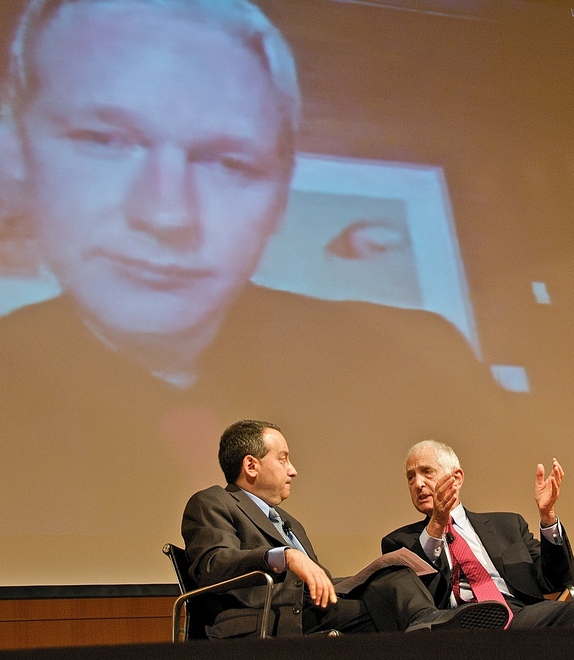
A projection of WikiLeaks founder Julian Assange looms over author Micah Sifry (left) and activist Daniel Ellsberg during a video conference in June 2010. Ellsberg's release of a classified report on the Vietnam War caused a storm of controversy forty years ago and shows that leaks of government information are not unusual in U.S. history. The WikiLeaks saga speaks to both continuity and change in the way that the United States carries out its foreign policy. (Flickr/JD Lasica http://bit.ly/ldm88t)
On a fundraising trip to California in April, President Obama was confronted by protesters demanding better treatment for Pfc Bradley Manning, who has been at the center of the WikiLeaks controversy. Private Manning has been imprisoned for passing on tens of thousands of military and diplomatic documents to WikiLeaks, in one of the greatest breaches of state secrecy in the history of the United States. This month, historian Ryan Irwin looks at the WikiLeaks tempest and what it tells us about America's role in the world.
On April 5, 2008, a small coterie of Republican senators and diplomats— John Barrasso, Saxby Chambliss, Mitch McConnell, and James Risch, among others—held a quiet meeting with then Egyptian President Hosni Mubarak at the Heliopolis Palace in Cairo.
The setting was regal. Designed in the early twentieth century by a Belgian architect, the one-time luxury hotel had been remade as Mubarak's home and workplace in the 1980s. Blending Arabic, European, and Persian architectural styles, the complex embodied purposefully Egypt's place at the crossroads of the pan-Islamic and pan-European worlds.
The conversation slid naturally to current events as the group settled down to talk.
After a brief back-and-forth about Israel, Mubarak turned to Iraq. "My dear friends," he began, "democracy in Iraq equals killing. The nature of those people is completely different. They are tough and bloody, and they need a very tough leader. They will not be submissive to a democratic leader."
Stability required an authoritarian fist.
"As I told Secretary of Defense Gates last year," Mubarak continued, "the only solution [to America's desire to leave Iraq] is to strengthen the military and security forces, arm and train them, wait for the emergence of some generals, don't oppose them, then stay in your camps in the desert and don't interfere. The military will control Iraq like the ayatollahs control Iran."
Twenty-eight years in power, and Mubarak's worldview amounted to a simple adage: never "mix democracy and tribalism."
The transcript drips with irony when read from the present.
It was sent to the Department of State by U.S. Ambassador Margaret Scobey on April 8, 2008. It allegedly comes to us via Private First Class Bradley Manning, who sits now in a U.S. military prison, awaiting trial for passing along 251,287 such cables—only 2,000 of which are available online currently—to the media organization known as WikiLeaks.
Manning's fate and the imbroglio surrounding Julian Assange, the controversial figure who shared the cables with the world, has faded somewhat from the headlines in recent months. Yet the WikiLeaks communiqués reveal much about America's role in today's world.
In the words of author Timothy Garton Ash, the documents are a "historian's dream" and a "diplomat's nightmare"—a spigot of information from the contact points of American power, where powerbrokers and diplomats go daily through the motions of statecraft.
Leaks, Yesterday and Today
In the United States, politicians have hyperventilated over the WikiLeaks story since it broke in 2010.
Despite the fact that most foreign leaders quickly dismissed the material as blasé, American leaders have framed Assange and Manning as unambiguous enemies of the international community.
Internal dissent—voiced notably by (now former) State Department spokesman P.J. Crowley, who criticized the U.S. government's imprisonment of Manning—has been cast as inexcusable and irresponsible.
But the American ship-of-state has long been a leaky boat.
George Washington reprimanded Alexander Hamilton for passing material to the British during the 1794 Jay Treaty negotiations, and James Madison castigated his secretary of state for giving administration secrets to members of the opposing Federalist Party.
There has been no shortage of leak-related precedents since then.
In 1848, as the United States' war with Mexico drew to a close, Senate investigators placed a journalist under house arrest for the first time because he refused to disclose how he obtained details about the not-yet-complete peace treaty.
At the height of the First World War, lawmakers considered making it illegal to leak state information to the public, but changed their minds because of first amendment concerns, opting instead for legislation that criminalized the act of relaying defense secrets to the enemy during wartime.
The most notorious leak in U.S. history came in the early 1970s, when Daniel Ellsberg—a Princeton-educated analyst who worked for Secretary of Defense Robert McNamara during the 1960s—delivered a 7,000-page Pentagon report to The New York Times, and later The Washington Post.
Unprecedented in scope, the collection of top-secret materials revealed that Lyndon Johnson's White House had lied systematically to the public about the rationale behind America's involvement in Vietnam.
Richard Nixon tried to use an injunction to stop the material's publication in 1971, setting another historical precedent in the process, but failed at the Supreme Court.
The ethics of leaking have never been straightforward. Nixon's own contradictions were on full display as he and his advisors formulated their response to Ellsberg:
Nixon: "Let's get the son of a bitch into jail."
Henry Kissinger: "We've got to get him."
Nixon: "We've got to get him ... Don't worry about his trial. Just get everything out. Try him in the press ... Everything ... that there is on the investigation, get it out, leak it out."
Such conviction, of course, facilitated Nixon's undoing, but the implications were clear and the sentiment was probably felt widely among American elites: leaking was bad when it violated the interests of power.
Or, as columnist David Corn said once, there are leaks "that serve the truth, and those that serve the leaker."
The second Bush administration blurred this line frequently.
White House staff members gave the identity of CIA agent Valerie Plame to columnist Robert Novak after her husband, Ambassador Joseph Wilson, criticized the rationale for the 2003 Iraq invasion.
Bush himself passed along (selectively chosen) top-secret documents to reporter Bob Woodward for the 2002 book, Bush at War.
Wheat from the Chaff
Each of these leaks tells a different historical story.
The Plame affair underscored the politicization of information in our fractured age, when partisans compete with cynical glee to mold Washington's weekly narrative.
Ellsberg's papers exposed the contradictions of an earlier epoch, highlighting the tenuous underpinnings of the global Cold War, particularly in Southeast Asia.
Controversies from the nineteenth and early twentieth centuries—sharpened often by war and codified through law—offer windows into the rise of the modern state, and highlight how the U.S. government came to police its inner correspondence.
And the experiences of the founding fathers hint at an era now long past, when leaders navigated questions of secrecy with little consideration of bureaucratic power.
So given this long leaky history, what makes the WikiLeaks material so interesting?
Size matters—there is a lot of information in the 251,287 cables—but the documents differ from previous leaks.
For one, they draw on different source material.
Unlike Ellsberg, Manning did not have access to top-secret reports. Most of the information he downloaded from his desk at a military base in Iraq never reached the Oval Office. It is likely that few of his cables even made their way to the seventh floor of the U.S. State Department, where America's top statesmen manage the daily business of U.S. foreign relations.
Moreover, the documents do not lend themselves to a Plame or Ellsberg-like controversy.
There are embarrassing tidbits here and there—gossipy assessments of foreign leaders—and heart-wrenching details from the battlefields in Afghanistan and Iraq. But Washington's foreign officers come across mostly as professionals.
As commentator Fareed Zakaria opined, "Washington's secret diplomacy is actually remarkably consistent with its public diplomacy" this time around, unlike during the Vietnam War, U.S. diplomats are undeniably "sharp, well informed, and lucid."
What emerges from the WikiLeaks material is a story that features not the great men and women of Washington but the mid-level officials who work in U.S. outposts around the world.
These are the individuals who conduct American diplomacy on the ground. Their correspondence is dominated by neither turf battles nor policy debates, but rather a continual effort to collect accurate information, analyze trends, and advance U.S. interests in the world.
Looking through the eyes of such individuals reveals much about U.S. foreign relations, especially in the American hinterland—that zone of exchange at the outskirts of Washington's political influence.
The WikiLeaks documents showcase the common priorities of the officials who enact American policy in this region, and they tell scholars something about the challenges of U.S. foreign affairs in the early twenty-first century.
Things have changed certainly since the end of the Cold War, but they haven't changed as much as one might suspect.
Small States, Big Allies
Washington's global influence today is deeply contested. To a degree that might surprise both boosters and detractors of America's foreign policy, negotiation is the motif of the WikiLeaks documents.
Whether dealing with special friends or political afterthoughts, U.S. diplomats rarely dictate the terms of international exchange. They are caught instead in a continual two-way conversation that often obfuscates the asymmetrical nature of Washington's military and economic resources.
The examples are almost endless.
Take Yemen: residing at the outskirts of the Arab world with a harsh climate and a small population, there is little reason the country should possess any leverage over the U.S. policymaking establishment. Unlike Saudi Arabia, it possesses few oil reserves or regional clout—only the strategic port city of Aden, which provides access to the waters between the Red Sea and the Indian Ocean.
Although written by U.S. officials, the WikiLeaks material shows how Yemen's President, Ali Abdullah Saleh, pushed Washington to take a greater interest in his country.
"If you don't help, [Yemen] will become worse than Somalia," he told America's ambassador in September 2009—a threat that has proved to be remarkably effective. Between 2009-11, the United States tripled aid to Yemen, providing over $300 million in military equipment and security assistance.
On the ground, U.S. diplomats acknowledged that Saleh was using these funds for personal reasons. His principal aim, quite logically, was to strengthen his government's position vis-à-vis rebels in the north and secessionists in the south. (Yemen's borders have long been contested, and religious and ethnic tensions have simmered since the country took its current form in 1990.)
However, Washington was willing to give Saleh a wide berth, so long as the President remained an ally in the fight against terrorism.
The resulting situation has been rife with contradiction. The WikiLeaks material proves that the U.S. military has attained almost unfettered access to Yemeni territory in recent years.
Since late 2009, American warships and aircraft have bombarded training facilities linked to foreign groups such as al-Qaeda, and U.S. advisors have worked in various capacities with local military and police forces.
However, upon closer inspection, Saleh shaped the trajectory of these interventions. In a 2010 meeting with General David Petraeus, the President proposed he would "continue saying the [U.S.] bombs are ours, not yours"—especially at the local level, where such action feels suspiciously similar to old-fashioned imperialism—so long as American officials promised not to punish him personally for future terrorist acts and recognized his domestic enemies as terrorist sympathizers.
According to America's ambassador, Saleh knows exactly what he was doing: "The net effect" of the current arrangement, "and one we strongly suspect Saleh has calculated," has been an "iron fist" approach toward the President's enemies at home and interlopers from abroad.
Moreover, by capitalizing on Washington's anxieties, Saleh buttressed his defense budget while outsourcing counterterrorist operations to the United States, effectively giving him the political space and financial resources to address his real problem: anti-government unrest.
In June 2011, Saleh fled to Saudi Arabia to receive treatment for injuries he sustained during an attack on his compound, and his hold on power is now tenuous. But the basic dynamic remains unaltered.
Perusing the WikiLeaks material, one can unearth similar situations elsewhere in the Middle East and throughout Africa, Asia, and Latin America. Small states, or at least the politicians who sit at the interface of the international community and Third World conflict zones, influence how the U.S. government engages the world.
Washington's military might is unquestioned and often omnipresent, but this power can only function with intermediaries on the ground. These individuals rarely possess the same agenda as official Washington, and they often turn U.S. strategic interests to their advantage.
Irony of Strategy
This revelation should come as no surprise. A similar dynamic defined America's stance abroad during the Cold War.
The rhetoric of U.S. foreign relations has altered undeniably, specifically the strategy of containment, but small states have long influenced the form that American power has taken in the world.
As a primer, the strategy of containment was promulgated originally in the late 1940s. Theoretically, it defined America's foreign engagements throughout the second half of the twentieth century.
Under the guidance of U.S. diplomat George Kennan, Washington embraced a "long-term, patient but firm and vigilant" stance toward the Soviet Union after World War II, aimed explicitly at halting Moscow's advances around the world—an approach that culminated ostensibly with communism's collapse in 1989.
The closer one gets to the historical record the more ambiguous this story becomes.
Containment changed after the 1940s. Europe—Germany in particular—initially anchored the idea. Moscow's desire to prevent a Fourth Reich clashed fundamentally with Washington's plan to reintegrate Germany into the newly formed United Nations.
For Kennan and others, containment empowered America to address this dispute without losing sight of the postwar world's true pivots—Western Europe and Japan. These were the places where Moscow's influence had to be denied.
How then did containment become a global doctrine? Some scholars blame overly aggressive Washingtonians, but context and external actors mattered tremendously.
Not only did America's European and Japanese allies rely on markets and raw materials in the Middle East, North Africa, and Southeast Asia—regions outside the traditional scope of U.S. power—but also communists began establishing nodes of influence beyond Europe, with Mao Zedong's Communist Party taking control of China and Josef Stalin exploding an atomic bomb in Central Asia.
Fear pushed containment beyond Western Europe and Japan—fear that communists would gain further footholds in the Third World and fear that Washington's allies would tire of the benefits of U.S. patronage.
Politicians abroad understood the possibilities of this new mindset. As colonial rule collapsed, Europeans and non-Europeans alike began to court the United States, often with guile and sophistication, trading friendship and local resources for money and military equipment.
Consider the case of Pakistan: Washington's 1954 decision to give security support to Islamabad rather than New Delhi makes little sense against the backdrop of India's regional clout.
Yet the United States found itself wooed by Pakistan's threats of Soviet incursions and strident assurances that it would be an unwavering bulwark against communism in Asia.
The result was a slow-moving Cold War debacle, with U.S. diplomats dragged inexorably into a series of countervailing commitments that alienated India and frustrated Pakistan while draining American coffers and arming opponents in South Asia.
Or consider the Philippines: whereas U.S. planners hoped to remake the country in the image of liberal capitalism in the 1950s, the Philippine government sought, first and foremost, to use U.S. aid to build client relationships at the local level.
Whenever Washington threatened to withdraw aid, Manila hearkened on the specter of communist insurrection. By the onset of Ferdinand Marcos's dictatorship in 1965, the status quo was set: the United States maintained access to its military bases and the Philippines retained control of its crony capitalist system.
The quagmire in Vietnam also dramatized the influence of external actors on U.S. foreign relations.
American diplomats had little interest in Southeast Asia at the outset of the Cold War, and most officials recognized the region as unimportant to U.S. interests.
Nonetheless, London and Paris managed to pull Washington down the slippery slope of economic and military aid during the late 1940s and 1950s by actively policing information about Ho Chi Minh and exaggerating the menace of communism.
The result was a self-fulfilling prophecy, with the Viet Minh radicalized by resurgent French colonialism and America committed to the invented nation of South Vietnam—a commitment that culminated, of course, in the Second Indochina War.
Containment both rationalized and justified Washington's growing engagements abroad. But foreign actors—not only Washington policymakers—dictated how, when, and where containment was applied.
Cognizant of the benefits of U.S. aid, local elites tapped into American anxieties purposefully, pushing the United States in particular directions while pursuing goals that diverged from Washington's own aims.
This does not absolve the U.S. government of responsibility for its actions. Once committed to a country and its leaders, the United States pursued goals frequently with Manichean zeal, and its actions in Guatemala, Iran, and Chile should not be excused.
Nor does it deny the importance of rhetoric. Once employed, containment's logic morphed invariably in unexpected directions, and foreign suitors rarely walked away satisfied from their engagements with the United States.
From Communism to Terrorism
But the basic point remains: today's situation is not unique.
Saleh is merely the latest in a long line of astute intermediaries who have pulled Washington closer to the periphery by exchanging friendship for money.
Perhaps the true story of WikiLeaks, then, is one of historical continuity. The Cold War is over, but the processes that shape American foreign relations in the early twentieth century are remarkably familiar.
What is unique today is the way that counterterrorism frames the discursive landscape of U.S. diplomacy. The second Bush administration made no secret of its desire to recast America's grand strategy around the war on terror after September 11, and Barack Obama's White House—while opposed ardently to unilateral intervention—has done little to alter the fundamental logic of these efforts.
The effect has not been the rise of a new world order but the amplification and acceleration of older trends.
Whether summarizing the state of U.S.-Macedonia relations or surveying events in Russia, U.S. embassy officials fixate daily on information about terrorist behavior, reiterating rumors passed along invariably by liaisons on the ground.
Containment gave U.S. diplomats an opponent in the Soviet Union, but this new fight against terror is without political direction.
The reports speak for themselves: in October 2008, a vehicle with Iranian license plates parked outside the U.S. embassy in Azerbaijan for nearly an hour, driving off only when a man entered the car; a few days later an individual stood on a street corner near the American Institute in Taiwan, videotaping numerous buildings in the area before departing abruptly on a motor scooter.
The disconnected scenes flow to Washington every day, like a modern-day retelling of J.M. Coetzee's Waiting for the Barbarians.
And no country—no person, for that matter—appears too obscure for Washington's watchful eye.
Writing from the sleepy archipelago of Maldives in 2008, U.S. officials relayed that local police had given the embassy the name of a young man who may have recently met with a Waziristan group with unspecified links to al-Qaeda. Little was known of the man beyond the fact that he had visited a website associated with radical Islam—but his name was entered dutifully into a terrorist database, along with a solemn rejoinder about the potential dangers of Maldives-based, Waziristan-trained extremists.
How is it possible to police the line between America's vital and peripheral interests in such a world?
Everything and everyone matters to Washington, it seems, in the twenty-first century. The story of WikiLeaks is defined by continuity—yet it also hints at how the American geopolitical tradition has arced further downward since the end of the Cold War.
The material leaked by Manning tells us very little about the top-level debates in the Bush and Obama administrations.
But nowhere in the material that I read was there a sense of deeper proportion or humility. Nowhere was there an awareness of how distance and terrain affect international affairs in different ways around the world—or a cognizance that Yemen (and regions like it) simply do not matter to the United States.
Learning to Say No
Today, as in the past, small states appropriate American rhetoric. They lay claim to the language of U.S. foreign affairs, and push U.S. powerbrokers in particular directions by conflating their goals with America's stated strategic priorities.
Those who insist that America has lost its "influence" around the world seem not to understand this history.
Today's world is interconnected in novel ways, and new technologies pose threats and opportunities that are at once terrifying and exhilarating. But old lessons are worth keeping close.
The most important of these: not every region matters equally. And the most important task of every great power, now and yesterday, is saying no.
It is a lesson worth reflecting on, especially as diplomats and policymakers adjust to a political landscape without such mainstays as Hosni Mubarak.
Readers interested in American relations around the world, should read these recent Origins articles on Iran and America, The United States and Haiti, U.S. Counterinsurgency Doctrine, and Coalition Warfare.
Check out a lesson plan based on this article: Information Leaks in American History and Sociology—Deviance and Social Control
Cullather, Nick. Illusions of Influence: The Political Economy of United States-Philippines Relations, 1942-1960. Stanford: Stanford University Press, 1994.
Gaddis, John. Strategies of Containment: A Critical Appraisal of Postwar American National Security, 2nd edition. New York: Oxford University Press, 2005.
Lawrence, Mark. Assuming the Burden: Europe and the American Commitment to War in Vietnam. Berkeley and Los Angeles: University of California Press, 2005.
Leffler, Melvyn. A Preponderance of Power: National Security, the Truman Administration, and the Cold War. Stanford: Stanford University Press, 1991.
McMahon, Robert. The Cold War on the Periphery: The United States, India, and Pakistan. New York: Columbia University Press, 1994.
Rodgers, Daniel. Age of Fracture. Cambridge, MA: Belknap Press of Harvard University Press, 2011.
Simpson, Bradley. Economists with Guns: Authoritarian Development and U.S.-Indonesian Relations, 1960-1968. Stanford: Stanford University Press, 2008.
Westad, Odd Arne. The Global Cold War: Third World Interventions and the Making of our Times. New York: Cambridge University Press, 2005.


