
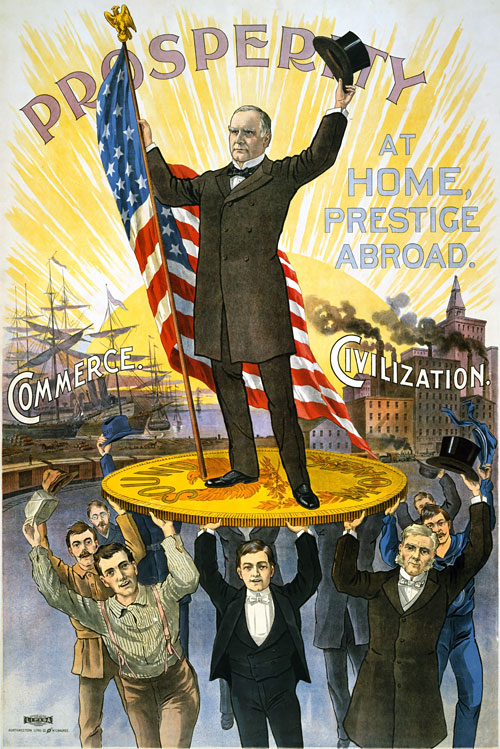
A 1900 poster shows President William McKinley campaigning for the maintenance of a gold standard for the dollar, which he said gave Americans prosperity and prestige. Although the United States later left the gold standard, its currency has been the world's default currency since the end of World War II. The historical debate over how to value world currencies has again heated up. And recent currency manipulations aimed at mitigating the economic downturn have led to warnings of the onset of currency wars.
In October 2010, the Brazilian Finance Minister made news by claiming an 'international currency war' had broken out. The term 'currency war' promptly became a buzz phrase with commentators and public officials warning about the dangers of these wars and their historical roots in the Great Depression. The U.S. government, in turn, has applied the idea to China, which it has accused of currency manipulation for the better part of a decade. So why does this matter? And how unusual is this all? This month, historian Steven Bryan puts currency wars in historical perspective and reminds us that currency policy is inextricably linked to national interests and that manipulation is the historical norm, not the exception.
Readers may also be interested in these two 1993 Origins articles on Global Monetary policy: International Monetary Policy: From a Fixed to Uncertain Future (PDF File) and Less Bang for the Buck: U.S. "Dollar Weapon" Policy in Historical Perspective (PDF File).
In October 2010, the Brazilian Finance Minister Guido Mantega made news by claiming an "international currency war" had broken out.
According to Mantega, countries worldwide were simultaneously attempting to force down the value of their money in order to reduce the price of their products sold in foreign markets.
Central banks in Japan, South Korea, and Taiwan had recently intervened in currency markets to control their currencies' appreciation. The Bank of England, similarly, had encouraged the pound to fall since 2008. The Swiss National Bank had intervened in foreign exchange markets as well.
For Mantega, such maneuvers signaled that these and other countries were entering into a competitive spiral of devaluations in an effort to export their way out of the ongoing economic slump.
And the inescapable conclusion for him and other finance ministers was that no country could gain if all countries devalued their currencies at once. They feared that such fiddling with currency would only serve to damage those countries most dependent on exports (such as Brazil), and increase political tensions worldwide.
The term "currency war" promptly became a global buzz phrase. Commentators and public officials—like Dominque Strauss-Kahn, the head of the International Monetary Fund, and his counterpart at the World Bank, Robert Zoellick—warned about the dangers of conflicts over money. Such wars, they argued alarmingly, had proven disastrous historically and, most chillingly, had worsened, if not actually caused, the Great Depression.
Despite the hyperbole, currency wars as described by Mantega--where the world's leading economies race together to depreciate their currencies--are, in fact, exceptionally rare historically.
Currency manipulation and selective devaluations to promote exports, growth, and employment, however, are not. Nor are the fears of established economic and political powers that perceived up-and-coming rivals will unseat them from their economic thrones.
Since the end of World War II, the United States has enjoyed the "exorbitant privilege" (in the words of France's 1970s President Valery Giscard d'Estaing) of having the dollar as the world's default currency. And the U.S. government has held the position that it is the responsibility of other countries to adapt to the perceived needs of the United States, rather than vice versa.
As the then Secretary of the Treasury John Connally famously put it to European officials critical of the inflationary effects of U.S. currency policy on their own economies in the early 1970s, "The dollar is our currency, but your problem."
International tensions surrounding currency competition, and the dollar's privileged status, were apparent at the G20 Summit in Seoul in November 2010.
In advance of the summit, the U.S. central bank--the Federal Reserve--announced that it would be purchasing government bonds in a maneuver called "quantitative easing."
This policy entailed multiplying the number of dollars in circulation in order to buy these bonds, with an end result of depreciating the dollar relative to other currencies. It also meant that excess dollars would likely flow to foreign markets such as Brazil, China, and Korea adding to price inflation and financial instability in those countries unless they acted to block the inflows.
In addition, the Obama administration hoped to use the Seoul G20 Summit to wage its own form of "currency war" by applying pressure on China to increase the value of its currency--the renminbi--and thus, indirectly, cause the dollar to depreciate. The U.S. has long argued that China itself was a currency warrior, which had fired the first shots in the money wars by consistently undervaluing the renminbi.
Rather than addressing this highly sensitive political issue directly, the U.S. administration sought to establish new international rules requiring countries to limit their trade surpluses.
Effectively such rules would mean that surplus countries like China would have to institute policies to cause their currencies to appreciate relative to the dollar. American officials hoped that this would increase U.S. exports, growth, and employment without the United States having to make economic or budgetary changes of its own.
The idea that other countries were to be charged with ameliorating conditions in the United States has been at the heart of U.S. international currency policy since the 1960s. In particular, it mirrors American proposals concerning its trade deficits with Japan in the 1970s-1990s.
Not surprisingly, the U.S. proposal went nowhere in Seoul. Countries ranging from Germany to Brazil denounced the effects on their own economies of the Fed's quantitative easing and dollar depreciation. Chinese officials joined in, short-circuiting U.S. efforts to build consensus on pressuring China.
But, in the media and political parlance, here were the rumblings of the onset of a global currency war.
The Appeal of Depreciation
Historically, depreciating one's currency relative to other countries has been a standard tool in seeking to promote economic development.
This was true in the late-nineteenth century when the rising powers of the age--such as Germany, Japan, Russia, Argentina, and the United States--sought currency systems most favorable to exports and domestic growth. It was true in the 1970s and 1980s when the United States devalued its currency relative to Japan and West Germany. It is true today when China intervenes to keep its own currency from appreciating.
In broad strokes, depreciating currency aids exporters--and industries that rely on exports--by decreasing prices of exported goods in foreign currency. Depreciation also makes goods imported from foreign countries more expensive in local currency, thus discouraging the purchase of those goods from abroad.
There are copious examples of the negative economic effects when money appreciates in value. Appreciating currency, which damaged exports, helped spark the economic crises in Thailand and the rest of Asia in the late 1990s and Argentina in the early 2000s.
Various studies have found that currency appreciation played a role in Japan's "lost decade" of the 1990s (either by itself or by prompting Japanese attempts to combat appreciation that, in turn, led to Japan's asset bubble of the late 1980s and the subsequent bust). Rapid appreciation of the yen relative to the dollar since late 2008 has exacerbated the effects of the global economic crisis for Japanese companies and industries relying on exports.
Today, countries on the periphery of Europe have found themselves constrained by a euro that was designed for the German economy and is currently too strong for these countries to expand exports and bolster their economic growth. Indeed, countries such as Spain, Ireland, Portugal, and Greece have found their ability to re-inflate their economies in response to the current financial crisis limited because, as members of the euro zone, they have been unable to devalue their currencies. [Read here for more on the euro in the Czech Republic and Slovakia]
Similarly, in the 1930s, many countries, in Europe and elsewhere, found themselves having to take austerity measures that only worsened their ongoing depressions in order to support fixed exchange rates with gold.
The more important exports are to a given country, the more damaging currency appreciation can be. Brazil, which relies heavily on exports, has seen its currency, the Real, appreciate by some 40% over the past two years. Brazil has also seen its exports contract at the same time that the appreciating Real has attracted inflows of foreign capital, adding to fears of financial instability and inflation. It is thus not surprising that it has now begun to implement new reserve requirements, taxes on foreign exchange transactions, and other measures meant to stop the Real's appreciation. [Read here for more on the recent history of Brazil.]
Appreciation and depreciation work a little differently for the United States, which saw its manufacturing jobs largely shipped overseas in the 1980s and 1990s. There, the issue of currency values is more one of political optics than a matter of economic life or death. [Read here for more on the impact on Detroit of this export of manufacturing jobs.]
Past appreciation of China's currency has had little effect on U.S. exports. In China, most U.S. products compete against European or Japanese ones meaning exchange rates with the euro and yen are more important.
There are also relatively few Chinese and American products that compete against each other in third countries. The two countries simply produce different goods. And, if U.S. firms decide to move their factories from low-wage China, they are more likely to go to lower wage Southeast Asia than they are to return the United States.
But as a matter of U.S. politics, it is easier to criticize China and Chinese currency policies than it is to criticize the management of Apple, General Electric, or Hewlett Packard for manufacturing in China, retailers such as Wal-Mart for selling products manufactured in China, or American consumers for ultimately buying those products.
The issue of China's currency has assumed nationalistic importance, then, even if its economic importance for the United States is marginal.
What the United States has been calling China's "currency manipulation"--fixing the value of its currency to the dollar as countries in Latin America and Asia regularly did in the 1990s--has become a symbol for Americans of a strategic threat from China, which refuses to play by American rules or, more fundamentally, might become economically stronger than the United States.
Barack Obama's use of the phrase "Sputnik moment" in his January State of the Union address none too subtly portrays contemporary China as analogous to the Soviet Union of the 1950s.
The Historical Normality of Strategic Currency Policy
Competitive devaluations were around long before the phrase "currency war" popped up last October.
Since the onset of the modern, global economic system, states have regularly intervened in currency markets. Individual nations have manipulated their currencies (and where possible those of other nations) to gain competitive advantage over others. Some ideal "free market" in currency--untouched by government interference--has never truly existed.
Such currency engineering has come in many forms. It may be as simple as the repeated statements from American officials in the 1990s that they favored a strong dollar, thus making clear to those around the world that the United States would view appreciation of the dollar favorably. Just as currency depreciation helps ease deflation and recessions, currency appreciation can help keep domestic inflation in check.
More commonly, though, currency intervention aims to cause currencies to depreciate and means central banks selling domestic currency and purchasing key foreign currencies.
States may also take steps similar to those recently taken in Brazil, Korea, and China to impose reserve requirements, transaction taxes, or other restrictions on currency speculation. Shortly after Dilma Rouseff's inauguration as Brazil's new President in January, for instance, the Finance Ministry under Mantega announced new reserve requirements meant to control the Real's appreciation.
Prior to the nineteenth century—with the formation of modern nation states and national currencies—currency exchange worked quite differently from today and in a much less systematized manner, with a reliance on precious metals to back the value of currency.
Before the nineteenth century, it was typical to have transnational currencies whose value depended on the amount of gold or silver they contained. Trade in East Asia was fueled in part by silver coins from Mexico. Prior to the Meiji Restoration of 1868 in Japan, a variety of currencies from Asia and Latin America circulated within Japan. The early United States had no centralized currency, with private banks emitting their own currencies.
The global monetary system experienced some standardization with the advent of the "gold standard," in which countries fixed their exchange rates to a given amount of gold. This meant that their national currencies were thus indirectly fixed relative to each other.
Britain started using a gold standard after the Napoleonic Wars in the early 1800s. Germany, France, and other European countries followed in the 1870s and 1880s. And by the 1890s and early 1900s, countries worldwide began pegging their currencies to gold as well.
This latter period is commonly called the classical age of the gold standard. It has also been called a first age of globalization, with the gold standard being a largely market-based system free from the state control of later years.
Notably, this pre-World War I era of currency is the image that today's opponents of the U.S. Federal Reserve System, such as Representative Ron Paul, advocate for the contemporary United States to (re-)adopt private currencies as needed with the government having no power to print, regulate or define those currencies.
"End the Fed" advocates like Paul have tended to look to the classical period of the gold standard as an ideal system of state-free, inflation-free, automatic, natural money. For them, gold has an intrinsic value that makes it uniquely resistant to political interference.
Some observers and analysts from the nineteenth century onward have agreed. For the strongest advocates of gold currency, gold has consistently been the only "true and universal money" whose value was set by nature, and whose worth was beyond government control. In November, the World Bank President Robert Zoellick started a minor controversy by seeming to call for some sort of modified gold standard.
But if this true and universal money of "Paul-ite" dreams ever existed, it was certainly not in the nineteenth century, and certainly not with the gold standard. Despite the attention currently paid to the presumed danger of competitive depreciations, the world economy of the late-nineteenth century was founded on similar currency policies and concerns.
To use the present-day terminology, the gold standard, as it emerged worldwide in the 1890s, was itself a tool of currency wars.
The gold standard, in its late nineteenth century glory days, was founded upon and operated by states seeking to work the system to their advantage. These states manipulated interest rates to control currency flows, and strategically adopted gold as part of industrial development and military calculations aimed at assuring the most favorable currency and exchange rate for their endeavors.
Argentina, Japan, Germany, Russia, the United States, and other countries that rose to power in the years before World War I, for example, followed currency policies similar to those of supposed currency warriors today. Rather than allying themselves with dominant, but fading British power, they used the gold standard to challenge that power.
Economically, these countries sought to lock in the most depreciated value possible for their currencies in order to promote industry and exports. Politically, they sought to use the gold standard to increase access to foreign loans for their military purchases.
At mid-century, the ideology of English liberalism dominated global economic thinking with ideas of an automatic, laissez-faire gold standard and a flurry of free-trade agreements.
However, all those countries striving to compete with the British began consciously to follow a developmental strategy advocated originally by Alexander Hamilton in the United States and Friedrich List in Germany. This strategy focused on government intervention in currency and other economic matters in an effort to build each state's economic might and wealth. This approach became dominant worldwide in the late-nineteenth century.
By the late-nineteenth century, in the face of a severe U.S.-European economic depression from the 1870s, the liberal orthodoxy had fizzled. Depression and deflation from the mid-1870s to the 1890s made economic growth and an end to deflation the dominant economic concern. In most countries, this meant a wide range of government measures to keep their currencies from appreciating.
It was common in the last quarter of the nineteenth century to find claims from American and European economists and politicians that currency appreciation was "one of the worst evils that can threaten humanity," that it spelled "ruin for the industrialist, misery for the worker, discontent and universal suffering," and that it would "bury the nineteenth century in a tumult of poverty and make felt in the cradle of the twentieth the heavy hand of paralysis."
This concern about appreciation was particularly acute in those countries already using appreciated gold currency--that is, amongst countries on the gold standard. French textile manufacturers and silk producers sought protection from lower-priced thread from Japan, which backed its currency with silver.
In the United States farmers and miners found themselves at a price disadvantage against the weaker currencies of non-gold standard countries such as Argentina, India, Brazil, China, and Russia.
Mixed in were also racial fears—particularly of the presumed danger of Asian immigration, the "yellow peril," and the threat this Asian encroachment was seen to pose to the Anglo-Saxon way of life.
Concerns about "unfair" Chinese currency were common. As Winston Churchill's uncle put it, "The yellow man using the white metal [silver] holds at his mercy the white man using the yellow metal [gold]."
Critics of a gold standard, therefore, saw in silver a way of keeping the United States and its currency competitive globally.
Concern with deflation and its economic and social effects helped fuel the rise of the Populist Party in the United States and the takeover of the then pro-banker, pro-hard money, pro-gold standard Democratic Party by William Jennings Bryan and his silverite supporters.
The silver movement dominated American politics in the mid-1890s with Bryan declaring that mankind would not be "crucified on a cross of gold." It also made its presence felt in children's literature with the Kansas populist L. Frank Baum writing The Wonderful Wizard of Oz as an allegory of silver politics, with the yellow brick road symbolizing the gold standard.
Even with this emphasis on depreciation in adopting the gold standard, states continued to tweak its workings to serve their needs. Rather than letting gold flows move purely pursuant to private market forces, nations such as Britain increased or decreased their interest rates in order to attract or repel gold.
In Argentina, the government exchanged paper for gold when it had gold, and ignored its currency's supposed convertibility into gold when it had none. Beyond fiddling with their currencies, states in the late-nineteenth century built tariff walls and otherwise sought to protect their developing industries.
Currency Wars and the Great Depression
The one example that contemporary commentators tend to give as a warning about the dangers of an actual currency war happened in the 1930s during the Great Depression.
Commentators argue that the simultaneous and at times rapid devaluations of the 1930s, which aimed to boost economic growth, actually worsened or even caused the Great Depression.
At the same time, the Great Depression has been attributed inaccurately to trade protectionism. Despite being refuted again and again by economists and historians, this cautionary myth about free trade nonetheless remains popular.
Quite the opposite was the case, however. The currency war of the 1930s was the start of recovery from the Great Depression.
Economic historians have regarded devaluation and abandonment of the gold standard in the 1930s as essential to allowing countries to re-inflate their economies. Only after countries began to devalue their currencies did they gain the expansionary and inflationary benefits that helped pull them out of the Depression.
This is precisely what Spain, Portugal and other peripheral European countries are unable to do today because their policies are restricted within the larger currency policies of the European Union and the euro.
Exorbitant Privilege: The Dollar after World War II
The principle behind currency wars—i.e., the strategic use of currency for national ends, economic and political—has continued at the heart of the international monetary system since World War II.
In 1944 the Allied powers signed the Bretton Woods agreement establishing a "new international monetary order" of fixed exchange rates, modeled on the gold standard but intended to be more flexible and lasting. Though ostensibly based on gold, it was really a system based on the U.S. dollar, tailored to U.S. needs, and intended as a centerpiece of what Time magazine publisher Henry Luce called "the American century."
The British sought an alternative system that relied on a new international currency unit rather than the dollar, but lacked the political, military, and financial power in the wake of the war to alter American preferences.
The French, split between one government essentially allied with Germany and another powerless and in exile in London, played virtually no role until the 1960s when they attempted, unsuccessfully, to switch the system to a purer gold standard rather than a U.S. dollar standard that gave the U.S. sovereign control over the world's default currency.
With the help of two World Wars the dollar obtained the "exorbitant privilege" of being the world's default currency. The United States also gained the privilege of having the rest of the world adapt not only to its currency, but to its broader economic needs and desires.
When Bretton Woods no longer proved conducive to U.S. interests, the Nixon administration abandoned it in the early 1970s and ushered in the current era of floating, market based exchange rates with periodic interventions by states and central banks.
Dollar Wars: From Japan to China
If today the focus of most currency discussion in the U.S. is China, in the 1980s the focus was Japan. And today's tensions with China in many ways mirror those earlier ones with Japan.
Then as now, the United States was running a sizeable trade deficit with an Asian rival and accusing it of unfair trade practices, of closing its markets to U.S. goods and businesses, and of currency manipulation.
Under U.S. pressure, the Japanese government agreed to restrict exports to the United States and to change Japanese laws and business practices to accommodate American firms. Japan also agreed to loosen its monetary policy in order to increase domestic consumption--which U.S. officials imagined would mean greater consumption of U.S. goods--and to deregulate its financial and legal markets to accommodate U.S. firms.
The Reagan administration also engineered the 1985 Plaza Accord under which the United States, France, Britain, and West Germany spent the equivalent of $10 billion in order to depreciate the U.S. dollar and reduce the U.S. trade deficit.
The dollar did depreciate: some 54% against both the yen and the mark over the next two years. But this did little to reduce the trade deficit with Japan since the U.S. had few competing products to replace Japanese goods—just as there are few competing products with China today.
In Japan, however, the regulatory changes and low-interest-rate policy that followed the Plaza Accord led to the financial and real estate bubble from which Japan has spent the past twenty years trying to recover.
In short, the Plaza Accord amounted to its own sort of currency war. If the United States won relatively little, the clear loser was Japan.
In China today, this episode is viewed as a cautionary tale, and its moral is not to make economic policy changes in response to foreign pressure. History has taught the Chinese that it is more important instead to promote one's own needs and interests.
Japan's economic pliancy ultimately rested on the particular history of World War II, the U.S. Occupation, and Japan's incorporation thereafter into a U.S. security sphere.
In short, since World War II Japan has been reluctant to assert independent policies vis-a-vis the United States given the importance to Japanese governments of the American security alliance. Japan ultimately avoided conflict with the United States by placing its security alliance first and conceding to U.S. economic demands.
Domestically for Japan, preserving the U.S. alliance has been simpler and less controversial than revising the Occupation-era constitution and pursuing independent military and foreign policies. In effect this has meant that Japanese economic policy, as far as it impacts what U.S. governments consider their strategic interests, has been subject to U.S. approval. [Read here for more on post-WWII Japan PDF File]
For China the history is different. China is neither a U.S. military protectorate, nor does it wish to be. As a result, to date, the Chinese government has followed the late-nineteenth-century model of adapting international norms and institutions to its own needs and interests. Currency policy is one part of this approach.
In this sense, China's actions today resemble what the United States has done over the last 150 years and more.
A real currency war, if it ever comes, can only happen when, or if, the renminbi, euro, yen or some other currency is strong enough fully to challenge the dollar's "exorbitant privilege." That, however, as with currency policy in general, is as much a political issue as an economic one.
* * *
For more on the history of currency exchange and the gold standard by Steven Bryan, see his The Gold Standard at the Turn of the Twentieth Century: Rising Powers, Global Money, and the Age of Empire(Columbia University Press, 2010).
Liaquat Ahamed, Lords of Finance: The Bankers Who Broke the World, New York: Penguine, 2009.
Paul De Grauwe, The Economics of Monetary Union, Eighth Edition, Oxford: Oxford University Press, 2009.
Barry Eichengreen, Exorbitant Privilege: The Rise and Fall of the Dollar and the Future of the International Monetary System, New York: Oxford University Press, 2011.
Barry Eichengreen, Globalizing Capital: A History of the International Monetary System, Second Edition, Princeton: Princeton University Press, 2008.
Barry Eichengreen, Golden Fetters: The Gold Standard and the Great Depression, 1919-1939, New York: Oxford University Press, 1992.
Luca Einaudi, Money and Politics: European Monetary Unification and the International Gold Standard (1865-1873), New York: Oxford University Press, 2001.
Marc Flandreau, The Glitter of Gold: France, Bimetallism, and the Emergence of the International Gold Standard, 1848-1873, New York: Oxford University Press, 2004.
William Grimes, Currency and Contest in East Asia: The Great Power Politics of Financial Regionalism, Ithaca: Cornell University Press, 2008.
Eric Helleiner, The Making of National Money: Territorial Currencies in Historical Perspective, Ithaca: Cornell University Press, 2003
Eric Helleiner and Jonathan Kirshner, eds., The Future of the Dollar, Ithaca: Cornell University Press, 2009.
David Marsh, The Euro: The Politics of the New Global Currency, New Haven: Yale University Press, 2009.
Ronald McKinnon and Kenichi Ohno, Dollar and Yen: Resolving Economic Conflict between the United States and Japan, Cambridge, MA: MIT Press, 1997.
Mark Metzler, Lever of Empire: The International Gold Standard and the Crisis of Liberalism in Prewar Japan, Berkeley: University of California Press, 2006.
Hugh Rockoff, "The Wizard of Oz as Monetary Allegory," Journal of Political Economy, 98, 739-60, 1990.
Robert Skidelsky, John Maynard Keynes, Vol. 3: Fighting for Freedom, 1937-1946, New York: Viking, 2001. (The original subtitle "Fighting for Britain" was changed for the American edition)


