
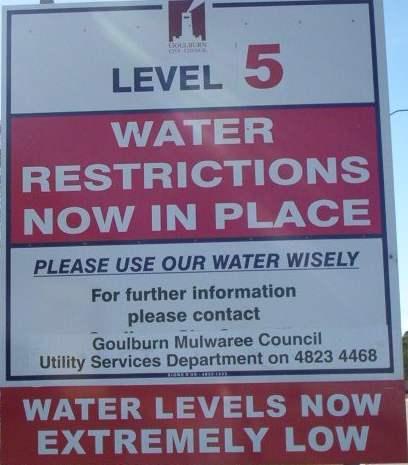
A sign illustrating Level 5 Water Restrictions in Goulburn, New South Wales, 2006, during the worst of Australia's decade-long drought. Australia's unique rainfall patterns and long history of human transformation of water combined to produce the "Big Dry," and Australians continue to struggle over how to respond to the challenge that repeated drought poses to their future.
For several years now, Australia, the driest inhabited continent, has been suffering perhaps the worst drought in its recorded history. Amidst disappearing rivers and empty dams, farmers have watched their fields go barren and their livestock perish, while urban dwellers face greater and greater restrictions on water use. Terrible wildfires have swept through the country, scorching millions of acres of land. The drought is challenging Australians' very idea of who they are as a people and their faith in the future. Australia is hardly alone with these problems, as much of the globe struggles with insufficient, polluted, oversubscribed, and increasingly expensive water. How successfully Australia responds to its current water woes will offer an important road map for others around the world. This month historian Nicholas Breyfogle puts the current Australian drought into historical perspective.
Readers may also be interested in these recent Origins articles on The Global Food Crisis, The Debate over Indian Population, Fishing and Over-Fishing in American Waters, and the Cane Toad in Australia.
The author would like to extend his deep thanks to Carmela Kiraly for her invaluable research assistance, David Bernstein, and to Jan Gothard and the participants and hosts of the 2009 CIEE International Faculty Development Seminar, "Water and Climate Change: The Reefs and Waterways of Australia."
UPDATE: This article was updated on January 26 2011 (click here to read the update)
Australia has water troubles.
For at least the past nine years, the people "down under" have been experiencing perhaps the worst drought of their history, the "Big Dry," as they're calling it.
The drop in rainfall and river flows has been most severe in the southern and eastern states (Victoria, New South Wales, South Australia, and parts of Queensland), which happen to house the majority of Australians and also the country's major agricultural centers. Dry days—dry decades, in fact—are also dogging Western Australia's major city, Perth.
Australia, with its approximately 22 million people, has by some estimates the planet's 15th largest economy. But the current drought has abruptly reminded Australians of the limits that natural resources and climate place on human activity.
Although rains this past winter have done their part to mitigate the worst of the drought, over the last decade city residents have been placed on stringent water-use restrictions in an effort to reduce daily consumption: gardens have gone unwatered and people showered with buckets to catch the water for other uses.
Even with the strictest of limitations in place, the threat that the water could run out confronted each of Australia's cities. In 2007, word in Brisbane was that without sufficient rain, the city would run dry in 2009. The same year, the people of Adelaide were told that "critical human needs" might not be met in the future.
To make matters worse, thirsty animals have been barging their way into human settlements. Snake bites are on the rise in Victoria and New South Wales as venomous snakes across southeastern Australia have slithered to urban areas in search of water. In November 2009, about 6,000 camels overran the outback town of Docker River in the Northern Territory (pop. 350) in search of water, head-butting water tanks, trampling fences, and licking water from air conditioning units.
If the urban areas have found their lifestyles cramped, the agricultural sector has been devastated by the drought. Irrigation farmers who specialize in "thirsty" but highly profitable crops like rice and cotton have been especially hard hit.
By 2008, rice growing came to a standstill, falling 98% across the country. The rice mill in Deniliquin (New South Wales), which alone used to produce rice for as many as 20 million people around the world, shut its doors. The result was a global shortage, with world rice prices doubling and violent food protests erupting across the globe.
Pastoral livestock farmers have also suffered. "I can't stand lying in bed every night and hearing the cattle bellow from hunger," lamented dairy farmer Malcolm Adlington in 2009 to a National Geographic reporter.
Not long ago, Anna Creek in South Australia was home to the planet's largest cattle station—24,000 square kilometers, larger than Israel—but now there are few cattle left. Most have been sold off, but carcasses of the less fortunate dot the landscape.
And the price tag for this agricultural breakdown has been high for the Australian government: several billon dollars in drought relief to rural areas since 2001.
To make matters worse, Australia's fragile ecosystems are also in crisis. The most important river system, the Murray-Darling Basin (MDB), is suffering severe environmental distress. The Basin covers 14% of Australia and produces 40-45% of all of Australia's agriculture (A$14 billion/year).
All through the catchment, wetlands have disappeared to disastrous results. Today, 75% of the long-lived, majestic River Red Gum trees are considered dying or stressed, and the birds and fish that relied on the river's water to breed are failing.
In recent years, as more and more water has been diverted for human usage, the Murray has dried up before reaching the sea. The extreme drop in fresh water has raised the salinity levels of the vibrant coastal ecosystem known as the Coorong and two nearby lakes, Albert and Alexandrina. Wholesale changes in flora and fauna are underway and, in the case of Albert, the receding water has exposed acid sulphate soils to the air producing poisonous sulfuric acid across large segments of the dry lakebed.
The drought, along with record high temperatures and strong winds, has also helped to spark bushfires. Black Saturday (February 7, 2009) saw ferocious wildfires tear through the state of Victoria, killing as many as 200 and reducing more than a million acres to ashes. It was Australia's worst peacetime disaster.
And the wildfires will make the drought worse. The new trees that grow up in the place of the burned-out forests require more water to thrive than do mature ones. With more of the precious rainfall diverted directly into the roots of these young saplings, there is less that flows into the rivers to then be used by humans, animals, and plants downstream. Like much in nature, the drought is a self-reinforcing event.
How, we should ask, has it come to all this?
Australia's water woes are, in part, a result of natural climate and hydrological rhythms that have characterized the continent for millennia (although transformed of late by climate change).
They are also the result of significant human meddling in the environment that has taxed the country's water and ecological systems to the point of collapse. Human transformations (especially through river regulation and irrigation) have intensified the extent of the drought while limiting the choices Australians have to alleviate its worst effects.
Australia is hardly alone in their water troubles. Much of the planet finds itself these days confronting serious water issues of one sort or another. In this way, Australia is likely to play the role of canary in the coalmine. The successes and failures of Australians to confront the Big Dry will be lessons that the rest of the world will ignore at its peril.
"A Sunburnt Country …. Of droughts and flooding rains"
Australia is no stranger to drought, as these words of 19th-century poet Dorothea Mackellar remind us. It is the driest inhabited continent (only Antarctica receives less annual rainfall) and the current drought is explained in great part by the cyclical (if unpredictable) rainfall patterns that have long typified Australian weather.
Droughts affect parts of Australia every few years and major droughts come at least once per generation. The Big Dry is one in a long series.
The Federation Drought (1895-1903)—so named because it coincided with Australia's birth as an independent and united nation—has long been considered the worst in Australian history. By 1902, Sydney's water supply was running out, and the New South Wales government declared a day for "humiliation and prayer" to bring rains. The number of sheep in the country was cut in half—from 91 million to 54 million—and almost 5 million cattle died. In 1903, horrifying dust storms raged.
Similar major droughts ravaged the landscape during the 20th century: in 1911-16, 1939-45, 1958-68, 1979-83, and 1997-98.
Australia is also no stranger to floods. Seasonal flooding causes as much as A$400 million a year in damages, and major floods appear on a regular basis. Just this March, southwest Queensland experienced its worst flooding in a century.
Between droughts and floods, one of the most defining characteristics of Australia's climate and hydrologic structures is the extreme variability of rainfall: from year to year and seasonally.
Scientists generally argue that Australia's cycle of boom and bust rainfall is the result of processes in the neighboring Pacific, Indian and Southern Oceans.
In particular, weather patterns in the South Pacific are crucial to the continent's climatic fortunes, especially El Niño events (which appear every 2-7 years and bring drought to southeastern Australia) and La Niña (rains and floods). Variations in air pressure in the tropical western Pacific (measured by the Southern Oscillation Index) and differences in sea temperature in the Indian Ocean (the Indian Ocean Dipole) are also driving forces of Australia's weather.
Australia is also characterized by high regional variation of rainfall, with 25% of the landmass receiving 75% of the precipitation. In fact, Australia has more water per capita than any other continent, but it all tends to come in huge batches and to land in parts of the country that are relatively unpopulated.
Australia is subject to significant drought for other reasons, including its latitude (with much of the country lying in the extremely dry belt between 15 and 35 degrees south of the equator) and its relative flatness (which means less rain and higher rates of evaporation).
Importantly too, Australia has the lowest run-off of any continent—that is, the lowest percentage of rainfall that actually makes its way into rivers, lakes, and other freshwater bodies: only 10% on average, compared to approximately 52% in North America, 48% in Asia, 39% in Europe, and 38% in Africa.
"Water Dreamers"
Yet, for all the variability built into Australia's climate and its propensity for drought, the current dry period is not simply an outcome of the continent's cyclical climatic patterns of wet and dry. It is also the result of what European settlers have done to transform and extensively regulate Australia's water flow since the First Fleet sailed into Sydney harbor in 1788. Through their history, Australians have often been, in the insightful phrasing of historian Michael Cathcart, "water dreamers."
The story of water during the opening days of Sydney's history unveils a pattern that has characterized much of Australian history since: the repeated, often desperate search for sufficient water; the enduring hopefulness that each new water source or hydro-engineering feat would "solve" the water problem; the boundless faith that they could make bounty pour forth from even the most arid lands; the ruination of ecosystems in the effort to redirect water; exploding costs for water projects that often produced unexpected and unwanted consequences; and tensions between private corporations and government officials, and between Europeans and Aboriginal peoples.
Over the centuries, animals and plants in Australia adapted to the arid, boom-bust cycles. The Aboriginal peoples—who arrived in Australia some forty to sixty thousand years ago—also developed their social, economic, migratory, and religious activities around the natural cycles of wet and dry.
By contrast, the Europeans who arrived in Australia were wetland people, and they had a hard time making sense of Australia's particular climate and hydrology. Instead of the water systems that they knew from Europe, they found "rivers that spread out into swamps then disappeared into huge reed beds; rivers that dried out, that went underground then reemerged further down the river bed; rivers that were salty; rivers that were chains of ponds; rivers that consisted of dry, sandy beds," as journalist Åsa Wahlquist has written.
The initial water supply in Sydney, the Tank Stream, quickly became a site of contention—and disastrously polluted—as local elites built houses next to the stream, into which they poured their sewage and the run-off from the pigs in their yards and their tanneries and other manufactories.
Those who could afford it paid water carters a handsome price to lug water for them from swamps at some distance from the settlement. As the water carters served primarily the rich, and any drinkable water became scarcer, local society came to argue that government authority needed to intervene to ensure water for all.
They turned to water sources farther afield. First came the Lachlan swamps about three kilometers from Sydney. Local officials planned to pipe water from the swamps to a central holding tank from which they would run water into the center of Sydney. Convicts were put to work building the water tunnel in a project that took substantially longer and cost a great deal more than planners had anticipated. Ultimately, the water was quickly squandered. No gate was included at the terminus, so the water simply poured out onto the streets. And very soon the swamps began to dry up, ending the water source and destroying the local ecology in the process. Then Sydney turned to the Botany swamps, with similar results.
The taking of these waters worsened already tense relations with the Aboriginal Cadigal people who had relied on these same waters for generations, and for whom the draining of marshes and the felling of trees was a spiritual and cultural affront as well as a threat to their existence.
The Water Seekers
Very soon after the initial Sydney settlement, the anxious if ever hopeful search for water intensified in scope. Through the early nineteenth century, there were a series of explorations—highly publicized, well funded, and ultimately fruitless—sent into the interior of Australia in search of a great river or an inland sea that would be the salvation of Australia.
Even in the face of thirst-induced deprivations, delusions, and occasionally death—and all manner of physical evidence to the contrary—these water explorers maintained a powerful, self-deluding optimism that the great river was just around the next corner (or over the next dune). Somehow or other the dryness would be conquered and a prosperous Eden would be created. The question was not if but when and how.
Leading Australians believed that if only a major river could be found, then the inevitable Golden Age of Australia would be attained. And they felt sure one must be out there. America had its Mississippi; Brazil its Amazon; China its Yangtze, how could it be possible that a continent as large as Australia would not have a similar river?
The absence of such a river, and the Europeans' inability to master Australia's waters, became linked in their minds with concerns about their colonial mission. Failure to find water, and failure to put this water to productive use, would entail a failure of Europeans to "civilize" the new continent. It would leave open the discomforting question—were they no better than the Aboriginal peoples who they chastised for not having developed "civilized" agricultural communities?
The line beyond which
The growth of Australia's population over the first half of the nineteenth century increased the demand for agricultural land, forcing Australians to confront the environmental limitations of their new continent. The battle between water idealists and realists was soon engaged.
During the drought of 1865, the Surveyor General of South Australia, G. W. Goyder, took extensive surveys of the native vegetation near Adelaide and determined a geographic line north of which it was no longer safe to practice agriculture.
In 1872, all land south of Goyder's line was officially opened to settlement, but the demand for land soon outstripped all good sense. Several very wet years in the 1870s lead settlers to push north, following the mantra that also helped propel people further West in the United States: "rain follows the plow." The government encouraged these people on. Goyder was ridiculed.
The drought years of the late 1870s and 1880s put an end to those dreams. The farmers packed up and moved south and east again, leaving behind ruined homesteads and ghost towns as monuments to their hopefulness and unrestrained confidence.
Their memory was short, however, and already by 1900 settlers had again moved their way north of the line, with predictable results of crop failure and destitution when the drought of 1914-17 hit. This time, however, the government stepped in to keep the farmers on this dubious land. The political pressures to find land for the growing population far outstripped the actual realities of sustainable crop cultivation.
The Engineers of Nature
As the dreams of the great inland river or sea desiccated in the failures of the Australian explorers—and as the truth of Goyder's line was made manifest—nineteenth-century advances in hydro-engineering once again fueled the Australian optimistic imagination and breathed new life into the water dreamers.
If an Australian Mississippi was not forthcoming, hope could be found in artesian groundwater and in the huge promise of irrigated agriculture.
Both of these required new technologies—machines to bore the ground for water and to build the dams and pipe systems to hold the water for irrigation—and trained engineers who would become the new high priests of nature change.
In these years, there was unlimited optimism in Australia that with these technological tools humans could transform and improve on what nature had provided. All too often, Australians believed, nature was inefficient and wasteful. Water often came at the wrong time, in the wrong quantities, and in the wrong places. Water that flowed through rivers to the sea was wasted. Every drop could and should be harnessed to human use. Droughts could be ended and floods controlled.
Artesian Waters
Over the nineteenth century, European settlers in Australia had noticed waters occasionally bubbling up from the ground—or more commonly had been led to these waters by Aboriginal guides. Now, with new drilling technologies coming in from Europe, the prospect of "unlimited" underground water gripped the settler community.
When drillers bored near Bourke in New South Wales in 1878, they stumbled upon the Great Artesian Basin, one of the largest groundwater supplies in the world (around 15,600 cubic miles of groundwater), which had been accumulating for millions of years. By 1915, more than 1,500 bores had been sunk in the Basin. The water flowed freely and seemingly endlessly, "bringing hope and comfort to the thirsty land again," as the famous bush poet Banjo Paterson wrote in his "Song of the Artesian Water."
Artesian waters opened thousands of square kilometers of arid, unproductive land for livestock. Adelaide, which had all but destroyed its nearby water supplies, was saved in the late 19th century by artesian water.
Water into Gold: The Alchemy of Irrigation
The faith in the power of civil engineering and human technology to improve on nature and to bring bounty to the population was even stronger in the case of irrigation and dam building.
As the nineteenth century progressed, it was becoming clearer to many settlers that water would need to be stored and regulated if agriculture was to have a chance to flourish and urban areas to receive a consistent supply of water.
There were years when the rains came nicely and Australians "forgot" earlier dry spells, but the intense drought years of 1877 and the 1880s convinced Australian capitalists and officials of the need for large-scale irrigation and damming.
While the necessity to combat drought was a driving force, there were also social, non-environmental reasons to work towards irrigated agriculture. Irrigation would build a more prosperous, populous, and egalitarian future for Australia. Opening up more land to farmers meant more opportunity for the poor, unemployed, and those without land. It would also allow more people to move to Australia, which was deemed necessary to defend Australia and to prevent Asian migration. And, of course, it would make some people rich.
Irrigation work began in earnest in the late 1880s, encouraged by the example of California. It started as a self-consciously private-capital venture, but by the early 20th century, state authorities stepped in to bail out failing irrigation trusts and take control of the irrigation process.
Much of this change in the relationship between water, irrigators, and state governments came under the watch of American Elwood Mead who stood as chairman of Victoria's Rivers and Water Supply Commission (1907-1915) and later would go on to head the U.S.'s Bureau of Reclamation (1924-1936, during which he oversaw the building of such massive dams as Hoover and Grand Coulee). Mead set up government supervision of the irrigation system and focused the irrigators on high-yield crops.
By the end of World War I, the process of damming the crucial River Murray was underway, spurred on by the memories of the Federation Drought. The planned dams and weirs took the next couple of decades to complete, but the resulting irrigation brought rapid agricultural development to the Murray-Darling Basin. Previously arid lands turned into highly productive fields—and diverse and remunerative produce was not only consumed at home but sent to the world market. Faith in irrigation to transform the future of Australia into a golden age only grew. The water problem, it seemed in the early twentieth century, had been solved.
In 1937, for instance, to mark the 50-year Jubilee of the Australian Dried Fruits Industry, Ernestine Hill produced the unambiguously titled book, Water into Gold. The damming of the Murray and the irrigation of its surrounding land was not without its obstacles, but Hill described the process in unabashedly religious terms as a "miracle" carried out by "apostles."
"The River Murray to-day is a pageant of God's handiwork and man's," she acclaimed. "From the serenity of the snow mountains all the way to the Southern Ocean, the magic of irrigation has changed the face of Nature. There is a kingdom, a power and a glory of the Australia yet to be."
Not everyone climbed on the irrigation band wagon, however. Thomas Griffith Taylor, a professor of Geography at Sydney University after 1920, believed that large chunks of the continent were simply too dry for settlement, whatever the water boosters said. For Taylor, the "vast potentialities," that so many Australians saw in the arid lands, "only existed in the mind of the ignorant booster" who was mistaking "patriotism and rainfall."
This perspective was unwelcome, even unpatriotic, in Australia in the 1920s and his textbook on Australian geography was banned in Western Australia because he refused to take out the words "arid" and "desert" in describing Australia. As with Goyder before him, the dream of water repeatedly trumped the more sober and restrictive realities of hydrology.
A Country Dammed
Australia built three quarters of its more than 500 dams after 1945, decisively realizing the 19th-century dreams of hydrologic regulation. From the mid-1940s to the mid-1960s, Australia expanded by threefold the amount of its irrigated land. In the Murray and Murrumbidgee areas alone, the amount of land given over to irrigated rice cultivation increased from 15,000 to 110,000 hectares between 1950 and 1980.
The process of extensive water control and its development of agriculture in the Murray-Darling Basin has been a huge boon to the Australian economy. At their peak, these extensive irrigation works transformed 2.5 million hectares into some of the most productive land anywhere. In good years, Australia's 22 or so million people could produce enough food for 70 million people—and food exports became a cornerstone of the economy.
The Snowy Mountains Hydro-electric Scheme—one of the most remarkable feats of hydro-engineering in the twentieth century—now produces a significant component of Australian energy needs and directs more water into the River Murray.
By the 1980s, when dam building came more or less to a halt, the country's rivers and water systems had become among the most regulated in the world. In the Murray-Darling Basin, only the Paroo River remains uncontrolled by human hand. The Murray became so regulated as to prompt some people to question whether it could still be considered a river at all.
Making the Drought Worse: The Balance Sheet of Water Control
The regulated hydrological structures created by Europeans since their arrival in Australia, along with their boundless faith in human engineering solutions, have made the effects of the current drought a great deal worse.
In the use of extensive irrigation Australians have focused their agricultural activities on highly lucrative, "thirsty" crops that require a great deal of water to grow. (In 2005-06, for instance, cotton alone used as much as 20% of all the water in the Murray-Darling Basin.) In exporting some of these profitable agricultural products, Australia ships off millions of tons of virtual water (the amount of water required to grow a certain food or manufacture a certain good). In recent years, Australia has exported as much as 430,000 tons of butter, cheese, and milk powder annually—the equivalent of shipping off 5.5 billion liters of valuable water.
As a result, Australia finds itself in the paradoxical position of having the lowest stream flow of any continent at the same time that, because of irrigation, it has by far the highest per capita level of daily water usage.
In addition, the schemes of water control that developed over the twentieth century have exacerbated the effects of the Big Dry by producing what many scientists call a "double drought."
Take the River Murray as an example.
Through damming and irrigation, the natural seasonal flow of the river has been turned upside down. Before regulation, the Murray "was really two rivers, a full surging river in the winter rising to a swollen flood in the spring, and a gentle docile summer-flow when the floods receded," in the words on one resident of Albury in 1981.
After regulation, the Murray has a more consistent flow, but the more plentiful winter rains are now released into the system in summer in order to irrigate crops. This 180-degree hydrological switch has created a human-made drought for the river and its flora and fauna.
According to renowned water scientist, the late Peter Cullen, "Australian aquatic ecosystems are adapted to drought, but between natural drought and man-made drought we've stressed systems beyond their normal capacity." They no longer receive the quantities of water, in the same quality, and at the same times of year as they did in the centuries before recent regulation.
Water from the dams evaporates more quickly than it would flowing down the river, so the amount of water available after regulation has declined. Moreover, water quality has deteriorated as the reduction in water during the swollen months means that various salts and other nutrients are not washed out.
And the impact of this human-made drought extends far beyond Australia, especially for birds whose migratory patterns tend not to respect national boundaries. Australia is the breeding ground for birds from as far away as Siberia. The drying of floodplains and the elimination of the annual flood has meant hard times for these birds, which affects distant ecosystems as much as local ones.
The problems of the current drought for the environment around the Murray have been made worse by problems of over-allocation of water. By the 1980s, as much as 90% of the river's average annual flow was legally committed to human use (especially agriculture but also industry and human water supply). The remaining ten percent was hardly enough for the flora and fauna to survive. Already in the 1990s, Australian state governments were making efforts to cap and control water usage from the Murray to a sustainable level.
To make matters worse, decisions about the allocation of water have been made since World War II, which historically has been a relatively wet period. As a result, not only have most of the waters in Australia's main rivers already been designated for some human use, but they have been designated based on assumptions about rainfall drawn from a wet period.
With the recent sharp drop in rainfall, the situation has arisen regularly where the legal rights of different humans to water are now greater than the volume of available water (and this is without taking environmental needs into account).
Climate Change
There is worrisome evidence that the Big Dry is also an harbinger of a more permanent shift in rainfall that results from global changes in climate—that it is something more than a hiccup in Australia's cycles of wet and dry and more than just a consequence of human water regulation.
In terms of temperature, the continent is clearly warming, with a 0.75 degree Celsius rise in the last 15 years, the result of which is more evaporation and less rainfall flowing through the rivers. The Great Barrier Reef—one of the most vibrant and productive ecosystems on the planet and the only non-human made structure of animal origin that is visible from space—is suffering and dying as a result of rising water temperatures and ocean acidification.
At the same time, a sudden and dramatic decline in rainfall in Perth since the 1970s also points to a more fundamental change in climate. From 1911-1974 the average inflow to the Perth dams was 338 gigaliters; from 1975 to 2001, the average plummeted to 167 gigaliters; and it has dropped sharply again over the last decade. Similar "step changes" in rainfall have been noted elsewhere in Australia too.
In February of this year, scientists at the Australian Antarctic Division offered new evidence of climate change at work in the Big Dry when they published ice-core findings that show a link between higher precipitation in Antarctica and the drought in Western Australia.
"This does not appear to be in the range of natural variability," notes glaciologist Dr Tas van Ommen. "We can see from the ice core that an event like the increased snowfall [in eastern Antarctica] would only come along once every 38,000 years without some change in climate patterns and, given the connection we see with Western Australia, it would suggest that the drought is also not a natural event."
Many in the Australian government are beginning to agree. The report, "Climate Change 2009: Faster Change and More Serious Risks" warned Australians to prepare for the possibility of "recurring severe droughts." Penny Wong, Australian Minister for Climate Change and Water, declares: "Climate change is with us now, and unless we act now, it will only get worse in the life of our children."
Australians Confront the Big Dry
The ongoing crisis in Australia of water supply, allocation, and degradation has no easy answers.
When I asked Ben Gawne, Director of the Murray-Darling Freshwater Research Centre, what makes this drought different from others this century, he talked about how Australians historically have followed a "hydro-illogical cycle," where drought generates massive concern, search for solutions, and promises of change, all of which promptly disappear once the wet years return and water optimism again blossoms.
This time around, there are some indications that efforts at changing policy, economic structures, and ways of thinking may be more lasting.
Perhaps most importantly, Australians are moving beyond their water dreaming days. If, as historian Michael McKernan has written, "Indignant surprise was, until very recently indeed, the usual response to drought in Australia," there is now recognition that Australia is an arid and hydrologically variable continent; that there are climatic and environmental limits that must be respected if the country is to sustain itself in the long-term.
The drought has required a substantial rethinking of how water policy is developed and implemented. In particular, the central government and its agencies have taken on a larger role. In 2004, the federal government unveiled the Australian Water Initiative; and in 2008 management of the Murray-Darling was handed over to a central agency, the Murray-Darling Basin Authority, which manages the Basin more holistically from a catchment viewpoint. The government has also legally redefined "drought" and now only offers aid under so-called "exceptional circumstances." At the same time, there has been an extensive effort to expand environmental education among school children.
Cities have renewed their efforts to develop alternative water sources—such as groundwater and desalinization plants—to complement the dams they currently rely on.
They have also endeavored to use the water that they already have more efficiently through ongoing conservation practices (such as dual flush toilets), Aquifer Storage and Retrieval (ASR) processes (to reduce evaporation), and extensive use of rainwater tanks. They are also focusing particularly on water recycling (use of waste water for watering gardens, agricultural use ("wine from sewage"), and in some cases for drinking). Many cities are now requiring a third pipe (marked purple) that brings non-potable water to houses for garden and toilet use (rightly noting the waste of flushing drinkable water).
These alternative water sources and efficiency measures are generally more expensive and more energy-needy than existing systems: desalinization, to take one, is often called "bottled electricity" for all the power needed. Prices for water will likely rise.
Australians are reformulating the way they approach the economics of water: from counting the actual cost of water—and the cost to the environment—in economic decisions to developing a water market, where rights to water allocations are bought and sold. Farmers too are being forced to change their agricultural practices to anticipate regular, prolonged dry spells.
Australians are also working extensively to repair the environmental harm that damming, regulation, and irrigation have done to their rivers and wetlands. Broadly speaking, the population accepts that only with a healthy environment can they expect a meaningful future. Vast government expenditures on the environment herald this commitment to nature.
In the case of the River Murray, efforts at river restoration and rehabilitation are combined in an ambitious recent program (2002) known as the "Living Murray," which "aims to achieve a healthy working River Murray system for the benefit of all Australians."
In addition, the Albury City Water Recycling and Management Program and the Wonga Wetlands offer an internationally renowned example of urban Australians trying to be more efficient with their water (through reclamation and re-use) and seeking improved environmental wellbeing through healthy wetlands and a return to natural river flow patterns.
In the case of Albury, the city now takes water from the Murray for the use of its citizens. The sewage and waste water is then taken through an advanced purification treatment plant and to a storage site. From there, the reclaimed water is released into the Wonga Wetlands and nearby areas during winter and spring when the surging river would naturally (before human regulation) have filled the wetland. Come summer, when the water would naturally have dissipated, the Albury water is sent down to irrigators to water their crops.
The project attempts to return a small corner of the river system to its natural flow regime, and to maximize water for multiple users. There is something curious in this reverse engineering process, of course, as it was human belief in their infallible ability to improve on nature that brought Australians to this problem in the first place. Yet, the results of Albury's current manipulations of water have been impressive. The floodplain wetlands are again beginning to thrive. Trees are returning to health, and fish and birds (many from far away) are returning to breed.
Perhaps more importantly than what is being done, however, is how hydro-social change is carried out. Australians have attempted as much as possible to take an inclusive approach to resolving these questions. On one level, many different types of knowledge are valued. Extensive scientific knowledge is integrated with policy expertise and local experience (especially of farmers and Aboriginal peoples, whose detailed understanding and long memory of the intricacies of the local environment are deemed crucial to decision-making).
On another level, there is an acceptance that the rights and needs of all stakeholders be respected and taken into account: including farmers and irrigators, urban Australians, industrial enterprises, the environment (with scientists and government officials as nature's proxy), and Aboriginal communities, for whom water is more than an economic resource, but also a cultural and religious legacy.
This does not mean that everyone will agree, of course, or that the pain of water shortage will be equally shared. But, there is a strong tendency to build "partnership." "That is the way we do it in Australia," says Adrian Wells of the Murray Darling Association, "We are all in this together."
Return of the Wet
"A Sunburnt Country …. Of droughts and flooding rains"
—Dorothea Mackellar (19th century)
In the months since this article was written, Australia's extremely variable, wet-dry climate has once again swung to the wet side of the spectrum, and with a record-breaking intensity.
Heavy rainfall and floods have struck many areas across the country, much as they have done at multiple times over the continent's history. In the 20th century alone, major floods appeared in 1916, 1917, 1950, 1954-1956, and 1973-1975, with smaller or seasonal floods in other years.
This year, La Niña weather patterns have helped to bring these massive rains (in comparison to the dry years that tend to come with El Niño events).
For the past several weeks, massive and devastating flooding has hit the northeastern state of Queensland, made worse by the landfall of Cyclone Tasha in December. An area the size of France and Germany combined was turned into a vast inland lake, with muddy brown floodwaters and dozens of towns entirely under water. The floods have caused billions of dollars of damage and at least 25 deaths, in what some are calling the continent's worst natural disaster.
In Toowoomba, one of the hardest-hit areas, cars, trucks, livestock, and debris from homes and businesses were swept away in the ravaging floodwaters through the city center. In desperation, residents escaped to house and car roofs or clung to trees, hoping to be rescued.
More recently, the flood waters have surged through Brisbane, Australia's third largest city. They have reached their peak one meter shy of the vast 1974 floods (and about 4 meters lower than the largest flood peaks of 1893 and 1841). However, the damage is tremendous.
Entire neighborhoods are submerged and many in the city are without power. Many heartbroken residents will never be able to return to their homes, businesses have been washed away, and Queensland Premier Anna Bligh laments, "We now face a reconstruction task of postwar proportions."
"This is a truly dire set of circumstances," declared Australian Prime Ministers, Julia Gillard. It will be weeks and months before all the damage can be counted and all the missing people accounted for.
What a difference from little more than three years ago when the people of Brisbane were living under severe water use restrictions and being warned that the water for the city might soon run out.
Flooding has also struck the state of Victoria. A body of flood waters that stretch 90-kilometers in length (and over 3,000 square kilometers) is sweeping through the state, forcing thousands from their homes. Others are rushing to reinforce levees, protect houses and farms, and move livestock to safer areas from what one reporter called "a sea of putrid water." Most observers expect the flooding to continue for days more, with large pools of water surrounding communities for several weeks.
These floods are a much more intense variant of what hit Australia during the (southern) summer of 2010. Last year, parts of Queensland experienced record breaking floods, made all the worse by Cyclone Ului. The "best rain in years" fell through much of the southern and eastern states. The flood waters made their way down the Darling and other rivers in the Murray-Darling Basin in what was called an "inland tsunami." The high degree of river regulation in the Murray-Darling Basin, though, did its job to control, capture, and store the surging torrents. The water last year filled up reservoirs for the first time in many years.
While devastating and heart-wrenching to human communities, the flooding serves very important environmental purposes: flushing out the river systems, spreading nutrients across floodplains, and watering the parched flora and fauna.
Over the centuries, animals and plants in Australia have adapted to boom-bust wet-dry cycles. Most species only reproduce when there is sufficient rain. Some invertebrates lay eggs that hatch at intervals, some after two or three heavy rains, just in case the first rain wasn't enough. The Sand Grasshopper's eggs can lay dormant in the soil for years waiting for rain. Kangaroos can maintain an embryo in diapauses; that is, freeze development until a drought passes.
When the water comes, the animals in Australia take advantage of the opportunity and breed very quickly. In the dry years, large stores of nutrients build up in the flood plains from the buildup of dead plant matter and when the water arrives, the continent witnesses one of the most explosive bursts of life anywhere—"the heaving, breeding morass," as one journalist for Australian Broadcasting Corporation called it. The waters become dense with fish, many of which are eaten by birds that also reproduce and flourish at this time.
Unlike the disaster of 2011, the floods in 2010 brought some relief from the drought to Australians and a growing optimism that the worst of the decade-or-so long "Big Dry" was behind them. As water returned to Lake Boga two years after it dried up, the community was "on an absolute high" of excitement. One politician from New South Wales called the rains "a return to normal."
Yet, both drought and flood, however severe, are normal to Australia's hydrologic cycles. The recent rains and flooding reinforce the persistence of Australia's long-term weather patterns of wet and dry cycles. Dry days will come again, as will wet ones.
The question of how to plan for and respond to these ongoing cycles of wet and dry continues to confront Australians, just as it has challenged them throughout their history.
Will the changes—to policy, economy, agriculture, lifestyle, and ways of thinking about water in Australia—begun over the past twenty years or so continue on? Will the debate over Australian water policy and usage become more heated or will the dry days fade from memory?
Overshadowing these questions as Australians move forward is the pressing problem of climate change. While La Niña weather patterns are the immediate cause of this year's flooding, many scientists and policy-makers wonder whether the severity with which the floods have hit Australia (and elsewhere on the planet this year) are the result of changes in the climate.
As Britain's Royal Geographical Society's Geographical magazine recently reported, evidence is quickly mounting that we are living through a fundamental climate shift that is making the world's weather patterns more extreme.
Whatever the answers, how Australians approach their water will remain an unavoidable and essential question for the country as it moves into the future. And those around the world interested in humanity's use of water will continue to watch Australia closely.
Australian Broadcasting Corporation, "Fire, Flood, and Acid Mud," http://www.abc.net.au/catalyst/murraydarling/ (March 8, 2010).
Australian Broadcasting Corporation, "Drought Culprit," http://www.abc.net.au/catalyst/stories/2583329.htm (March 8, 2010).
Australian Bureau of Statistics, http://www.abs.gov.au/ausstats/abs@.nsf/7d12b0f6763c78caca257061001cc588/0A4B8927D1D2015FCA2573D20010658A?opendocument (March 8, 2010).
Australian Government Bureau of Meteorology, http://www.bom.gov.au/ (March 8, 2010).
Michael Cathcart, The Water Dreamers: The Remarkable History of Our Dry Continent (Melbourne, 2009).
Matthew Cawood, "Going, Going, … Gone," Geographical (August 2007): 48-57.
Robert Draper, "Australia's Dry Run," National Geographic (April 2009): 35-59.
Ernestine Hill, Water into Gold (Melbourne, 1937).
Ion L. Idriess, The Great Boomerang (Sydney, 1942).
Michael McKernan, Drought: The Red Marauder (Crows Nest, NSW, 2005).
J. M. Powell, Environmental Management in Australia, 1788-1914: Guardians, Improvers, Profit (Melbourne, 1976).
J. M. Powell, Watering the Garden State: Water, Land and Community in Victoria, 1834-1988 (Sydney, 1989).
Fred Pearce, When the Rivers Run Dry: Water—The Defining Crisis of the twenty-first Century (Boston, (2006).
Paul Sinclair, The Murray: A River and its People (Melbourne, 2001).
Åsa Wahlquist, Thirsty Country: Options for Australia (Crows Nest, NSW, 2008).
Diane Raines Ward, Water Wars: Drought, Flood, Folly, and the Politics of Thirst (New York, 2002), esp. 124-151.
Ann Young, Environmental Change in Australia since 1788 (Melbourne, 2nd edition, 2000).
W. J. Young, ed. Rivers as Ecological Systems: The Murray-Darling Basin (Canberra, 2001).


