
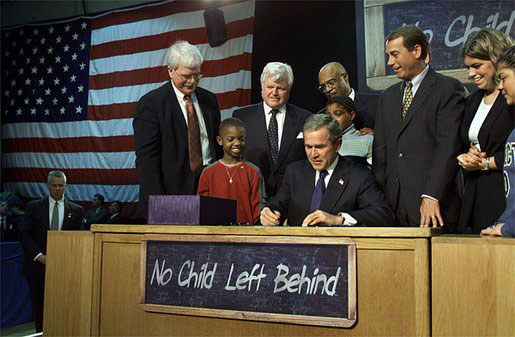
President George W. Bush signs "No Child Left Behind" into law in 2002. Supported by those looking for school accountability in educational achievement, NCLB's tenure has been marked by significant protests by teachers and others. As NCLB comes up for reauthorization, the political desire to improve academic achievement will confront those who feel that the concentration on achievement testing unfairly scapegoats teachers and cheats students out of a complete educational experience.
In the wake of a highly polarized battle over health care reform, Congress and the Obama Administration began to take up another major piece of domestic legislation: reauthorization of the Elementary and Secondary Education Act (ESEA, originally enacted in 1965), now more commonly known as No Child Left Behind (NCLB). (NCLB was itself a reauthorization of ESEA.) Put forth in 2001 by the George W. Bush administration and passed with overwhelming bipartisan support, NCLB has attempted to hold schools more "accountable" for student achievement, as measured by regular standardized testing. The law has been widely unpopular, especially among educators who feel it scapegoats them for the "achievement gap" between students of different racial and social class backgrounds. Yet politicians of both parties remain attracted to its main emphasis on test-driven accountability. As the debate over federal education policy gains momentum, historian John Spencer looks at how NCLB-style accountability grew out of, and at the same time ignores key lessons of, a long history of educational inequality.
Readers may also be interested in this Origins article about Vocational Educational Reform in the 1990s. Please also read these recent Origins articles about current events in the United States: Detroit and America's Urban Woes, Darwin in America, Child Kidnapping, the Mortgage and Housing Market Crisis, and the 2nd Amendment Debate.
When President George W. Bush signed the No Child Left Behind (NCLB) legislation into law in 2002, one thing was strikingly clear: politicians loved it almost as universally as educators hated it.
The legislation was central to the Bush administration's domestic policy agenda, yet Democrats embraced it as well. Congress passed NCLB by margins that seem inconceivable today (384-45 in the House of Representatives; 91-8 in the Senate).
Politicians praised NCLB because it promised to measure student achievement in math and reading, through regular standardized tests, and to use that data to hold schools "accountable" for reducing academic achievement gaps between students of different racial and socioeconomic backgrounds. These gaps in educational achievement have long troubled Americans, especially those who hoped that public schools and education could serve as a great equalizer in American society.
Educators tended to take an opposite view of these developments, believing that they cheapened the educational process, forcing teachers to "teach to the test," and that NCLB blamed schools for social problems beyond their control: such as poverty, urban decay, racial inequalities, and disparities in health care.
Little has changed in eight years.
Barack Obama's Secretary of Education, Arne Duncan, has described NCLB as a "toxic brand" because of significant opposition to its approach. Instead, he has offered a re-packaged "Blueprint" for the law's reauthorization, which was released in March, 2010.
But while Duncan sketched a host of changes to the controversial law, the Blueprint preserved the basic approach of using standardized test scores to hold schools "accountable" for student achievement—especially the roughly five thousand lowest-performing schools in the nation.
And that does not sit well with Randi Weingarten, president of the American Federation of Teachers (AFT). Weingarten complains that the administration's plans "put 100 percent of the responsibility on teachers and give them zero percent authority." Likewise, Dennis Van Roekel, president of the National Education Association (NEA), sees "too much top-down scapegoating of teachers and not enough collaboration" in the plan.
As was the case in 2002, politicians across the ideological spectrum—from Newt Gingrich to Al Sharpton—support the current educational reforms, while those who actually work in schools remain suspicious, feeling scapegoated by those politicians.
The accountability agenda of No Child Left Behind, and the fierce debate it has generated, did not arise out of nowhere in the Bush years. The conflict over accountability has historical roots that reach back to two developments of the 1960s, and especially to the relationship that developed during that time between public education and the African-American civil rights agenda.
First, black educators, parents, and activists during that era fought to hold urban schools more accountable for the achievement of their children, who were often given a second-class education and were dismissed by white Americans (and white teachers) as uneducable. NCLB's focus on teacher and school accountability has its origins to some extent in this African-American civil-rights activism.
At the same time, social scientists in the 1960s began to sharpen our understanding of how school achievement is powerfully shaped by social and economic conditions beyond the direct control of schools and teachers. These ideas that universal educational success is possible only through broader social and cultural transformation have often overlapped with those of the school-focused activists, but they have also come to loggerheads—as they have done most recently.
Understanding that history helps explain why the primary division over education reform is not between Republicans and Democrats but between those who work inside schools and those who make policy for those schools on the state and federal level.
Both the reformer politicians and the school-based educators contribute important perspectives that are grounded in historical experience. At stake on both sides is the question—so foundational to the meaning of American democracy and society—of what role the schools play in creating equality of opportunity for all Americans.
Schools, Opportunity, and (In) Equality
No Child Left Behind is an expression of the widespread American idea that education is key to opportunity in America, and in this sense it is part of a tradition that goes back to the founding of public school systems in the early nineteenth century.
The "father" of public education, Horace Mann of Massachusetts, saw many purposes for state-supported school systems, including the Jeffersonian idea of making educated citizens for democracy. But perhaps his most enduring idea was that schools would be a "great equalizer of the conditions of men." Education "does better than to disarm the poor of their hostility toward the rich," wrote Mann; "it prevents being poor."
The idea of schools as a social equalizer has been a powerful one in the United States. However, it has also fueled a sense of disappointment among many Americans for whom education did not pave the way to equality and opportunity—in particular, among racial minorities and those of low socioeconomic status.
The difference between the ideal of American public education and its often disappointing realities can best be brought into focus by looking at the experience of African Americans. Even as Horace Mann pioneered the notion of free public education in the mid-19th century, most blacks were not only denied an avenue of social advancement through education, but were stigmatized as an intellectually inferior people.
As a result, educational achievement has been a core value and political goal for African Americans, especially since emancipation. As the historian James Anderson and others have shown, academic achievement—particularly the acquisition of literacy—was a way for African Americans to transcend racist assumptions and to assert themselves as free and equal citizens.
The abolition of slavery brought significant progress in the African-American quest for education and literacy, but blacks continued to find their educational opportunities to be seriously limited. In the North as well as the South, many attended segregated schools, which, contrary to the U.S. Supreme Court's decision in Plessy v. Ferguson, were not "equal" in terms of resources. Meanwhile, those who attended integrated schools (mainly at the junior and senior high-school level in the North) were often steered into separate, non-academic curricular tracks—a practice that was reinforced by the rise of racially biased IQ tests.
In 1935, the African-American scholar and activist W.E.B. DuBois expressed the frustration of many blacks over their dismal educational options. Segregated schools had inadequate facilities, poor salaries, and teachers of uneven quality—but at least black teachers treated black students "like human beings."
Just a few decades after co-founding the NAACP on an integrationist platform, DuBois concluded that it was better for black students to be taught by members of their own race than to enter white-run schools and be made into "doormats to be spit and trampled upon and lied to by ignorant social climbers, whose sole claim to superiority is ability to kick 'niggers' when they are down."
DuBois's reluctant rejection of integrated schooling got him kicked out of the NAACP. Still, his sentiments were shared by many African Americans whose children fell victim to low expectations in white-run schools.
Ruth Wright Hayre was a leading black educator in Philadelphia from the 1940s through the 1990s. She recalls how her high school guidance counselor tried to steer her away from a college-prep program and into home economics because, the counselor said, there were "just not any opportunities for colored girls for scholarships or professional jobs."
Later, as one of only two black teachers at Sulzberger Junior High School in the 1950s, Hayre bristled when white colleagues openly disparaged black students in her presence: "You can't teach them anything," they would say; "I'm going to transfer where I can teach children, instead of animals."
African-American educators like Ruth Hayre devoted their lives to raising expectations of black students and fulfilling the dream of social advancement through education. As of the mid-twentieth century, though, the public schools were not an "equalizer" in the way Horace Mann had envisioned, so much as an obstacle to true equality.
Education in the Age of Racial Liberalism: 1940s-1980
The blatantly unequal academic expectations that had dominated the history of public schooling began to come under wider criticism in the 1940s, a shift that gained powerful momentum in the 1960s, and eventually helped fuel the creation of No Child Left Behind.
Changes in education grew out of larger social changes, especially since World War II. From the 1920s through the 1960s, millions of southern blacks migrated to the nation's big cities, leading to a transformation of race relations and urban schools. African Americans sought new opportunities in urban workplaces, neighborhoods, and schools. White residents fought hard to exclude them. [For more on this process, see the recent Origins article on Detroit and the Fate of Urban America.]
As the cities became a racial battleground, the combination of liberal social science and the war against Hitler's genocidal racism did much to discredit the racist ideologies (that is, biological explanations of racial inequality) that had dominated American society since slavery and Reconstruction. In public life (though not among all citizens and communities), racism gave way to a new "racial liberalism": an increasingly widespread acceptance that it was time to begin to address the civil rights agenda, to do away with segregation, and to stop openly expounding racist justifications for policy.
The shift from racism to racial liberalism was epitomized by the massive study of American race relations, An American Dilemma, published in 1944. Sponsored by the Carnegie Corporation and led by Swedish economist Gunnar Myrdal, An American Dilemma defined racial inequality as a vicious circle of white "prejudice" and black cultural "pathology." Inequality went from being an inevitable condition to one that could be altered—especially through education.
Postwar liberals thus rejected the biological racism of the early twentieth-century and replaced it with an emphasis on the educability of all children, regardless of racial or social class background.
Out of this milieu came the "compensatory education" programs that became a key element of Lyndon Johnson's "Great Society" (including the Elementary and Secondary Education Act, ESEA, the forerunner of NCLB). Compensatory education was based on the idea that low achievement among urban black children was not a matter of race, per se, but a problem of poverty and social isolation in declining urban environments. It was up to the schools to "compensate" for the educational and cultural "deprivation" of children in the "ghetto."
As American politicians and educators focused attention on what they saw as the social and cultural causes of achievement gaps, however, black activists and educators increasingly pointed a finger at white-run schools to explain why African-American performance lagged.
In 1966, for instance, activists in Oakland, California formed the Ad Hoc Committee for Quality Education and began to publicize what came to be known as the "achievement gap": students in predominantly black schools had less than half the average percentile rank of their counterparts at all-white schools on standardized math and reading tests. Poor students, regardless of race, actually tested worse as they advanced from grade to grade.
In a report on their findings, the Oakland activists quoted education critic John Holt to suggest that the schools themselves were to blame for unequal achievement: "The conventional wisdom of our day has it that…the children's lack of ability and skill is not their fault, but the fault of their environment, their neighborhoods, above all their homes and families. . . The diagnosis is false. The most important reasons for the failure of slum children's education lie not in the children but in the schools."
The impulse to hold schools responsible for student achievement was also a major factor in one of the most notorious educational conflicts of the 1960s, the battle for "community control" of the schools in the Ocean Hill-Brownsville section of New York City.
In one sense, Ocean Hill-Brownsville was a power struggle: black parents and community activists gained a measure of "local control" over their neighborhood schools and used it to fire white teachers who were members of the United Federation of Teachers. (After a series of strikes that divided white and black New Yorkers as bitterly as any event of the 1960s, the UFT prevailed in re-instating the teachers.)
But "community control" was not just about power; it was also a struggle over who was responsible for low achievement. Black students were not learning in white-run schools, and in New York City and other urban centers, African Americans believed that more pro-active and responsive leadership would make the difference.
African-American educator Marcus Foster, of Philadelphia, captured this emerging sense of accountability when he wrote, "Inner city folks . . . want people in there who get the job done, who get youngsters learning no matter what it takes. They won't be interested in beautiful theories that explain why the task is impossible. The people believe that the job can be done. And they want it done now."
From Reagan to NCLB
Education policy since the Reagan years is often described in terms of a shift from "equity to excellence"—that is, a shift from desegregation and other policies aimed explicitly at racial equality, to a focus on academic achievement and standards. This is true in significant ways. No Child Left Behind, with its focus on holding schools accountable for measurable results (including the ultimate penalty of shutting down chronically low-performing schools), represented a triumph for those who came to apply a bottom-line business mentality to the world of education.
But it is also true that the struggles of the 1960s were about "excellence" all along—excellence and higher achievement for all students, including many who previously had been written off as uneducable.
Echoes of the 1960s were plain to see in the passage of No Child Left Behind. When George W. Bush decried "the soft bigotry of low expectations"—when he and the Congress created a law that broke down achievement data by race and socioeconomic status in order to shine a light on achievement gaps—they took their cues and rhetoric from black educators and activists in the civil rights era.
That is not to say NCLB has been a cause for celebration among those who fought for equal educational opportunity in the 1960s—or for many other people. The law has been tremendously unpopular for many reasons.
Among the most important: it established what nearly everyone saw as an impossible deadline (2014) for all students to test at a "proficient" level. It narrowed the curriculum by prioritizing basic skills in math and reading to the exclusion of nearly every other subject. It led many states to "dumb-down" their tests in order to reduce the number of "failing" schools. And, even with such downward pressure on standards, it led to the labeling of one in three American schools (including many high-functioning ones) as failing.
NCLB has also failed to produce big improvements in student achievement or in racial and socioeconomic achievement gaps. According to the National Assessment of Educational Progress (NAEP), sometimes referred to as the "nation's report card," math and reading scores for both blacks and whites showed modest gains from 2003-2007—but the gains were smaller than those made in the three years prior to implementation of NCLB.
Roughly two-thirds of American students are still not "proficient" as defined by NAEP (which most serious observers believe to be a more reliable standard than the widely varying state tests).
Meanwhile, the gap between black and white scores was narrowing at a faster rate in the three years before NCLB than in the years since—and it is still a substantial gap (at least 26 points on a 0-500 scale, in all subjects, at each tested grade level).
And yet, despite NCLB's failure to make a dent in the achievement gap, its declared focus on this goal has taken a firm hold in national debates over school reform, regardless of the shift from a Republican to a Democratic administration. In those debates, in fact, the very designation of "reformer" now tends to be reserved for those who advocate standardized testing to hold schools accountable for reducing or ending the achievement gap. The "reformers" are described, and they describe themselves, as being in opposition to excuse-making "traditionalists"—that is, teachers, their unions, and other supposed defenders of a failed system.
The continuing cachet of "accountability," and the aura of civil rights activism that surrounds it, is strikingly evident in the work of a national advocacy group called the Education Equality Project (EEP). EEP was founded during the 2008 presidential campaign by a group of urban school superintendents, political figures, and education activists who wanted to influence the future of No Child Left Behind and other policies of the next president. In particular, EEP is dedicated to "one clear goal: Close the achievement gap in public education now."
EEP ties this goal to a larger history of African-American struggle in education. Its number one Statement of Principle reads: "Fifty-six years after Brown vs. Board of Education, forty-two years after the assassination of Dr. Martin Luther King, Jr. and twenty-seven years after the publication of A Nation at Risk, we must confront a shameful national reality: If you are an African American or Latino child in this country, the probability is high that our public education system will fail you, that you will not graduate from high school, that your ability to function successfully in the twenty-first century economy will be limited, and that you will have no real prospect of achieving the American dream."
Or, as EEP co-founder Al Sharpton has said, the achievement gap is "the civil rights issue of the 21st century."
Sharpton has been joined by more than 140 signatories to the Education Equality Project. Two of them—Rod Paige and Margaret Spellings—are the Secretaries of Education who implemented No Child Left Behind during the Bush years. Another signer is the current Secretary, Arne Duncan.
How do the "reformers" who comprise EEP propose to end the achievement gap? Nearly all of the organization's proposed steps focus on factors within schools and school systems—for instance, an effective teacher in every classroom (and fewer union restrictions on firing ineffective ones); expansion of charter school options for parents; and the need to hold teachers, principals, and administrators "accountable for student progress."
The reformers' impatience with educators is understandable, considering the long history of low expectations and underachievement among working class students and racial minorities—and the inspiring example of individual schools and educators that do produce greater-than-expected achievement for such students.
Still, as the critique of low expectations gained steam in the 1960s, so did another current of thought and research that calls into question the accountability agenda ushered in by No Child Left Behind.
The Limits of School Reform
NCLB ignored what more than fifty years of social science research has made clear: what goes on outside of schools, in homes and neighborhoods and social and economic life, is as important to school achievement, if not more so, than what goes on inside.
A defining moment in the development of this research was a massive U.S. government study, Equality of Educational Opportunity (1966)—better known as the Coleman Report, after lead researcher James Coleman. The Coleman Report suggested that factors associated with a child's family and social class background—the education level of the parents, for example, or the degree of exposure to books and other cultural materials in the home and community—had a greater impact on achievement than did resource "inputs" like the amount of school funding or the quality of the facilities.
The Coleman Report echoed the "cultural deprivation" thesis, which had been controversial but persistently influential since the early 1960s. As such, it drew criticism from some black activists and critics who saw it as "blaming the victims" of racially biased schools and an unequal social system.
Analysts still debate the interplay between family background, social structure, and educational achievement. However, since the 1960s, historians and sociologists have reinforced the basic thrust of the Coleman Report, emphasizing social and structural forces that shape the lives—and the educational achievement—of racial minorities and low-income students.
After World War II, de-industrialization and other aspects of the "urban crisis" trapped many African-American and Latino families in urban poverty, and the effects of poverty—for example, inadequate nutrition and pediatric care, or greater transiency due to unstable housing—have had a negative impact on student performance in school.
At the same time, racial minority and low-income students have tended to lack what sociologists call "cultural capital"—the knowledge, skills, resources, and attitudes that some parents (especially those who know the unwritten codes of the dominant culture and can afford such amenities as summer camps and private lessons) are able to pass on to their children to ensure their academic success.
The social science research that has followed from the Coleman Report is, in a sense, a corrective to Horace Mann: it has showed that schools are not, in fact, the "great equalizer"—at least not by themselves.
Even among charter schools that have been celebrated for making inroads on the achievement gap, the lesson seems to be that only unprecedented commitments of resources will do the trick.
In the one-hundred-block area of New York City known as the "Harlem Children's Zone," for instance, Promise Academy charter schools do not raise achievement by themselves; they are part of a more ambitious social experiment that provides health clinics, parenting workshops, and other community services aimed at supporting children from birth through college graduation.
The nationwide KIPP schools network, or "Knowledge is Power Program," thrives on extended school days, after-school tutoring, Saturday sessions, and summer school. Students have their teachers' cell phone numbers and are obligated to call them at night when they get stuck on a homework problem. Turnover is high among the young, enthusiastic teachers the schools tend to attract. As critics tend to point out, KIPP is impressive, but it could not be replicated on a large scale without a massive commitment of resources.
Just as the accountability agenda is well-expressed by the Education Equality Project, the legacy of social research on achievement gaps is captured in an initiative entitled the "Broader, Bolder Approach to Education." Like the Education Equality Project, "Broader, Bolder" emerged during the presidential campaign of 2008, and it gained attention because of the list of educational luminaries who signed on in support. (In this case the list was skewed more toward researchers than to politicians and other "reformers.")
Some people—notably Education Secretary Arne Duncan—have signed both statements. And indeed there is overlap, especially in the passion with which both groups call for an end to racial and socioeconomic achievement gaps.
But whereas EEP calls on schools and school systems to eliminate the achievement gap, the "Broader, Bolder" group emphasizes that school improvement strategies, by themselves, are inadequate. We will not break the enduring correlation between socioeconomic disadvantage and low student achievement, they argue, unless we combine school reform with policies that improve the health, the early childhood learning, and the out-of-school experiences of underachieving children. Such policies, needless to say, are expensive—much more expensive than annual standardized testing.
In addition to spotlighting a wide range of factors that influence school achievement, the "Broader Bolder" proposals raise important questions about the very definition of educational "achievement." Arguing that NCLB has narrowed that definition to basic skills and cognitive growth, they call for an expanded sense of purpose in education, one that includes the development of physical health, character, social development, and non-academic skills.
Obama's "Blueprint for Reform"
The Obama administration's Blueprint for revamping NCLB contains a number of proposed changes. One of Duncan's main priorities has been to shift from punishments to incentives. Under the new plan, annual testing in math and reading would continue, but only the bottom 10 percent of all schools would face "warnings" or sanctions (including, in many cases, the firing of all staff). The other 90 percent—many of which have been declared "failing" under the current law—would enjoy greater flexibility and incentives to broaden their curricula.
Meanwhile, the Blueprint also recognizes the impact of economic disadvantage on achievement, in the form of incentives for creating "Promise Neighborhoods" modeled after the Harlem Children's Zone.
And yet, as critics such as Richard Rothstein (a "Broader, Bolder" advocate) have pointed out, the part about "Promise Neighborhoods" is contradicted by the part about getting tougher on the nation's worst schools. Those lowest performing schools have the highest concentration of disadvantaged students; according to the logic of "Promise Neighborhoods," they need extensive services in order to succeed. Yet, regardless of whether they get such services, the staff is likely to be fired if test scores do not show improvement.
In this sense, the Obama Blueprint seems to maintain the NCLB practice of holding educators solely responsible for academic achievement (the big difference being that middle-class schools will now be under less pressure).
In fact, in one key respect the Obama Administration's brand of accountability goes a step further than NCLB: it seeks to tie teacher evaluation directly to standardized test scores. Already, under the administration's much touted $4 billion "Race to the Top" program, the chance to win competitive grants has been limited to states that are willing to buck the teachers unions on this controversial new policy.
As we've seen, the belief that public schools should be social "equalizers" is rooted deeply in U.S. history—in the vision of Horace Mann and, more recently, in the unwillingness of the civil rights movement to let schools off the hook for achievement gaps.
Arne Duncan captures that view when he says that the children in the low-performing schools "can't wait for incremental reform. They need radical change right now—new leadership, new staff, and a whole new educational approach…we have a moral obligation to save those kids."
No one would argue with that. The question that has plagued education reform for over half a century has been whether that "whole new educational approach" comes only inside the school building, or in attempts to deal with the larger questions of socio-economic inequality.
Kantor, Harvey and Robert Lowe. "From New Deal to No Deal: No Child Left Behind and the Devolution of Responsibility for Equal Opportunity." Harvard Educational Review 76, no. 4 (2006): 474-502.
Moss, Hilary J. Schooling Citizens: The Struggle for African American Education in Antebellum America. Chicago: University Of Chicago Press, 2009.
Neckerman, Kathryn M. Schools Betrayed: Roots of Failure in Inner-City Education. Chicago: University Of Chicago Press, 2007.
Noguera, Pedro A. and Jean Yonemura Wing. Unfinished Business: Closing the Racial Achievement Gap in Our Schools. San Francisco: Jossey-Bass, 2006.
Payne, Charles M. So Much Reform, So Little Change: The Persistence of Failure in Urban Schools. Cambridge: Harvard Education Press, 2008.
Perry, Theresa. "Up From the Parched Earth: Toward a Theory of African-American Achievement." In Young, Gifted, and Black: Promoting High Achievement Among African American Students. Boston: Beacon Press, 2003.
Ravitch, Diane. The Death and Life of the Great American School System: How Testing and Choice Are Undermining Education. New York: Basic Books, 2010.
Rothstein, Richard. Class and Schools: Using Social, Economic, and Educational Reform to Close the Black-White Achievement Gap. Washington, D.C.: Economic Policy Institute, 2004.
Spencer, John. "A 'New Breed' of Principal: Marcus Foster and Urban School Reform in the United States, 1966-1969." Journal of Educational Administration and History 41, no. 3 (2009): 285-300.
Sugrue, Thomas J. Sweet Land of Liberty: The Forgotten Struggle for Civil Rights in the North. New York: Random House, 2008.
Tough, Paul. Whatever It Takes: Geoffrey Canada's Quest to Change Harlem and America. Boston: Houghton Mifflin Harcourt, 2008.
Urban, Wayne J. and Jennings L. Wagoner Jr. American Education: A History. 4th ed. Routledge, 2008.
U.S. Department of Education, "Reauthorization of the Elementary and Secondary Education Act." http://www2.ed.gov/policy/elsec/leg/blueprint/index.html [Accessed May 14, 2010].


