
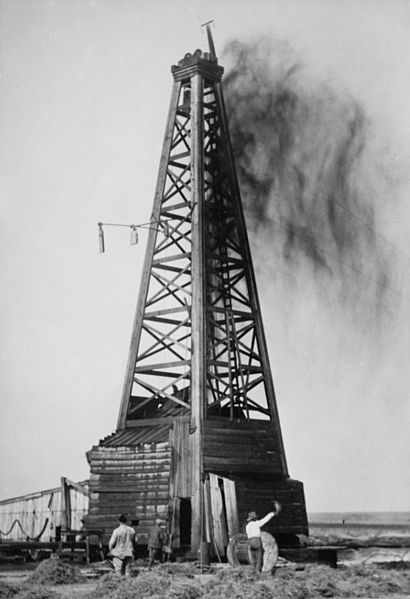
Oil and coal dominated U.S. energy production in the twentieth century. Since the 1970s, America has been making a "long transition" away from carbon-based fuels toward new sources of energy and a different sensibility to consumption.
Energy has been in the news lately: The natural gas industry appears to be developing a world market; the U.S. Army is experimenting with "alternative" and "renewable" energy sources; "green" and "conservation" are being marketed as sound corporate management strategies. A half century ago the emphasis on natural gas, alternative and renewable fuels, and conservation were not in the energy policy mix in the United States. The convergence of historical trends in the 1970s, however, ushered in a "long transition" in American energy policy-making that is on-going. This month historian William R. Childs untangles a few of the many complex strands that make up the history of energy policy in America.
Read this update: How is the "Long Transition" from Fossil Fuels Doing?
Readers may also want to see these Origins articles on Nuclear Power in Japan, Drought and Flooding in Australia, The Global Food Crisis, The Debate over Indian Population, and Fishing and Over-Fishing in American Waters.
You can't read the newspapers or surf the web without coming face to face with the pivotal human problem of energy resources: what sources we should produce and consume, the environmental impacts, and who should control energy development.
"Fracking" has rejuvenated the natural gas industry, but some are attacking the process as unhealthy to humans and the environment.
The U.S. armed services have begun to experiment with "alternative" fuel sources in order to reduce battlefield deaths and rising fuel costs.
Corporations market themselves as firms dedicated to "energy conservation"—"green" companies whose management strategies rest on the efficiencies of "sustainability."
And when it comes to energy, much has changed in recent decades. A half century ago fracking, alternative fuels, energy conservation, and sustainability were neither everyday news items nor were they significant forces within American energy policy-making.
In the 1960s, carbon-based fuels sustained the ongoing postwar economic expansion. Coal-fired electric plants served factories and homes. Oil refineries produced fuels for transportation and petro-chemicals for consumer goods (such as plastics and fashions).
A convergence of historical trends in the 1970s, however, "shocked" American energy markets. From that point, energy policy-making entered what analysts call the ongoing "long transition" away from carbon-based fuels.
This long transition is characterized by two strands—deregulation of markets on the one hand, and an environmental sensibility, on the other hand, that recognizes that earlier policies, which encouraged increased consumption of carbon-based fuels, are no longer sustainable. Instead, around the globe, states, scientists, entrepreneurs, and consumers are emphasizing different approaches to developing energy sources that sustain this more recent environmental perspective.
This long transition, however, is not complete, coherent, nor accepted by all interests involved in energy policy-making in the U.S. The fact is that coal still dominates our electric generation and oil still drives transportation. As has been the case since the beginning of the industrial revolution in the early 19th century, there is a lot of both still to be mined and produced around the world, while the prices of both remain lower than alternative sources.
Comprehending the complexities behind energy policy-making is a daunting task. A recently published book that attempts this, Daniel Yergin's The Quest: Energy, Security, and the Remaking of the Modern World, is 800 pages long and covers only the last 20 years. And some reviewers point out that this world-renowned expert's analyses are incomplete!
By focusing here on four themes—the paradox of abundance, the patterns of regulation, the transition decade of the 1970s, and the parameters of the long transition—we can untangle a few of the many complex strands that make up the history of energy policy in America. And that, I hope, will enable readers to conclude for themselves whether and how future energy needs will be met—or not.
Generally speaking, much of the economics and politics that shaped energy policy-making before the 1970s continue to influence the story. There is one major difference, however. The environmentalism that emerged in the 1970s has promoted multiple, new approaches to policy-making and ways of thinking about energy, including attempts to conserve energy, reduce pollution, and improve public health.
The Paradox of Abundance
Energy policy involves how people decide to use the available natural resources that make up energy markets. A central tension sits at its heart.
On the one hand, following from the concept "the commons," natural resources are seen as belonging to every citizen, and every citizen has the right to participate in deciding how they are used. On the other hand, in the American economic system, we have given to entrepreneurs and private interests the right to extract natural resources, process them into useable things or services, and make money from that process, sometimes even subsidizing them, as long as they follow rules established by the political process.
American energy policy has floundered at times on the inherent conflicts between joint ownership and the exploitation of natural resources by private interests. How much should be exploited now? How much should be conserved for future generations? Who should govern the exploitation and the conservation? Should public or private interests be privileged?
Complicating the question of control over natural resources is the fact that the U.S. has enjoyed an abundance of energy throughout its history: from the founding of the country in the 18th century (wood and water for heating and small-scale manufacturing), to the 19th and early 20th centuries (coal and water for steam engines and electric generators for manufacturing, lighting, home heating and cooking), to the mid-20th century and beyond (oil for transportation and nuclear-powered electricity and natural gas for heating and cooking).
This existence of abundant energy has masked another fact, that the U.S. has long utilized a mix of energy sources, and that mix has changed over time.
For example, even though petroleum has appeared to be the dominant fuel of the 20th century, the consumption of coal has increased to the point that in 2011 coal-fired plants still generate about 50 percent of the electricity in the U.S. Production of electricity from hydro-electric dams, which expanded from the 1930s to 1970s, has declined as a percentage of total electricity production since the 1980s in part because environmental groups have successfully argued that the dams constructed earlier in the century were unnecessary and damaged the environment.
Nuclear power is potentially unlimited, yet sustains only 20% of America's electrical production. (That percentage compares in interesting ways with other nations. France, for example produces 75% of its electricity through nuclear plants.) Some predict, moreover, that over the next several decades natural gas will overtake coal as the fuel of choice for electricity generation.
Thus, there has long been and continues to be an abundance of energy sources. Americans have structured the mix of these abundant natural resources according to the unique costs of production and distribution and interest-group political influences.
Patterns of Energy Regulation
Energy regulation has encompassed two separate but related regulatory stories—the regulation of electricity and natural gas systems and the regulation of the oil industry. The former involved domestic policy, while the latter connected domestic issues with international developments.
The regulation of electricity and natural gas systems began in the late 19th century, and expanded throughout the 20th century as more Americans moved to urban areas. Various interest groups—some representing the competing interests within the coal, oil, and natural gas industries, and others representing various consumers' groups—clashed in the political arena to determine levels of private and public control over energy resources.
These clashes resulted in a regulatory era in which municipal, state, and national commissions shaped the markets in two general ways.
First, regulators promoted industry interests. They restricted competition, guaranteed returns on investment, and encouraged expansion of services. Second, these actions enabled regulators to better protect consumers. In exchange for shielding the utilities from competition, regulators insisted that they furnish reliable, abundant, and cheap energy to all consumers desiring service.
That was the theory, at least. In fact, regulators faced difficult tasks because the economic structures of electric utilities and natural gas utilities were complex and disparate. As a result, energy regulation happened on an industry-by-industry basis, with no real attempt to coordinate policies across the entire market.
Sometimes government actions expanded markets to consumers at low prices (Tennessee Valley Authority and Rural Electrification Administration in the 1930s); and sometimes government policy undermined the market with ill-chosen policies (regulation of natural gas and nuclear plant construction in the postwar era).
The regulation of oil occurred at the same time as the regulation of electricity and natural gas, but remained mostly a separate policy story (even though oil and gas were often produced from the same wells).
In the late 19th century, after kerosene was overtaken by electricity as the main source of lighting in American homes, oil industry entrepreneurs transformed their operations to serve the internal combustion engine and transportation interests (autos and trucks, ships, and airplanes).
Beginning in earnest in the 1920s, and continuing into the mid-20th century, automobile clubs and the tourist industry supported gasoline taxes to expand construction of highways across the country. Over the same period, various interest groups, including the states, oil producers, and consumers, created a regulatory policy that matched oil supply to demand and kept retail gas prices low.
In matching oil supply to demand, regulators stopped the "boom and bust" cycle of crude oil markets where overproduction drove down the price of oil below the costs of drilling and production.
The regulatory policy was defended on the basis of "conservation": Booms often resulted in economic waste (oil was sold at less than its real value) and physical waste (the oil would not be available in the future). Yet, the conservation argument was undermined by other energy policies that ensured that retail gasoline prices remained low. Low prices stimulated more demand, which encouraged more drilling and production.
The emphasis on increasing demand through maintaining low prices not only frustrated conservation efforts, it also forced Americans to seek more oil from foreign sources as domestic production could not keep up with growing demand.
This turnaround occurred rather quickly. During World War II, what some have labeled the "war of oil," the United States produced and refined all of the oil needed by the Allies. In the mid-1950s the U.S. produced enough oil to help supply Europe when Middle East supplies were disrupted during the Suez Crisis.By the 1960s, Middle Eastern and African oil producers began to work among themselves and with other nations to establish an oil cartel to control the price of oil worldwide.
In the mid-20th century, then, the American domestic oil market became intertwined with the world market. Domestic electric and natural gas markets, moreover, were narrowly focused on stimulating consumption, maintaining low prices, and relying on mostly carbon-based energy sources.
Transition Decade of the 1970s
By the 1970s, American domestic energy policy and the world-wide oil market lurched toward a two-pronged crisis that rocked American politics. One crisis was self-inflicted and led to some reform of natural gas policy; the other was connected to broader historical trends (anti-colonialism, decolonization, and the Cold War) and reshaped the world market for crude oil.
From the late 1940s through the 1960s Congress and five presidents failed to shape effective policy for promoting and regulating natural gas. Consequently, in the 1970s, shortages of natural gas plagued the Midwest and Northeast while consumers in the Southwest had plenty of gas, but paid high prices.
State and federal officials struggled to shift natural gas supplies to areas that needed the fuel during winter cold spells. In some cases regulators ordered gas curtailments to manufacturers to ensure heat was available to consumers' homes. Meanwhile, natural gas producers claimed that incentives (i.e., prices) were not high enough to pay for exploration for new sources. This failure of the regulated natural gas market disrupted local economies, which affected the national economy.
Meanwhile, in the international arena, oil-producing nations belonging to the oil cartel, the Organization of Petroleum Exporting Countries (OPEC), attempted to wrest control of their natural resources from western oil companies. OPEC employed its cartel muscle to withhold oil supplies to the U.S. and Western Europe, and to raise prices across the board. These cooperative actions, in 1973 and again in 1979, led to higher gasoline prices and in some cases, if only temporarily, no gas at all.
These "oil shocks," along with the shortages in natural gas supplies, prompted much discussion in America about energy. From one perspective, the economics of energy, interest-group politics, and industry-specific approaches continued to shape legislation.
From another perspective, though, Americans began in a halting fashion to develop new and broader approaches to natural resources policy-making. The 1970s marked the beginning of the long transition.
Deregulation and Environmentalism
In addition to the usual forces shaping the political economy of energy, two new forces emerged to shape responses to the crises of the 1970s: deregulation and environmentalism. Both are ongoing today, although with different impacts.
"Deregulation" began as early as the 1950s, but really gained traction in the 1970s and became a broad-based approach to reforming business-government relations in America.
In part a political, ideological attack on the New Deal, the movement was also a pragmatic response to problems with regulation (complex and time-consuming regulatory procedures increased costs to businesses and consumers, and hindered innovation in the marketplace).
Following in the footsteps of state and national deregulation of trucking, airlines, and banking, some states and the national government tentatively deregulated energy industries in the late 1970s, 1980s and 1990s. Not every state participated in electric deregulation, and there was no overall coordination among states and between states and the federal government.
Deregulation of natural gas was not comprehensive either.
The one clear failure of state deregulation in California—precipitated in part by the actions of Houston-based Enron—dampened enthusiasm elsewhere for deregulation.
While deregulation of energy producers has not created the success of deregulation that has been seen in other industries (or, with the exception of Enron, the huge problems of other deregulated industries), the programs have shown modest increases in participation year after year in those states where it has not been abandoned.
Arguably, however, one piece of deregulatory legislation may have trumped all other deregulatory efforts in terms of its later impact on natural resource policy. Over time, the freedom from regulatory oversight included in the Natural Gas Policy Act of 1978 has encouraged exploration for new natural gas sources.
More significant than deregulation to the evolution of energy policy has been the impact of environmentalism. During the mid-20th century, the modern environmental movement grew at the state and national levels. Various interest groups (scientists and outdoor enthusiasts, including fisherman, hunters, and hikers) exerted political pressure to clean up America's air, water, and land, which had been despoiled by the carbon-based manufacturing and transportation economies during the previous century.
Drastic increases in pollution began with the industrial revolution, but it was the economic expansion during World War II and the postwar era—including the expansion of chemical industries—and its effects on natural resources and public health that underlay the emergence of the environmental movement.
Parameters of the Long Transition
The crises of the 1970s combined with modern environmentalism to create the "long transition" away from a reliance solely on carbon-based energy sources to a more comprehensive approach to the mix of energy sources.
The National Environmental Policy Act, the Environmental Protection Agency (EPA), and the Clean Air Act—all coming in 1970—kicked off a decade of environmental policy-making. Working with the states, the EPA created a more comprehensive approach to reducing pollution nationwide, which affected energy policy.
Following experience gained at the state level in California, the national government prodded auto manufacturers to design and produce lighter autos and cleaner and more fuel-efficient engines. Renewal of environmental legislation in 1990 sustained this new approach to natural resource management, and that led to changes in energy policy. To cite one notable example, coal plants in the Midwest joined a variety of programs designed to reduce acid rain, which had polluted New England waterways, farms, and cities.
Other approaches have met success in reducing the pollution from coal-fired electric plants. Beyond Coal, sponsored by the Sierra Club and Bloomberg Philanthropies, has targeted coal-fired plants on the basis of health issues. Efforts have forced some plants to shut down and prodded owners of existing and new coal-fired plants to reduce toxic emissions.
In addition to reducing carbon-based pollution, the long transition has been distinguished by more interest in pursuing a variety of approaches to producing energy than ever before. Renewable and "clean" sources, particularly wind and solar but also natural gas, and in some people's minds, "clean coal," have become increasing portions of the mix. Still, developing a variety of options to reduce reliance on carbon-based fuels has not been easy.
Alternative fuels are used mostly for transportation and include biodiesel, ethanol, hydrogen, electric, natural gas and propane. Promoted by special interests, including environmentalists, industrialists, and farmers, some of these fuels consume as much or more in fossil fuels to be produced as the energy they provide. And some of them exude high concentrations of pollution when they are used.
One of the most contentious alternatives is ethanol; it is produced from corn, requires lots of energy to produce, and has raised the price of corn, altering the world-wide food balance.
Electric cars, which have received much media attention, present environmental challenges even as they reduce reliance on carbon-based sources. More electricity will be required, and disposal of batteries may present environmental problems.
The long transition has been simultaneously promoted and undermined by one long-standing myth, that the world has passed the point of "peak oil." That term describes the point where discovery and production of oil no longer exceed consumption but rather begin to decline relative to the increase in demand. Eventually, given this scenario, our autos and trucks would run out of gasoline and diesel.
The peak oil argument reflects both a constant refrain in the history of oil and the basic boom-and-bust cycles of the industry. Since the early 20th century, petroleum analysts have predicted periodically that the nation would run out of oil. Again and again, however, more oil has been discovered and produced than was thought available.
Technologically improved methods of drilling (e.g., horizontal drilling) are producing oil from old fields many thought were dry. Deep-sea drilling techniques enable oil companies to extract petroleum from pools tens of thousands of feet below the surface of the sea.
So, the argument that the world has hit "peak oil" is irrelevant in the short and medium term because there is enough oil available with current drilling techniques to supply the world for several generations. Ironically, of course, the efforts to improve energy efficiency through conservation, green construction, and smart grids will help sustain the dominance of oil.
That oil is bought and sold in a global market, moreover, will ensure that the U.S. remains involved in the politics of international oil. (The same argument can be made for "peak coal," from which the peak oil argument derived.)
In addition to the peak oil argument, the long transition has been shaped, most recently, by the notion of "energy independence." Especially after the terrorist attacks on the U.S. on September 11, 2001, some advocates have championed "energy independence" as a worthy policy goal. They hope to break the Middle East's alleged hold on Americans' reliance on oil.
This political movement has promoted expanded drilling for oil that could unnecessarily harm the environment (e.g., drilling in the Arctic Refuge). Americans are not as tied to Middle East oil supplies as proponents of energy independence allege. The U.S. receives most of its "foreign" oil from Canada; more oil arrives in the U.S. from Africa than from the Middle East.
So, how dependent are we on foreign oil? While there is a connection to Middle East oil—American diplomatic and military involvement in the Middle East (Suez Crisis of 1956 ; Kuwait, 1989-1990 ) has involved protecting oil supplies for Europe and Japan, not necessarily for the U.S.—the connection is not as strong to the domestic market as some believe.
"Energy independence" remains an elusive dream unless Americans are willing to discard the automobile culture in favor of a drastically different transportation system. If that unlikely cultural revolution were to happen, it would take years to complete.
Natural Gas and the Future of American Energy
Perhaps it is appropriate to end with mention of the most recent media focus on energy. Natural gas appears to be on the threshold of becoming a major energy supply, not only as a substitute for coal-fired electric plants, but also as a substitute for nuclear power, an especially appealing alternative to some given the problems in Japan earlier this year. Natural gas also shows promise for fueling the transportation system.
In part, the deregulation of natural gas industry that began in 1978 encouraged this expansion, but that is not the entire story. There is rarely in history a singular cause; the origins of the natural gas resurgence are more complex.
Until recently, the lack of a worldwide market for natural gas, as well as access to abundant reserves, have prevented it from assuming a larger portion of the energy mix. Both of those impediments seem to be dissolving. CNG (compressed natural gas) and LNG (liquefied natural gas) are enabling natural gas to be transported over long distances in a world market. While the costs to construct CNG and LNG terminals are high, they are falling as more transference hubs and transport ships are built.
The media, however, have focused more on the expansion of natural gas production through hydraulic fracturing. Commonly known as "fracking," this is an old technology updated to unleash large amounts of natural gas previously unreachable in various shale formations in the U.S. and elsewhere, especially Europe.
Not surprisingly, given the historical trends noted above, there are some problems associated with natural gas increasing its portion of the energy mix. Increased use of natural gas to produce electricity, furnish heating and cooking in homes, and fuel autos and trucks might add to the effects of global warming.
Fracking, moreover, is not necessarily "clean" when it comes to environmental threats to the land and water supplies. A consensus is building, though, that these issues can be addressed. Even industry interests concede that drilling techniques, including fracking, should be and can be environmentally safe. This emphasis on the environment clearly distinguishes the latest period of the long transition from earlier times when environmental issues were not in the forefront of policy discussions.
In conclusion, environmental politics have made a difference in energy policy-making since the 1970s, shaping the long transition in new ways. Energy-related pollution has been reduced; conservation and sustainability are more accepted and promoted in legislation (e.g., see the American Recovery and Reinvestment Act of 2009); and the largest retail business in the world, Walmart, has become a leader in sustainability-based business practices. Industry firms and interest groups are taking on "green" personas on their web sites.
For the foreseeable future, however, the economics of alternative sources, sustainable fuels, and clean energy will hinge on the price of coal and petroleum, and given the immense supplies of both, the interest group influences, and ideologically based politics, the long transition will likely continue for some time.
Childs, William R. The Texas Railroad Commission: Understanding Regulation in America to the Mid-Twentieth Century. College Station: Texas A&M Press, 2005.
Clark, John G. Energy and the Federal Government: Fossil Fuel Policies, 1900-1946. Urbana and Chicago: University of Illinois Press, 1987. Detailed, opinionated analysis focusing on individual industries, complex interest-group politics, and the lack of planning in energy policy making.
Hirsh, Richard F. Power Loss: The Origins of Deregulation and Restructuring in the American Electric Power Industry. Cambridge, MA: MIT Press, 2000. Historically analyzes interrelationship between technology, markets, and regulation in the electric power industry.
Lifset, Robert, ed. Energy in Historical Perspective: American Energy Policy in the 1970s. Norman: University of Oklahoma Press, forthcoming. Solid overview of various energy policy making stories of the 1970s.
MacAvoy, Paul W. The Natural Gas Market: Sixty Years of Regulation and Deregulation. New Haven, CT: Yale University Press, 2000. Slim, accessible volume tracing the various phases of natural gas regulation from the 1930s to the 1990s.
Melosi, Martin V. Coping with Abundance: Energy and Environment in Industrial America. Philadelphia: Temple University Press, 1985. Focuses on producers and consumers of energy in an affluent society where general abundance undercut notions of scarcity and crisis in energy policy making.
Pope, Daniel. Nuclear Implosions: The Rise and Fall of the Washington Public Power Supply System. New York, NY: Cambridge University Press, 2008.
Vietor, Richard H. K. Energy Policy in America Since 1945: A Study of Business-Government Relations. Cambridge: Cambridge University Press, 1984. Details interaction between markets and policies revealing that poor policy choices and implementation often misshape markets; also underscores lack of coherent energy policy in U.S.
Yergin, Daniel. The Prize: The Epic Quest for Oil, Money and Power. New York: Simon and Schuster, 1991. Sprawling, insightful narrative of the rise of oil as a dominant force in the world economy in the twentieth century.
Yergin, Daniel. The Quest: Energy, Security, and the Remaking of the Modern World. New York: Penguin, September, 2011.
The White House. Energy and Environment. http://www.whitehouse.gov/issues/energy-and-environment Outlines current (2011) approaches to energy policy, with emphasis on sustainability and alternative fuels development.
Useful Links
http://www.sciencedaily.com/releases/2011/07/110711164533.htm
http://www.sciencedaily.com/releases/2011/05/110524153418.htm
http://www.sciencedaily.com/releases/2011/05/110511134335.htm
http://www.ngpowereu.com/news/newsgerman-solar-energy-policy
http://wattsupwiththat.com/2009/05/24/energy-availability-is-almost-infinite
http://www.nytimes.com/2011/09/21/books/the-quest-by-daniel-yergin-review.html


