
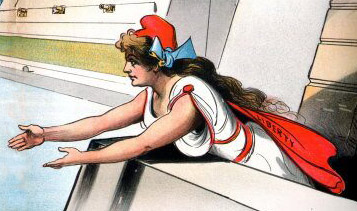
In the late 19th century, humanitarian intervention was a popular idea among U.S. citizens. In this detail from a political cartoon, a caring woman whose garment reads "liberty" symbolizes this impulse.
Many of us think of humanitarian intervention as a recent phenomenon of United States foreign policy. Certainly, critics of Barack Obama's intervention in Libya saw America's humanitarian involvement there as some new-fangled excuse to go mucking around in other countries. This month historian Jeff Bloodworth traces a much longer history of humanitarian intervention that goes back to the administration of William McKinley and is connected with the Protestant ideals of some of the nation's founders. Far from being new, Bloodworth demonstrates that humanitarism has been a central concern of American foreign policy for a very long time.
Read more on the U.S. and the World: U.S. relations with Iraq, U.S.-Iranian relations, coalition warfare in Iraq, U.S. counterinsurgency strategy, anti-Americanism in Latin America, The United States and Haiti, and what WikiLeaks tells us about American foreign relations.
If he were alive today, William McKinley would understand Barack Obama's 2011 humanitarian intervention in Libya. Like Obama, McKinley confronted geopolitical disorder and economic distress wrought by swashbuckling capitalism. As Commanders-in-Chief and liberal Protestants, the twenty-fifth and forty-fourth presidents both confronted the knotty issue of humanitarian intervention.
Until recently, historians conceived of humanitarian interventionism as a policy with shallow roots in America. Seemingly born from what J. Daryl Charles calls the "defects of the post-Cold War period," American forays into Somalia, Bosnia, and Kosovo have been described as ad hoc and lacking precedent. Such observations reflect a misunderstanding of America's deep history with humanitarian intervention.
At the center of this misunderstanding is religion. The U.S. is the only major industrial democracy where religion still permeates contemporary society as it did three centuries ago. Many analysts have failed to recognize the extent to which religious thinking infuses U.S. foreign policy.
Obama and the Libyan Intervention
Obama's first humanitarian intervention was multilateral and restrained, designed merely to stop an imminent massacre and offer Libyans an opportunity to overthrow dictator Muammar Qaddafi themselves.
Libya's uprising began in February 2011. It was a byproduct of the Arab Spring, prompted by similar issues of government corruption and economic malaise.
Erratic and borderline delusional, Qaddafi was no garden-variety autocrat. Armed with a messianic vision and his revolutionary Green Book, Libya's "Brother Leader" seemed more Mao Zedong than Hosni Mubarak.
But despite his declared benevolence, when provided an opportunity Libyans revolted en masse. Within weeks of the popular uprising's genesis, rebels controlled much of the nation. By early March, they even threatened the capital, Tripoli.
Flush with oil money, Qaddafi employed sophisticated armaments to crush and roll back the lightly armed and untrained opposition. Supplemented by foreign mercenaries, by mid-March government forces slowly pushed toward the rebels' stronghold, Benghazi. Wantonly slaughtering civilians, Qaddafi's forces appeared poised to take the city, destroy the rebellion, and butcher the inhabitants.
As March crept toward April, Qaddafi presented Obama with a stark choice: stage a humanitarian intervention or witness horrendous carnage. Stuck between the realists, who preached against intervention, and the neoconservatives, who urged an immediate NATO air campaign, Obama opted for a multilateral approach. (He was later ridiculed for "leading from behind.")
Transforming a French "no-fly zone" resolution into a UN-sanctioned military intervention, the administration achieved a diplomatic triple play. Endorsed by the Arab League and publicly pushed by the French, the UN approved its first-ever military action to stop an "imminent massacre."
Though messy, NATO airstrikes and military aid did turn the tide and enable the rebels to depose Qaddafi.
The primary influence on Obama's nuanced humanitarian intervention—as with McKinley's intervention in Cuba in the 1898 Spanish-American War—was the long-standing idea of the American sacred-secular world mission, combined in Obama's case with the influence of twentieth-century philosopher Reinhold Niebuhr.
The Sacred-Secular Mission
The Puritans' Reformed Protestantism remains the alpha and omega of U.S. foreign policy and still shapes Americans' view of their role in the world.
Key to understanding the connection between the seventeenth and twenty-first centuries is the Puritans' "destinarian" zeal. As a radical schism of a messianic outlier in Europe's Protestant movement, the Separatists saw their march into the wilderness as nothing less than a journey to save the world. Four centuries later, U.S. foreign policy still bears the destinarian imprint.
Anders Stephanson has argued that the founders of the U.S., taking the baton from the Puritans, conceived their new nation as a "sacred-secular project, a mission of world-historical significance in a designated continental setting of no determinate limits."
Thomas Jefferson's political thought and presidential action reveal the sacred-secular mission fueling nineteenth-century U.S. foreign policy. The third president's "empire of liberty" amounted to more than acquiring the Louisiana territory for settlement. In his mind, it constituted a move toward the universal liberation of humanity.
While the Puritans' distinctive Calvinism ebbed, their proselytizing ardor remained influential among American leaders. A hopeful offshoot of a religion founded upon expectation, nineteenth-century Protestantism maintained the founders' emphasis upon millennial progress. Fusing republican ideology into their theology, American Protestants boasted, Mark Noll has written, a "nearly messianic belief in the benefits of liberty … and the providential destiny of the United States."
Nineteenth-Century Humanitarianism
While naked self-interest and chauvinism propelled westward expansion, "Manifest Destiny" also justified Americans' sacred-secular project. With faith in Jesus, liberal individualism, and belief in America's millennial destiny, Protestants pushed west.
Once the frontier closed, however, Americans sought new outlets for their destinarian impulses. Moved by genuine charitable impulses and as an emergent power, they found one in the burgeoning humanitarian movement.
"Humanitarianism" and humanitarian intervention—governments acting to protect human life beyond their borders—do not usually play significant roles in most historical treatments of nineteenth-century diplomacy. Indeed, the nineteenth century has a well-deserved reputation as the heyday of European and American imperialism and realpolitik.
In spite of this reality, humanitarian sensibilities did influence Western foreign policies. Whether it was anti-slavery agitation on both sides of the Atlantic or the 1885 Berlin Treaty, a distinctly modern version of "humanitarianism" increasingly informed Western, democratic foreign policies.
Initially catalyzed by the "teeming mass of ideas" linked to the American and French Revolutions, the humanitarian "association mania," as the London Times dubbed it, flourished in America. Humanitarianism was a decidedly liberal project premised on the Enlightenment's fundamental hypothesis that all human life is equal.
The American and French Revolutions' emphasis on natural rights along with the emergence of the mass press, public opinion, and participatory government helped transform humanitarianism into a mass movement. More importantly, these ideological and institutional developments made humanitarian intervention both politically possible and popular.
Humanitarian sentiments were not limited to the foreign policy sphere. Early nineteenth-century British and American nationalists fancied their countries world liberators in the age of revolution.
Britons regularly bandied their slave trade ban as proof that they remained at the vanguard of human rights. Picking up this cue, early American abolitionists pushed for the eradication of slavery from a distinctly modern, humanitarian worldview. In part, abolitionists sought to eradicate slavery to maintain America's status as global redeemer.
The "CNN Effect"
The "CNN effect" is a theory that modern news coverage, exemplified by the 24-hour international news network, began during the Cold War to significantly shape foreign policy by generating public outcry at images of human suffering. However, the media's ability to depict individual anguish, shape public opinion, and create calls for intervention certainly existed prior to cable news.
Indeed, rising literacy rates across Western Europe and America caused the proliferation of newspapers and magazines, which performed the same functions as television does today.
In large part, humanitarians pushed for global action due to the influx of news, which enabled them to read about and view images of human suffering as never before. During the 1890s, the international telegraph, along with the maturation of Reuters and Associated Press news services, allowed newspapers and magazines to more easily report international news. For example, the Christian Herald and Harper's regularly publicized Turkish atrocities committed against Armenians.
New photographic technologies rendered human suffering all the more real to readers. In the Harper's 1895-96 series "The Troubles in Armenia," editors used eleven-by-sixteen photolithographs and drawings graphically depicting the Armenians' "utter extinction." American opinion leaders such as Julia Ward Howe and Charlotte Gilman Perkins called for intervention.
In conjunction with newspapers and magazines were books, like Frederick Greene's bestseller, The Armenian Crisis in Turkey, which further publicized the slaughter. Greene also pleaded for U.S. involvement.
The Iowa Russian Famine Relief Commission
Humanitarian intervention in the nineteenth century was not a top-down endeavor led by the White House. Instead, it was a grassroots movement emanating from the nation's educated middle class. America's first humanitarian intervention emerged as a private venture.
In response to the 1892-93 Russian famine an obscure Davenport, Iowa newspaper editor, Benjamin Franklin Tillinghast, launched a national famine relief effort. Much more than simple charity, the Iowa Russian Famine Relief Commission created a new chapter in U.S. diplomatic history.
Quintessentially American, the effort emanated from sacred-secular tendencies but was coordinated from Tillinghast's newspaper office. Lacking federal oversight, military transports, or bullets, what became a national famine relief enterprise nevertheless constitutes a humanitarian intervention. In foisting 32,000 tons of food and hundreds of foreign observers, media and relief workers upon a reluctant Tsar, Americans effectively barged into the internal affairs of a sovereign state.
Trumpeted by President Benjamin Harrison, governors, and celebrities, the effort grew in popularity. Ultimately, the endeavor also helped condition voters and politicians to accept humanitarian interventions as a legitimate foreign policy expression of the traditional American mission.
Within three years of the creation of the Iowa Russian Famine Relief Commission, Congress debated the merits of militarily intervening to stop Ottoman atrocities against its Armenian subjects. Despite significant activism, President Grover Cleveland refused to act. Once again, private citizens stepped into the breach.
Flanked by relief organizations and Tillinghast's committee, Clara Barton negotiated access to the Armenians and directed the American Red Cross's first humanitarian intervention onto foreign soil. The excursion established yet another precedent for intervention.
It also ensured Armenia remained a potent political issue. In response to Cleveland's continued dithering, the 1896 Republican platform explicitly called for action to "bring these atrocities to an end."
In justifying the Spanish-American War two years later, McKinley referred to the "many historical precedents where neighboring States have interfered … to check the hopeless sacrifices of life by internecine conflicts beyond their borders." The president merely followed where the American people had already led.
Despite Barton's humanitarian aid, an estimated 186,655 Armenians died in the autumn of 1896 alone. The memory of the failed cause loomed large when Americans turned their attention to Cuba. In the days leading to McKinley's declaration of war, the New York Times equated Armenia with Cuba.
"The barbarities of the Spaniard, like the barbarities of the Turk, are … essential to his rule … [a]s Europe recognizes that to put a stop to Turkish misrule it is necessary to put a stop Turkish rule … so we must recognize that to pacify Cuba Spain must go."
Realizing this, Cuban rebel leaders used the specter of "Armenia" as a propaganda tool to maintain the American public's interest in the conflict.
The Spanish-American War as Humanitarian Intervention
As the proverbial ugly stepchild of American diplomatic history, the Spanish-American War occupies complicated territory. Because foreign policy specialists realize the war's imperialist results, many are reluctant to identify it as a humanitarian intervention.
Humanitarian concerns, however, paved McKinley's path to war. Even though the conflict had imperial consequences, the president's rationale should be considered separately from the war's outcome.
McKinley's spiritual life and Methodist Christian moorings proved decisive in his determination to launch a humanitarian intervention. Staid and stiff, the president hardly seems religious in contrast to his 1896 electoral opponent, William Jennings Bryan. And compared to his ebullient successor, Theodore Roosevelt, McKinley comes off as boring. In this case, appearances deceive.
The religious equivalent of kudzu, Methodism converted so many nineteenth-century Americans that it became the single largest Protestant denomination in the U.S. Among these converts was a young Will McKinley. A fervently anti-slavery teetotaler, McKinley's inner spiritual world ran hot.
The minister who oversaw his conversion and baptism actively worked in the Underground Railroad, while his hometown, Poland, Ohio, was a veritable hotbed of abolitionist sentiment. The self-described "soldier of Jesus" who served in "the psalms-singers of the Western Reserve" during the Civil War very much embodied mainstream liberal Protestantism.
In American politics, "mainstream" is often synonymous for banal. Anything but lackluster, Gilded Age Protestants boasted a worldview rife with messianic visions, which effectively updated the sacred-secular mission for a new era. Indeed, one leading proponent of an interventionist foreign policy, Josiah Strong, claimed his generation's actions would "hasten or retard the coming of Christ's kingdom."
Reflecting the destinarian imprint, liberal Protestants, including McKinley, pushed for humanitarian interventions as an expression of America's sacred-secular project. Not coincidentally, in the late nineteenth century Americans took the lead in establishing foreign missions and tending to the needy across the seas. Strong, for one, called for Americans to Christianize the world.
It was at this crucial historical juncture that Americans pushed their nation to stanch Spain's bloodletting in Cuba. In due course, humanitarian calls for intervention convinced the president to act.
The Maine's explosion is rightly credited with rousing mass sentiment for war. However, elite opinion regarding the humanitarian situation in Cuba was much more significant in shaping McKinley's policy than headlines in the penny press. Disregarding pro-war hysterics from the start, it was the first-hand reports from Clara Barton and Senator Redfield Proctor which proved decisive.
The latter's fact-finding trip to Cuba reveals the central role humanitarian concerns played in McKinley's decision for war. The senator's visit and interventionist bent hardly made him distinct. Nonetheless, his conservative bona fides, perceived relationship with the president, and sense of drama rendered his pronouncement a political bombshell.
After visiting the island, Proctor refused all interview requests. Instead, he penned a simple "statement" which he planned to deliver to the Senate.
Proctor dramatically took the senate floor before a packed gallery, describing the "desolation and distress, misery and starvation" that was Cuba. Proctor's speech rallied the business community and wary business journalists to combat the humanitarian nightmare.
Convinced that "an American Armenia" was festering 100 miles away, the Wall Street Journal and the New York Commercial Advertiser threw their weight behind intervention. McKinley called for war to "put an end to barbarities, bloodshed, starvation, and horrible miseries now existing there."
For decades, historians dismissed this rhetoric as insincere cornpone. Hardly deceitful, McKinley's humanitarian motives and religious hubris led him to war while also blinding him to the dangers of its aftermath.
Twentieth-Century Humanitarian Interventionism and Rienhold Niebuhr
In the years following the Spanish-American War, the Social Gospel movement animated U.S. foreign policy. Looking to ameliorate domestic and foreign ills, American Progressives also heeded the sacred-secular mission.
Confident that their new millennium still beckoned, many Progressives backed American entry into World War I as a vehicle to "end all wars and institute world democracy." The wartime experience and postwar peace, however, destroyed their hopes that military engagements could achieve millennial results.
Consequently, interwar Progressives and religious liberals largely embraced pacifism. This antiwar bent hardly negated all international humanitarian endeavors. Following his famine relief efforts in Belgium in 1921, Herbert Hoover organized a massive food drive for the Soviet Union, honoring the sacred-secular mission even as pacifism crested.
By the 1930s, most mainline liberal Protestants had accepted the Social Gospel's newfound antimilitarism. Yet in the face of fascist aggression and Soviet brutality, Niebuhr pioneered a fundamental rethinking of liberal Protestantism's stance toward world events. Attacking a "Christianity that suffers from modern liberal illusions," he maintained that in certain instances pacifism represented a greater evil than intervention and war.
With humanity's inherent sinfulness rendering millennial progress moot, the theologian opted for chastened domestic and foreign policy goals. The archetypal realist nevertheless remained unwittingly committed to the sacred-secular charge.
Developing a more refined and sophisticated version of the American mission, Niebuhr claimed God had chosen the U.S. to defend "Western Civilization." All the same, he fundamentally rejected any nation or ideology's claim to transhistorical meaning. In other words, Niebuhr might have embraced America's "chosenness" but he contended no individual or nation could fully act immanently.
Niebuhr would only support humanitarian intervention, or any foreign policy venture, under certain circumstances. Recognizing that nations act from self-interest and individuals discern their motivations only with extraordinary difficulty, if at all, Niebuhr called for multilateralism.
With allies better able to detect hidden, selfish motives within their partner states, the theologian reasoned America could maintain its "responsibility" to the world, while restraining its messianic passion and inherent sinfulness.
In a stark about-face from their Social Gospel brethren, Christian Realists not only backed American nuclear policy, they also supported Truman's Cold War policies.
The Soviets might have required containment, but for Niebuhr, any superpower utterly convinced of its transhistorical role presented an international danger. In this way, Niebuhr's brand of liberal Protestantism offered a necessary rein upon on Americans' destinarian fervor.
The theologian's restraints came none too soon. Whereas the founders envisioned their democratic experiment as world altering, they possessed little power to pursue their grand project. The geopolitical equivalent of a Chihuahua, few, if any, world leaders much noticed the infant republic's braggadocio. One hundred and seventy years later, however, America's greatly enhanced power rendered its sacred-secular missionizing a global concern.
Once engaged in a global struggle against the Soviets, American policymakers inevitably overreached. From CIA-backed coups to Vietnam, the potent cocktail of power politics, self-interest, and destinarian passion produced bad and, at times, immoral decisions.
Attempts to remove humanitarian concerns from U.S. policy proved futile. Richard Nixon and Henry Kissinger's realism effectively united conservatives, neo-conservatives, and liberals in their contempt for détente. As a result, disparate politicians—from Jimmy Carter to Henry Jackson and Ronald Reagan—made "human rights" central to their foreign policy worldviews.
In the early post-Cold War world, America possessed a relatively free hand in global affairs. Not surprisingly, the 1990s witnessed an abundance of U.S.-led humanitarian interventions. From Somalia and Bosnia to Kosovo and the Iraq War, Republican and Democratic presidents looked abroad to channel the sacred-secular mission. Producing uneven results, humanitarian interventions lacked sound guiding principles.
Barack Obama's Humanitarian Intervention
The key to understanding President Obama's foreign policy lies with Niebuhr. In 2007, New York Times columnist David Brooks accidentally discovered Obama's inner Niebuhr. Searching to enliven a limp interview, Brooks asked the senator-cum-presidential-candidate, "Have you ever read Reinhold Niebuhr?" The candidate vigorously recounted The Irony of American History's basic argument.
Two years later, the president's connection to a then-obscure thinker had faded into little more than a campaign footnote. The president's Nobel Peace Prize prompted the association's return. An obvious commentary on George W. Bush's pervasive unpopularity rather than Obama's accomplishments, the Nobel gave the newly inaugurated president a global stage from which to announce his worldview. Obama's address walked a precise Christian Realist line, verging on theological.
Pronouncing war and violence "a fact" of human existence emanating from "the core struggle of human nature," Obama struck a realist note. Hardly a latter day Kissinger, the president still endorsed robust action to improve the world but warned, "We are fallible. We make mistakes, and fall victim to the temptations of pride, and power, and sometimes evil." The address echoed Niebuhr's tragic sense of history and human nature.
An unlikely liberal Protestant and Niebuhrian, Obama grew up without organized religion. Exposed to a multiplicity of faiths and creeds in Hawaii and Indonesia, the president only found God as an adult.
Constantly in and out of Chicago's black churches while working as a community organizer, Obama discovered faith at Jeremiah Wright's Trinity United Church of Christ. The predominately white, liberal Protestant denomination had established a parish on Chicago's south side in the late 1960s. Derided as a "white church in black face," Wright quickly made the institution respond to the spiritual and political needs of Chicago's educated, black middle class.
A Christian whose first church community emphasized social action and the "audacity of hope," Obama's newfound spiritual life merged with his careful intellect. The Harvard-trained lawyer renowned for his ability to synthesize seemingly incongruous arguments brought these skills to his religious life.
In this context, Obama's attraction to Niebuhr appears quite understandable, even predictable. Like the president, the neo-orthodox, liberal Protestant also synthesized incompatible ideas and impulses.
The United States and Libya
Organizing an international response to Qaddafi required deft and original thinking. A regional menace and certified megalomaniac, Qaddafi had distinguished himself in a region dominated by autocratic sadists. Moreover, his bloody crackdown on his corner of the Arab Spring forced the president to confront the Niebuhrian "core struggle": doing right without arrogantly doing too much.
When Qaddafi first began slaughtering innocents there hardly seemed much of a policy or moral struggle in the administration. With the vice president, secretary of state, defense secretary and national security adviser preaching restraint, intervention appeared unlikely.
In early March, Robert Gates publicly wondered whether American participation in an Arab League no-fly zone would be a "wise thing to do." From the mouth of the famously understated defense secretary, the oblique comment sounded like definitive policy. Indeed, Qaddafi's terrorist past and penchant for bizarre behavior were mitigated by Libya's oil reserves and recent détente with the West.
Political realists offered sound arguments against removing Qaddafi. If Libya's uprising had emerged outside the Arab Spring's timeframe, Gates probably would have prevailed.
Caught flat-footed by the Arab Spring, Obama struggled to balance the region's democratic aspirations with short-term American interests. After belatedly calling for Hosni Mubarak's ouster, Hillary Clinton found herself on the wrong side of the generational and political divide. Clinton realized, "We didn't get off to such a great start with Egypt—let's reverse that with Libya."
Others in the administration shared similar views. Susan Rice, appointed by Obama as U.S. ambassador to the United Nations, still agonized over her role in the Clinton administration's dithering in Rwanda. Claiming she would rather see her career "go down in flames" than America sit idly by during another genocide, Rice looked to Libya for redemption.
With the Arab Spring producing tectonic shifts in the region's politics and Qaddafi's forces moving toward Benghazi, Clinton, Rice, and others backed intervention. Their combined bureaucratic heft and strategic argumentation, along with the president's own inclinations, proved decisive.
Echoing a much-tempered version of the sacred-secular project, Obama explained his intervention in a televised address: "To brush aside America's responsibilities as a leader and—more profoundly—our responsibilities to our fellow human beings under such circumstances would have been a betrayal of who we are. Some nations may be able to turn a blind eye to atrocities in other countries. The United States of America is different."
Somewhere, William McKinley must have been smiling.
Still more hammer than scalpel, humanitarian interventionism remains a decidedly perilous foreign policy tool. Shorn of sound strategy and moral principles, it can easily produce imperialist or destabilizing results.
Lacking Arab unity and an impending Benghazi-like massacre, Obama has, thus far, resisted intervention in Syria. The sacred-secular mission in concert with popular pressures and changed circumstances could very well prompt American intercession.
Indeed, the combination of power, religious thinking, and ongoing atrocities leaves the possibility of a U.S.-led humanitarian intervention as likely an option as it ever was.
Gary Bass, Freedom's Battle: The Origins of Humanitarian Intervention, Knopf, 2008.
Paul Berman, Power and the Idealists, Soft Skull Press, 2005.
Jeff Bloodworth, "A Complicated Kindness: The Iowa Famine Relief Movement and the My of Midwestern (And American) Isolationism," The Historian, fall 2011, pp. 480-502.
Jeff Bloodworth, "For Love or for Money?: William McKinley and the Spanish-American War," White House Studies, Volume 9, Issue 2, p. 135-158.
James Field, America and the Mediterranean World, 1776-1882, Princeton University Press, 1969.
Lewis Gould, The Spanish-American War and President McKinley, University Press of Kansas, 1982.
Ryan Lizza, "The Consequentialist: How the Arab Spring Remade Obama's Foreign Policy," The New Yorker, May 2, 2011.
Malcolm Magee, What the World Should Be: Woodrow Wilson and the Crafting of a Faith-based Foreign Policy, Baylor University Press, 2008.
Walter Russell Mead, "God's Country?: Evangelicals & Foreign Policy," Foreign Affairs, October 2006.
Samantha Power, A Problem From Hell, Harper, 2007.
Andre Preston, Sword of the Spirit, Shield of Faith: Religion in American War and Diplomacy, Knopf, 2012.
David Remnick, The Bridge: The Life and Rise of Barack Obama, Vintage, 2011.
Brendan Simms, Humanitarian Intervention: A History, Cambridge University Press, 2011.


