
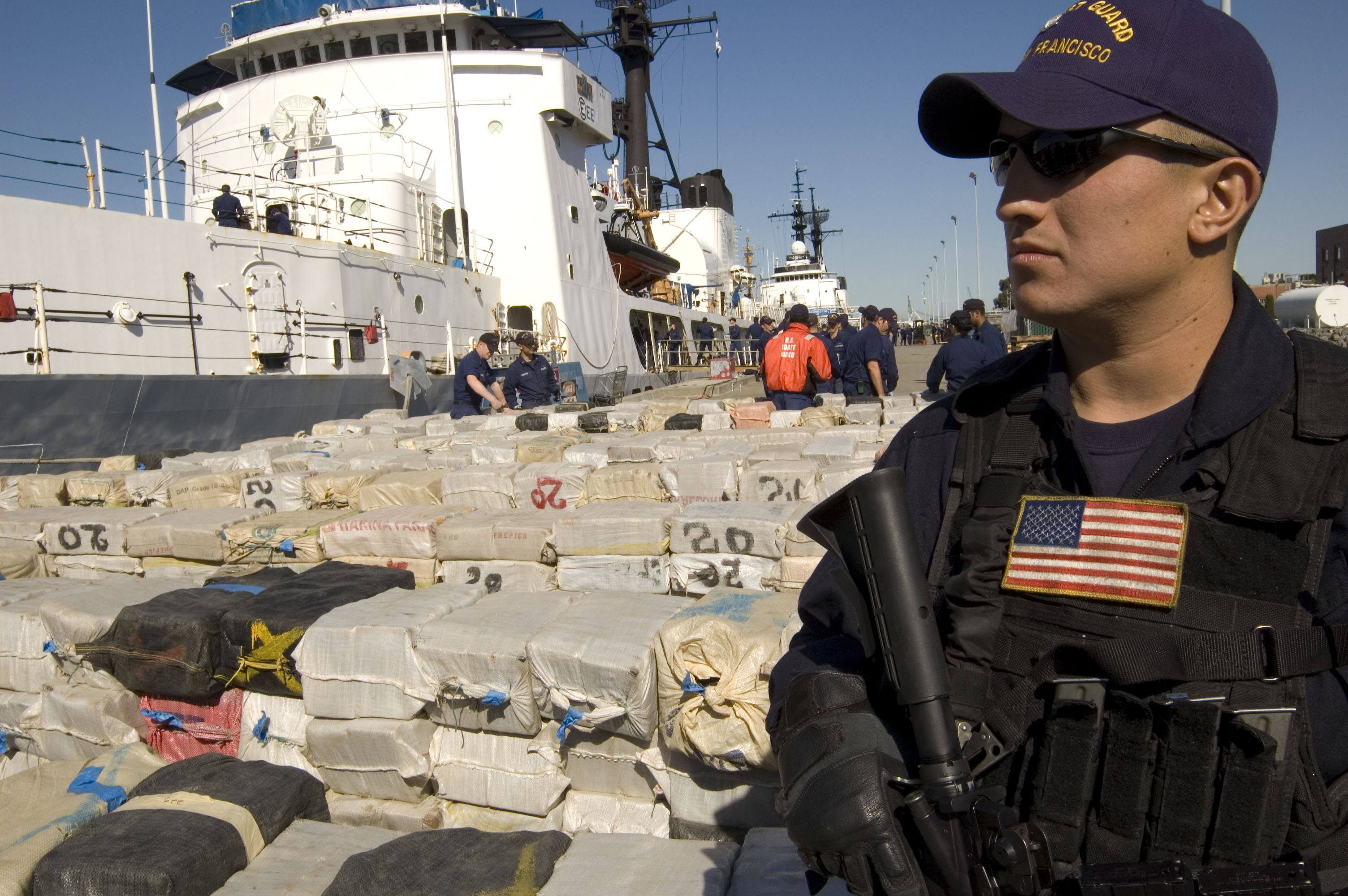
A U.S. Coast Guard sailor stands guard over more than 40,000 pounds of Latin American cocaine seized in 2007 and valued at around $500 million. Latin America's long history of adaptive drug production and distribution and persistent U.S. demand for narcotics help to explain why the U.S. 'war on drugs' has resulted in so few battles won despite its enormous cost in money and human lives.
Forty years after President Richard Nixon declared a 'war on drugs,' the countries of Central and South America remain a central battleground. Though the horrific drug violence in Mexico has captured our attention recently, the history of the trade in the region stretches back much farther. This month, historian Steven Hyland explores how illicit drugs have been one of Latin America's principal contributions to our globalized world, and how narco-trafficking has adapted to market shifts in taste and demand and global and local politics over the last century.
Readers may also be interested in these recent Origins articles: Populism and Anti-Americanism in Modern Latin America, Brazil's 2010 Election, and The United States and the Fate of Modern Haiti.
In June 2011, the non-governmental organization Global Commission on Drug Policy published a report detailing the failure of global and national illicit-drugs policies and urging a fundamental change in approach to the global drugs trade.
The report coincided with the fortieth anniversary of President Richard Nixon's famous declaration of the "war on drugs." It offered a variety of policy measures for individual states to consider, ranging from targeted legalization to health services for those afflicted by addiction and prevention programs designed to limit the number of new users.
These sharp critiques and proposed policy initiatives come after the billions of dollars invested in the militarization of the drug war by the U.S. and its far-reaching consequences for societies in Latin America and elsewhere.
The violence associated with the trafficking of illicit narcotics and stimulants continues to stoke a macabre fascination among North American observers and politicians, who bandy about tired terms and phrases such as narco-terrorism, failed states, and security.
But it is the long history of drug production and distribution in Latin America—and the enduringly strong demand for narcotics in the United States—that best helps to explain why the "war on drugs" has resulted in so few battles won and has come at such a great cost both in money and human lives.
The trafficking of illicit drugs is a signature Latin American contribution to our globalized world, and today Colombia and Mexico play the paramount roles in terms of production and distribution. While cocaine, heroin, and marijuana have long figured as primary trafficked products, in the recent past drug trafficking organizations (DTOs) have increased shipments of methamphetamines. Yet, this contemporary arrangement was not always the case.
The production, trafficking, and distribution of drugs to consumers have moved geographically many times across Latin America. Like all successful businesses, organizations for narco-production and narco-distribution have responded rapidly and extensively to changing tastes and strong market demands in the consumer countries especially the United States.
At the same time, the often drastic shifts in the political fates of Latin American countries, geopolitics (most notably the Cold War), supra-state institutions (such as the United Nations with its anti-drug policies), and the increased militarization of efforts to eradicate drugs production (spearheaded by the United States) have also shaped the development of the narcotics trade.
In broad terms, the development of the Latin American drugs industry can be broken into four periods. From the late nineteenth century to 1945, Mexico controlled the illegal trade in opium and marijuana, and Peru dominated the mostly legal trade in cocaine products. A second period, from the end of World War II to the 1960s, saw the professionalization and greater organization of trafficking as networks of traffickers emerged.
The third era, from the 1960s to 1984, witnessed the rise of Colombia as the predominant producer and trafficker after Bolivia, Chile, and Cuba fell by the wayside and the Mexican government attempted to curb marijuana and opium production. This period also witnessed a sharp spike in the violence associated with the drug trade. Finally, Mexico has returned to a leading role since 1984 (as a result of connections made with Colombian traffickers in Panama), and drug-trade violence continues to escalate.
The history of Latin American narcotics production and distribution thus reveals the ways in which efforts to suppress the drug trade in one state have tended only to shift its location to another country in the region. Entrepreneurs throughout Latin America worked to take advantage of any opportunity to increase their share of this highly lucrative business and to take advantage of consistently strong demand.
Many drugs pose very real personal health or societal dangers. But, bluntly speaking, they are also commodities traded and consumed by societies for a variety of reasons, including casual and social uses, health purposes, and religious rites and rituals. It is the ways in which certain societies and polities view particular mind-altering substances that make one or many narcotics and stimulants acceptable or not.
These views of drugs have changed markedly over time and in different places. The designation of items such as cocaine, marijuana, and alcohol as illicit had far-reaching consequences in Latin America on the development of production zones, trafficking networks, destination markets, profitability, and violence.
From Opium to Cocaine: Creating the Latin American Narco-System (the late 19th century to 1945)
The beginnings of large-scale narco-trafficking in Latin America came with the production of coca and coca-based goods in Peru and the movement of opium and marijuana from Mexico into the United States.
As described by Paul Gootenberg, a legal cocaine industry emerged in Peru in the late nineteenth century and serviced pharmaceutical and commercial concerns in Europe and the United States. Cocaine is a derivative of the coca plant, a plant endemic to the Andean highlands and chewed by the indigenous populations residing in the present-day countries of Peru and Bolivia. During the colonial period (1532-1825), Spanish bureaucrats and elites largely viewed the consumption of coca as evidence of the local populations' inherent backwardness.
Beginning in the nineteenth century, however, scientific curiosity in coca emerged. These interests were largely based on the myths propagated by European travelers attesting to the coca leaf's power to allow indigenous peasants to work endlessly and commit great feats of strength as muleteers and porters.
Coca earned the interests of entrepreneurs who created tonics, such as Vin Mariani, that infused the plant into an energy drink to salve the vagaries of modern life. As a result, coca exports to German pharmaceuticals, such as Merck, increased in the second half of the nineteenth century.
In 1860, a graduate student in a German university gained the cocaine alkaloid from imported Peruvian leaf. Two decades later, the ophthalmologist Karl Koller proved cocaine to be an effective anesthetic for eye surgeries, and it was later utilized in dentistry and spinal surgeries.
In the years that followed, a booming international market emerged for coca and medicinal cocaine. The U.S. quickly became the largest and most enthusiastic market for coca products and rivaled German manufacturers in terms of cocaine production. Most famously, in 1886 John Pemberton produced Coca-Cola as a non-alcoholic herbal remedy to compete against the French Vin Mariani and as a response to the prohibition of alcoholic beverages in Atlanta.
In response to this new market, Peru promoted coca exports and a vibrant, legal cocaine manufacturing sector. In 1885, the Peruvian pharmacist Alfredo Bignon created a "crude cocaine," or cocaine sulfate, by using an efficient kerosene precipitation method. This innovation allowed for easier shipment in terms of size and, more importantly, the power of the cocaine alkaloid was not lost like in coca leaves that dried out during shipment abroad.
Because of the newfound medical use, and increasing European and American acceptance of cocaine, Peruvian liberal elites praised cocaine as a viable, national industry. Placing cocaine at the heart of Peruvian economic growth and trade led to a spurt in entrepreneurial activities throughout the Peruvian highlands. Nearly two dozen cocaine factories were in active operation by 1905.
Despite the early enthusiasm for cocaine by Peruvian elites and by North American and European physicians, surgeons, and commercial concerns, the first half of the twentieth century saw Peruvian coca and cocaine confront a series of challenges.
In the first decade of the 1900s, the reputation of cocaine plummeted. The U.S. government initiated a crusade to limit the production and export of coca and cocaine, as well as opium and marijuana, because government officials came to believe that cocaine was a threat to society.
This belief in the social threat of drugs, infused by the assumptions and beliefs of the Progressive Era, gave rise to the mythical cocaine "fiend" in American popular culture. A series of laws beginning in 1914 with the Harrison Act led to the prohibition of cocaine by 1920.
In the 1920s, during the period of America's alcohol Prohibition, the United States led an international drive to ban cocaine. However, the League of Nations and such producers as Peru, the Netherlands, and Japan resisted the effort.
Although allies against any ban on cocaine, Peruvian coca and cocaine competed on the market against Javan coca initiated and developed by Dutch colonialists, and later, from Imperial Japanese coca grown on Formosa (Taiwan).
As result, the legal cocaine industry limped along throughout the first half of the twentieth century. Peruvians were alternatively defensive of this crucial national industry and supported legal cocaine, at the same time that they were dismissive of what some elites saw as the "backward" native use of coca.
While Peru struggled to figure out what to do with its coca trade, an illicit production and trafficking network was also developing during the first half of the twentieth century in Mexico.
During the Mexican Revolution, which began in 1910, opium traveled up from Baja California and passed through the border towns of Mexicali and Tijuana, destined for the opium dens in San Francisco and Los Angeles.
As part of its long-standing opium trade in China and elsewhere in Asia, Europe initially produced much of the trafficked opium. Thanks to the Panama Canal, the product was more easily moved from Atlantic to Pacific, where it transited Nicaragua and entered Mexican ports.
Although the opium poppy had been grown in Mexico since the end of the nineteenth century, local production began to surge following the Mexican state's prohibition on the importation of opium in 1920. Despite a rapid production increase, Mexican poppy growers could not meet market demands. In the 1920s and 1930s, traffickers in Ciudad Juárez imported opium and morphine produced in India and Burma that transited Hong Kong, Los Angeles, California, and El Paso, Texas.
Marijuana was also produced in increasing quantities in Mexico over the course of the first half of the twentieth century, as fields blossomed in the central states of Puebla, Guerrero, and Tlaxcala. The target market was the growing demand in the United States. Marijuana consumption by residents of Utah was perceived so worrisome that the state banned its consumption in 1915. Even after the Mexican government prohibited marijuana in 1920, production could be measured in tons by the 1930s.
A loose network of traffickers evolved, which included Mexicans, Chinese, and U.S. citizens, in addition to immigrant Romanians, Spaniards, French, Greeks, and Japanese on both sides of the border.
These traffickers worked closely with local political elites and law enforcement officials. Beginning in the 1920s, the emergent Mexican political class viewed trafficking as just another profitable business opportunity. As such, the most important politicians of these northern states, including Governor Esteban Cantú Jiménez of Baja California, managed, allowed, and regulated the trade within local power arrangements. Scholars have asserted that the direct involvement of local political elites played an important role in reducing conflict and violence over the drug trade.
Peru and Mexico were not alone in their burgeoning drug production and distribution. Marijuana was introduced to Colombia before World War I from Panama. In 1925, the Colombian government noticed its extensive cultivation and consumption and by 1940 the Colombian state initiated an anti-drug campaign.
Cuba also emerged as a transit point and destination for illicit narcotics during the first half of the twentieth century, and organized crime groups from the United States established themselves there during Prohibition.
Taking Deep, Firm Root: 1946 to 1960s
The emergence of the United States as a global power and the growing importance of supra-state organizations like the United Nations characterized the second period of Latin America's evolving drug trade. In this new global context and in the highly unstable political environment of post-war Latin American politics, the production and distribution of drugs became both more organized and more regional in scope as it continued to shift across Latin America. Most tragically, this period witnessed the massive expansion of drug-trade connected violence.
In the wake of World War II, the United States and the United Nations emerged as the leaders of international anti-drug initiatives. The United Nations adopted the goal of eradication of the Andean coca bush in 1948. Peru, isolated politically and led by a pro-U.S. military junta, finally criminalized cocaine.
Yet, by 1948, an emerging network of traffickers connected Lima and Havana to New York City and other North American urban drug scenes, replacing irregular and opportunistic smuggling by individuals. Time Magazine reported in April 1949 that a Cuban diplomat stationed in Peru was arrested while carrying nearly one kilogram of cocaine in a diplomatic pouch.
Bolivia emerged as a key player in the development of the illegal cocaine complex following its 1952 revolution. The overthrow of the Bolivian government resulted in the dismantling of the national army and immediately created a vacuum of state power. The revolution also gave indigenous peasants access to large amounts of land, leading to a surge in coca production.
Coca consumption in Bolivia is an accepted social convention practiced by the indigenous majority and other segments of Bolivian society. With the criminalization of the cocaine industry in Peru, Bolivia stepped in after 1952 to nurture this illegal enterprise.
At the same time, Cuba became perhaps the most consequential location for the development of cocaine as a pleasure drug. Havana was one of the "first post-war global sin capitals"—a distinction that dated back to the Prohibition era in the United States—and a locus of conspicuous consumption. By 1954, Havana had the most Cadillacs per capita of any city in the world. Here, American mobsters mingled with their counterparts from Mexico and Central and South America.
This wealth—coupled with Havana's renowned hedonism industries of casinos, prostitution, and sex clubs—created a fertile location to test-market cocaine as a leisure drug. Entrepreneurs in Bolivia and Chile began exporting cocaine to Havana for further distribution to the U.S. and beyond. By the mid-1950s, Havana had emerged as the nexus of this intercontinental cocaine trade.
By driving out drug dealers, however, the 1959 Cuban Revolution transformed cocaine distribution. Smuggling corridors disappeared, as this network of traffickers based in Havana sought places of refuge throughout the Americas, from Argentina (to set up operations near Bolivia) to Mexico (to establish distribution facilities) and to Miami (an important entry point to the lucrative U.S. market).
For its part, the illicit drugs trafficking complex in Mexico matured as it became increasingly integrated into local political and social structures.
In 1947, U.S. Secretary of State George Marshall forwarded a report by Harry Anslinger, the U.S. representative on the U.N. Commission on Narcotic Drugs, to the U.S. ambassador in Mexico City. The report focused on opium production in Mexico, noting the principal producing area covered nearly 6,000 square miles, numbered 4,500 fields with an annual production of 32 to 40 metric tons of opium. During the year, the Mexican government was only able to eradicate 200 fields, equal to 90 acres of fields, which paled in comparison to the 10,000 to 12,000 acres under production at the time. There were at least 12 clandestine labs that apparently processed half of the raw opium produced in Mexico into either morphine or heroin.
U.S. criminal groups in Mexico encouraged the cultivation of opium and worked to produce less bulky, yet more valuable derivatives. Traffickers utilized twenty to thirty airfields to facilitate the movement of these drugs into the United States. Air trafficking of drugs intensified in the coming years, prompting the Mexican government to postpone all commercial flights in the states of Chihuahua, Durango, Sinaloa, and Sonora. By the 1960s, officials estimated traffickers used some 300 airfields in northern Mexico alone.
The Rise of Colombia and the "War on Drugs:" 1960s to 1984
The structure of the international drug trade again changed in the 1960s and 1970s as demand for marijuana surged in the 1960s and for cocaine in the 1970s and 1980s.
As traffickers became more sophisticated and demand increased, the U.S. Government declared a War on Drugs in June 1971. And while the United States devoted more resources to eradication, interdiction, and the extradition of traffickers, the level of drug violence in Latin America and the U.S. surged dramatically. This violence was one of the most tragic, unintended outcomes of American anti-drug efforts.
By 1975, the epicenter of marijuana production shifted from long-dominant Mexico to Colombia, spurred on by a sharp rise in demand for marijuana in the U.S. After constant prodding by the U.S., the Mexican government initiated Operation Condor in 1975—cracking down on opium and marijuana production and distribution in the northwestern Mexican states of Chihuahua, Durango, and Sinaloa. The United States locked down the Mexican border while the Mexican state launched a campaign against its domestic producers.
These policies inadvertently offered Colombian traffickers an opportunity to seize the marijuana market. By the end of 1970s, Colombia owned seventy percent of the marijuana reaching the United States from abroad.
Colombia had a long history at the heart of regional contraband trade and smuggling. This, and a tradition of tremendous political instability, contributed to its ascension to the global apex of the trafficking of illicit drugs. Fabulous inequality of the national wealth coupled with the success of the Cuban Revolution to inspire entrenched guerilla warfare. There were an estimated 12,000 to 15,000 guerilla combatants in Colombia by late 1980s. Left-wing violence produced right-wing responses, with a great expansion in the 1980s, with some 138 organizations, some of which contained retired and active military personnel. Violence became part and parcel of political life.
The marijuana trafficking complex proved critically important for the local economy in Colombia. Between 30,000 and 50,000 small farmers along Colombia's Atlantic coast relied on marijuana cultivation. The system also included as many as 50,000 additional seasonal workers, traffickers, security, financiers, and others.
New moneyed drug elites married into local prominent families, attempted to bribe officials at all levels, and bought up legitimate businesses to launder cash. Unfortunately, as production and profits surged, so did the violence as police and judicial institutions waned.
Cocaine distribution followed the networks established for the marijuana trade. Here, political events in Chile also pushed the drug trade to Colombia. Chile became an important smuggling corridor after cocaine production in Peru was criminalized and Bolivia emerged as a center of coca production in the 1950s. Trade grew until the army, led by Augusto Pinochet, overthrew Salvador Allende in September 1973.
Entrepreneurs from Medellín, Colombia seized on the opportunity presented by the collapse of democracy in Chile and the elimination of Chilean smugglers. And they took drug transportation to new levels. In the mid-1970s, Carlos Lehder and Jorge Luis Ochoa transformed the trafficking of cocaine into huge airlift operations.
After consolidating control of the South American market, the traffickers in Medellín looked to control wholesale distribution in the highly profitable United States. As a result, Miami—the principal port of entry—became a virtual war zone, with a homicide rate of seventy per 100,000 in 1980. (By comparison, the 2010 homicide rate for Miami was fifteen per 100,000 and about six per 100,000 in the U.S. as a whole in 2007.)
By 1981, seventy percent of all marijuana and cocaine coming into the United States passed through South Florida. In 1976, between 14 and 19 metric tons of cocaine were smuggled into the U.S. That number jumped to nearly 45 metric tons annually by 1982. Colombian traffickers generated roughly $1.5 billion in revenue from the marijuana and cocaine trade in 1980 and almost $3 billion in 1985.
Time Magazine's famous November 1981 lament, entitled "Miami: a paradise lost," reported on the problems of trafficking, violence, and money laundering in South Florida, while the television show Miami Vice seared the images of Latin American drug runners, bosses, and heroic law enforcement officers into U.S. popular culture.
The 1981 kidnapping of the sister of Jorge Luis Ochoa, a prominent trafficker based in Medellín, by leftist M-19 guerrillas proved a critical moment in the evolution of Latin American drugs trafficking. The guerillas demanded a $1 million ransom. In response, Ochoa called together the leading traffickers to meet at his family restaurant. There, all agreed that their wealth made them targets of the guerillas and paramilitaries. Each trafficker offered up $7.5 million to form MAS, a Spanish acronym translating to "Death to the Kidnappers."
This agreement started the Medellín cartel and effectively ended the cocaine wars that bloodied the streets of Miami. In addition, each trafficker donated money to build a massive cocaine lab on the Yarí River in southern Colombia.
A division of labor soon emerged. Jorge Luis Ochoa and his two brothers oversaw the distribution networks in Florida and California. Carlos Lehder organized the air transport into the United States, using a Caribbean island as a stopover. The most infamous member of this cartel, Pablo Escobar, served as the muscle. It is believed that he employed 200 gunmen and established two assassin training schools.
Medellín traffickers attempted to expand their social and political sway in an attempt to normalize their business in Colombian society. Traffickers contributed to political campaigns. Several, such as Lehder, bought radio stations and newspapers. Escobar created a welfare program, gave alms to the poor, built low-income housing in the slums, and won election as an alternate congressman on a Liberal Party ballot.
At the same time, the trafficking in drugs supported many legal businesses throughout Latin America. For instance, Argentina experienced a surge in hydrochloric acid exports to Bolivia in the 1980s, an additive in the production of cocaine. (In the earlier part of this century, Argentina witnessed a similar surge in ephedrine exports to Mexico, a critical ingredient in the production of methamphetamines.)
Other events in the early 1980s transformed the landscape of Colombian drug production and distribution. The extradition treaty between Colombia and the United States, which was signed in 1979 and enacted in 1982, provoked a spike in violent crime by the cartel.
In addition, a joint Colombian police-DEA raid on the Yarí River facility in March 1984 netted a seizure of fourteen tons of cocaine (with an estimated street value of $1.2 billion), seven airplanes, and some weapons and production materials. The cartel responded by assassinating the Colombian minister of justice.
Colombia unleashed a crackdown on the Medellín cartel following the assassination, which forced Escobar and the Ochoa brothers to hide in Panama in May 1984. While there, these traffickers attempted to negotiate a settlement with the Colombia government. The men, who controlled three-quarters of the South American cocaine trade, offered to turn over landing strips and labs, promised to invest their capital into national industries, and proposed to pay $15 billion in cash, the equivalent of Colombia's foreign debt. The deal was refused due to pressure from the Reagan administration and Colombian popular resentment to negotiating with the cartel.
As a result of the Colombian government's refusal of their offer, the cartel began to make new connections with Central American traffickers who introduced the cartel to Mexican heroin and marijuana smugglers and Mexican authorities willing to be bribed. These ties opened Colombian cocaine to smuggling routes in the American southwest and set the stage for the rise of violent Mexican trafficking organizations.
Following 1984, the Medellín cartel began to self-destruct, even as its power and attending violence grew. The Ochoa brothers turned themselves into Colombian officials in 1990 for lenient prison sentences and were released in 1996. Pablo Escobar was shot and killed with the help of U.S. material aid in 1993. Carlos Lehder is serving a life sentence in a U.S. federal prison.
Yet, the connections made by the Medellín cartel with Mexican traffickers while in Panama in 1984 proved to be a turning point, with Mexican groups increasingly ascendant in the movement of drugs into the U.S.
By 1986, traffickers had diverted forty percent of cocaine flowing into the United States from the historical Caribbean routes to transit networks along the U.S.-Mexican border. Miguel Ángel Félix Gallardo, a former bodyguard of the Sinaloan governor, was the first Mexican trafficker to move Colombian cocaine into the United States across the southwestern border. Today, ninety percent of cocaine smuggled into the United States passes through Mexico.
A Return to Mexico: 1984 to the present
With the demise of the Colombian cartels, which controlled distribution into North America, Mexican drug trafficking organizations now dominate the wholesale drug trade in the United States. The business is extremely lucrative with wholesale illicit drug trade earnings now estimated between $13.6 and $48.4 billion annually. Mexican and Colombian trafficking organizations annually smuggle an estimated $8.3 to $24.9 billion in drug proceeds into Mexico for laundering.
There are four major Mexican drug trafficking organizations (DTOs)—the Gulf, Sinaloa, Juárez, and Tijuana—who have sometimes formed alliances. The Tijuana and Gulf organizations joined forces after their respective leaders struck an agreement in prison. The so-called Federation emerged after agreements by leaders from the Sinaloa, Juarez and Valencia cartels.
Evidence suggests Mexican DTOs are working in conjunction with American gangs to distribute products such as methamphetamines. Mexican operations are mainly interested in the wholesale trade and leave the retail to American gangs.
The emergence of enforcer gangs is a direct consequence of internal fighting among the Mexican DTOs. The most notorious of these gangs are the Zetas, originally employed by the Gulf Cartel as assassins on their behalf (as well as its rivals).
The Zetas were almost certainly formed by a group of 30 officers who deserted from the Mexican military's Special Air Mobile Force Group (GAFES) to the Gulf cartel in the late 1990s. This background allows the Zetas, who number between 31 and 200 men, to carry out more complex operations and use more sophisticated weaponry.
Officials believe this organization controls trafficking routes along the eastern half of the U.S.-Mexico border and have set up airfields in northern Guatemala to assist in logistical support and transportation of cocaine from Colombia.
Mexican and U.S. drug officials now say that the Mexican cartels have closed ranks, including the apparently short-lived "New Federation" that included the Gulf, Federation and La Familia organizations. This new conglomerate has begun to fight the Zetas, who are now viewed as having become too powerful and determined to take over the trade themselves. The violence long associated with Colombian drugs trade now characterizes the Mexican trafficking complex.
Latin America and the Future of Narco-trafficking
The many legal prohibitions and international efforts to eradicate illicit drugs, especially since the "war on drugs" began, have done little to end narco-trafficking. Instead, they have tended only to influence the location of production and methods of distribution. Demand for these drugs and their attendant profitability continue to drive the cycles of manufacture and circulation of these products.
Traffickers are constantly adapting to the state of the market. Of the five principal illicit drugs trafficked into the United States, only cocaine is on the decline. The trafficking and availability of heroin, methamphetamines, marijuana, and ecstasy are all increasing, and Latin American DTOs are involved in four of the five commodities. (Ecstasy is the domain of Asian DTOs that use Canada as a gateway into the United States.)
Colombian DTOs are increasingly identifying new markets for cocaine. Europe is an attractive destination because profitability is similar to the U.S. market, yet the penalties for trafficking at the wholesale and retail levels are significantly less onerous than in the U.S. legal system. Law enforcement officials have noticed an increase of cocaine trafficked in Spain and United Kingdom as Colombians are using unstable West African states as transit nodes. In addition, Colombians are penetrating Asian markets with greater intensity, using Hong Kong as a gateway into China and Thailand. Mexican DTOs are now the premier traffickers of methamphetamines into the United States.
The future of narco-trafficking in Mexico remains unclear. The Mexican state initiated a frontal assault in 2006, under the aegis of President Felipe Calderon. Since then, more than 23,000 Mexicans have lost their lives. In 2009, there were 2,100 drug-related murders in Ciudad Juarez—a poignant contrast to El Paso, just on the other side of the Rio Grande, which had only ten homicides that year.
In response to the violence, grieving families have criticized this frontal assault policy, much of which is underwritten by U.S. taxpayer dollars. Some have formed civil-society groups that demand a rethinking of policy and argue that trafficking must be controlled, but not at the expense of the larger Mexican social fabric.
An open question concerns the 2012 Mexican Presidential election. Certainly, the issue of trafficking will frame the campaign debates as many observers are predicting an almost certain victory for the opposition Institutional Revolutionary Party (PRI), regardless of its candidate.
Addressing the desire to consume these narcotics and stimulants, however, is the issue that must be the basis for designing programs and policies that can diminish the abuse, addiction, and violence associated with the drugs trade.
As noted in the Global Commission's report, the number of global consumers of opiates, cocaine, and marijuana increased from 1998 to 2008—and this in spite of the billions of dollars spent, the tens of thousands of lives lost, and the hundreds of thousands of people incarcerated for production, distribution, and consumption.
The report also urges countries to rethink how to treat various social groups along the drug commodity chain, such as creating programs for farmers to grow alternative and equally remunerative agricultural products and secure access to markets.
Without the simple admission by the U.S. and other destination markets that demand drives production and distribution, control of this trade is likely to remain a futile endeavor.
Astorga, Luis. "Drug Trafficking in Mexico: A First General Assessment." Discussion Paper No.
36. Management of Social Transformations – MOST. UNESCO. Accessed July 26, 2011.
http://www.unesco.org/most/astorga.htm.
Astorga, Luis. "Mexico: Drugs and Politics." In The Political Economy of the Drug Industry:
Latin America and the International System, edited by Menno Vellinga, 85-102.
Gainesville: University of Florida Press, 2004.
Bagley, Bruce. "Colombia and the War on Drugs." Foreign Affairs 67, no. 1 (1988): 70-92.
Gootenberg, Paul. Andean Cocaine: The Making of a Global Drug. Chapel Hill: University of
North Carolina Press, 2008.
Gootenberg, Paul. "Talking About the Flow: Drugs, Borders, and the Discourse of Drug
Control." Cultural Critique 71, no. 1 (2009): 13-46.
Hanratty, Dennis M. and Sandra W. Meditz, eds. Colombia: A Country Study. Washington:
GPO for the Library of Congress, 1988. Accessed July 26, 2011.
http://countrystudies.us/colombia/.
Mottier, Nicole. "Drug Gangs and Politics in Ciudad Juárez: 1928-1936." Mexican Studies/Estudios Mexicanos 25, no. 1 (2009):19-46.
Sáenz Rovner, Eduardo. The Cuban Connection: Drug Trafficking, Smuggling, and Gambling in Cuba from the 1920s to the Revolution. Chapel Hill: University of North Carolina Press, 2008.
Recio, Gabriela. "Drugs and Alcohol: US Prohibition and the Origins of the Drug Trade in Mexico, 1910-1930." Journal of Latin American Studies 34, no. 1 (2002): 21-42.
U.S. Department of Justice. National Drug Intelligence Center. National Drug Threat Assessment 2010 . Washington, 2010.
U.S. Library of Congress. Congressional Research Service. Mexico's Drug Cartels by Colleen
W. Cook. Washington: The Service, 2007.


