
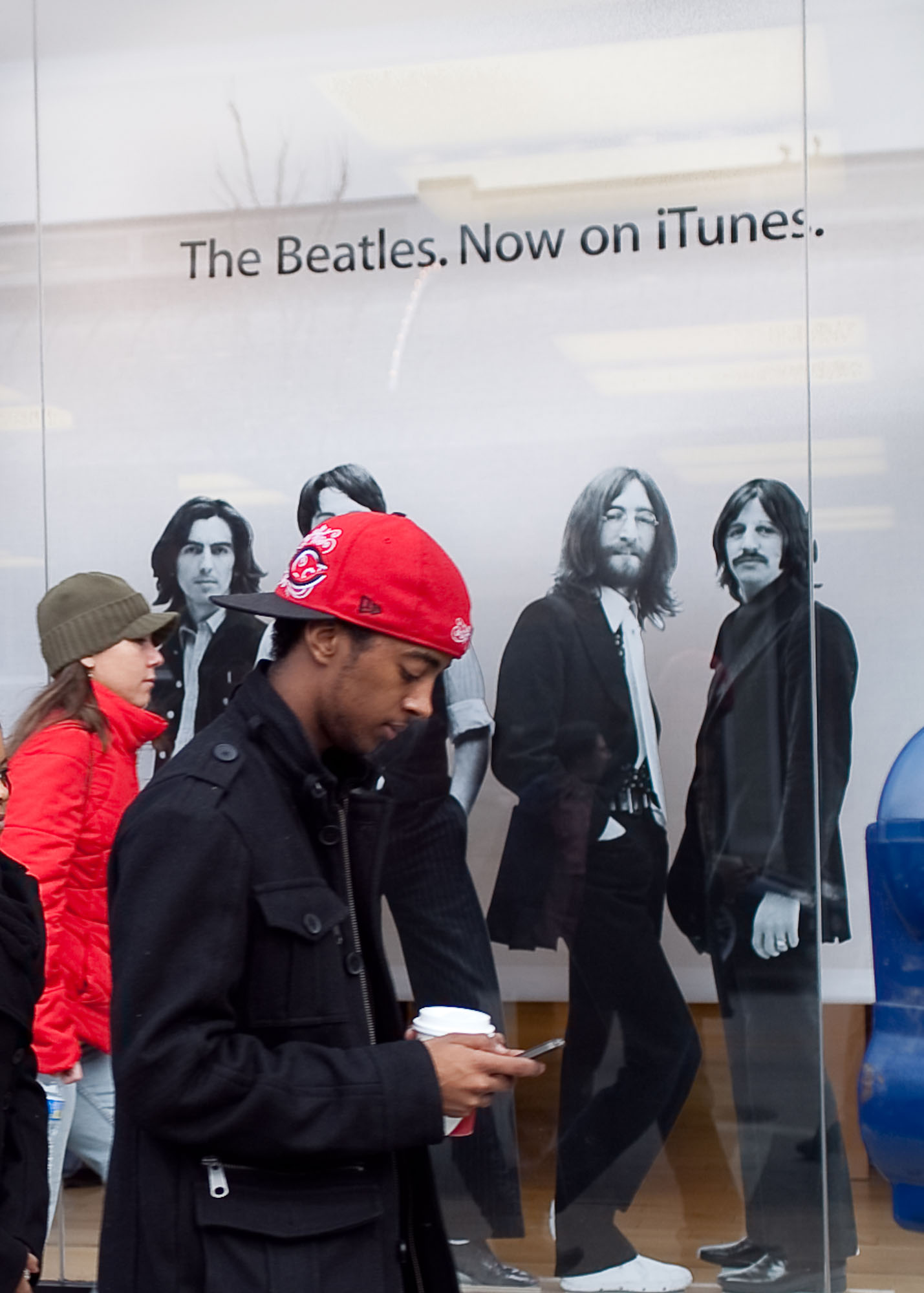
A young man stays connected on his cell phone as he strolls by a store advertising the Beatles' music on Apple's online store. The concept of 'alienation,' the predominant and popular explanation after World War II for social and psychological discontent in affluent societies, now seems to have gone by the wayside in our contemporary age of consumerism, 'choice,' social media, and instant communications. (Photograph by Marco Calderon. Copyright 2010. marcocalderonphoto@gmail.com)
Alienation. In the 1950s and '60s, this concept was used by sociologists, psychologists, pundits, and critics to explain any number of social problems. Kids were 'alienated' from their parents and from the larger society; adults were 'alienated' from their work and from their communities. It was a powerful concept and one that defined a generation of social commentary. Now, it seems, no one is alienated anymore. Historian David Steigerwald examines what happened to the notion of alienation by looking at the roots of the idea, the way it was used, and how it has disappeared from our discussion. Perfect reading for the holiday season!
Readers may also be interested in these recent Origins articles about current events in the United States: The Debate Over Illegal Immigration, Updating 'No Child Left Behind' , The Policymaking of Student Loan Debt, Detroit and America's Urban Woes, the Mortgage and Housing Market Crisis, and the 2nd Amendment Debate.
Over the last year, we have come to know a good deal about Umar Farouk Abdul Mutallab. You'll remember that he is the young Nigerian passenger who last Christmas attempted to blow up a Detroit-bound airliner, known now to the world as "The Underpants Bomber." Luckily, he was an amateur. The only one he hurt was himself.
The more we learned about him, the odder it seemed that he should have become a terrorist. This fresh-faced twenty-three-year old enjoyed a privileged upbringing. His father, a wealthy banker and former Nigerian economics minister, made sure his son had the best of everything.
His was "a gilded life," according to the Independent, which included the best schools and expensive homes. "With his wealth, privilege, and education," the newspaper declared, he "had the world at his feet—able to choose from a range of futures to make his mark on the world."
Yet the son went off to sojourn with Yemeni jihadis, and the father was so worried about him that he asked U.S. officials not to renew his visa. "My family system, our village system, broke down," the father explained.
New York Times columnist Thomas Friedman, that one-note charlie of globalism, complained soon after that there weren't enough such fathers in Muslim societies: "Unless more Muslim parents, spiritual leaders, political leaders—the village—are ready to publicly denounce suicide bombing . . . this behavior will not stop."
Friedman didn't bother to ask why the son of such a man might have given himself over to radical Islam; much less did he bother to ask himself what the present state of this hypothetical "village" might be. He avoided more or less entirely the central question: Why would a privileged youth feel drawn to immerse himself in so deadly a cause?
We used to have a handy answer to that question. We used to call such young people "alienated youth."
Between the end of World War II and the 1970s, it was a truism that affluence bred alienation as the institutions of modernity replaced more traditional social relationships. Alienation, in turn, was presumed to generate either apathy, on the one hand, or rage against the machine, on the other.
This same explanation holds merit for our understanding of young Mr. Mutallab. The reason why "Muslim parents, spiritual leaders, political leaders—the village," as Friedman puts it, are unable to direct the lives of some of their young people is because the very processes of economic and technological change that Friedman and others never tire of promoting systematically undermine the power of those traditional forms of authority.
Alienated from traditional authority, privileged young people are apt to harbor contempt for the village. Their basic identities dissolved away in the transition to affluence, young people like Mr. Mutallab predictably gravitate toward extremists who promise a restoration of what presumably has been lost.
Such lost souls are the flotsam and jetsam of fundamental social change, and one never knows exactly where they will end up. But undoubtedly for some, suicide for a cause is an appealing alternative to a life shorn of meaning.
Alienation Arrives in America
For those of us who study the intellectual and cultural history of the post-World War II West, it is strange that the concept of alienation seems to have evaporated. It was the paradigmatic explanation for social behavior in the 1950s and 1960s.
In the 1950s, alienation explained the timidity of white-collar workers and the conformity of suburbanites. It explained the eruption of juvenile delinquency in middle-class communities. It accounted for high divorce rates and the heavy use of alcohol and barbiturates among the professional classes.
Both the decline in voter participation and the political irrationality of the Red Scare were chalked up to alienation. In The Feminine Mystique, Betty Friedan deployed the concept to give voice to the vague but powerful "problem with no name."
The concept gained even more persuasive power in the 1960s, when a generation of young people who had enjoyed unprecedented affluence erupted in radical protests across the developed world. Some rode that wave of public activism to violent extremes.
The causes of alienation were well understood. Privileged young people rebelled against the Affluent Society (the title of one famous book from that era), because the institutions and processes that created material well-being did so at steep human costs. Homogenized anonymity left individuals adrift in lonely crowds (the title of another).
Powerful corporations and impersonal bureaucracies imposed rigid, inscrutable rules and turned people into IBM punch cards. Reduced to automatons, people felt powerless. Computerized technologies of production, whether on the assembly line or in the office, gutted whatever was left of the worker's control over the labor process and sucked away the pleasures of creative work.
American commercial culture offered the "choice" of three television networks that said pretty much the same thing at pretty much the same time about the same issue. The political class, united behind the Cold War "consensus," engineered the entire political apparatus to suit themselves.
Even the geography of middle- and upper-class America, de-centered into undifferentiated suburban non-communities, destroyed neighborly relationships, and, as Holden Caulfield said over and over in Catcher in the Rye, made people "phony."
These structures of affluence undermined people's control over their daily lives and removed the sources of meaningful living—creative work, human relationships not besmirched by calculation, and connections to usable and dignified community traditions of art and folkways.
At least to me, this narrative made sense in the 1950s and 1960s, and today it makes sense of jihadism's appeal to young people like Mr. Mutallab.
But when was the last time you heard someone say that alienation is the root cause of religious fanaticism? For that matter, why is it so rarely used to describe the social psychology of Americans? After all, none of those structures of power that emerged in the early postwar period have gone away, and several are arguably stronger.
No one, it seems, is alienated anymore.
In the midst of the worst economic downturn since the Great Depression, an MTV poll finds 75 percent of its young respondents reporting that they are happy, their economic worries offset by pleasing relationships with family and friends. Holden Caulfield is a has-been.
"Present-day students," a high-school literature teacher explained recently in the New York Times, "do not have much sympathy for alienated anti-heroes; they are more focused on distinguishing themselves in society . . . than in trying to change it."
Never ones to miss an obvious trend, Hollywood filmmakers have reinforced this more recent mood. The emblematic youth film of the early postwar period was James Dean's Rebel Without a Cause, the crucial scene of which had Dean screaming at his messed-up parents, "You're tearing me apart!"
By sharp contrast, the emblematic youth film of the last quarter of the twentieth century, Ferris Buehler's Day Off, was decidedly free of existential angst. Instead the protagonist is anything but alienated: Ferris, the free-spirited son swaddled in the affections of adoring suburban parents, has the world at his command.
Meanwhile, the intellectuals, who as a class were not only responsible for disseminating the concept but who, legend has it, were once alienated themselves, rarely employ the concept anymore. It no longer speaks to their condition. Secure in tenured university posts and yet often given to the self-delusion that they are still radicals, content in their comfort and given to toothless criticism, they enjoy their avocational prerogatives without the discomfort of the hand-to-mouth existence of bohemia.
Alienation? Who needs it? It doesn't pay well, and there's no 401(k).
The Roots of the Idea
So where did the concept of alienation come from and why did it carry such power in the early postwar period?
As a formal philosophical proposition it begins with Georg Hegel, whose phenomenology deployed alienation as a way to describe the individual separated from Truth. Most people, though, connect the concept to Karl Marx, who applied it to the separation of the worker from the work process in the development of capitalism.
The great Continental sociologists, Georg Simmel, Max Weber, and above all, Emile Durkheim, added elements to the concept. Simmel spoke of the "stranger" in urbanizing societies. Weber decried modernity as the "iron cage" of bureaucracy. And Durkheim's anomie challenged the quaint notion that human happiness would inevitably increase with material well being. Anomie, he insisted, was more likely to set in because of modernization, not in spite of it.
If anomie and alienation were not exactly the same concepts, their close kinship and the quickly broadening use of each in the 1950s washed away their differences, so that by 1960 they were more or less synonymous in conventional usage.
Explaining why these ideas gained purchase in postwar America is an exercise in the sociology of knowledge. Each had its appeals. Radical humanists warmed to Marx's alienation as a way of keeping faith with dialectical materialism without bowing to Communist dogma, a very useful thing in Cold War America.
Weber's critique of the bureaucratic regime obviously appealed in a society where conglomerates and the Cold-War state dominated.
Because Durkheim warned that modernization had severe socio-psychological effects, he spoke powerfully to the condition of a society that had gone from its most severe depression, through the enormous sacrifice of world war, to the greatest prosperity in human history in less than a generation.
No wonder Americans felt discombobulated.
Those Damn Alienated Kids
By nearly every account, youth were.
American intellectuals were never more secure than when they moved from their precarious existence as independent writers to tenured professors. They were never more alienated than when they woke up to see that they had traded independence for the bureaucratized grind of university life.
Factory workers were never so well paid, thanks to their unions and general prosperity. Yet every study of blue-collar workers revealed deep dissatisfaction. "The job gets so sickening—day in and day out plugging in ignition wires," one autoworker told sociologists Charles Walker and Robert Guest in the early Fifties. "I get through with one motor, turn around, and there's another motor staring me in the face. It's sickening."
Meanwhile, the white-collar managerial class, supposedly the leading edge of the post-industrial society, was increasingly yoked to computers and quartered in cubicles. The professional class had the added burden of living up to new social expectations by moving to suburbia, where they pursued the autonomy in private life that they had surrendered in their work.
Many postwar Americans chose suburban living in search of an independent, rural idyll. This was, of course, an absurdity. Surrounded by the same people they knew at work, dependent on the automobile, cowering in the corners of their cul-de-sacs in hopes of keeping the rest of the world at bay, the white-collar suburbanites were by most accounts in the early postwar years psychologically crippled.
While it turned up practically everywhere someone bothered to look, many observers came to think by 1960 that alienation fell hardest on "youth," as the ridiculously generic noun tagged them.
From the good Dr. Wertham's crusade against comic books to the raft of books such as The Shook-Up Generation, The Trouble Makers, Suburbia's Coddled Kids, and Teenage Tyranny, observers of young people wrung hands over the behavior of middle-class youth. It was this atmosphere that produced Rebel Without a Cause, the intended message of which was that coddling parents created troubled teens.
Yet young people made a cult favorite of the film because they saw in James Dean a friend in agony, suffering under what Paul Goodman called the American system of "growing up absurd."
For Goodman, youthful alienation was not just a stage-of-life problem but the product of the social system; and whether through anguished cries, drug use, or even petty crime, young people were launching rational, even necessary replies to an "absurd" situation. Far from a sign of sickness, the "youth problem" was to Goodman an indication that at least some Americans intuited that a society built on mass-produced materialism was deranged.
Thus the Sixties. Most of those white middle-class kids who launched themselves into public activism or into the non-political counter-culture did so in a self-conscious quest to overcome alienation.
The renowned manifesto of Students for a Democratic Society, The Port Huron Statement, was nothing if not a repudiation of the calcified, bureaucratic, automaton world to which they were expected to conform. Recall the opening sentence: "We are the people of this generation, having been bred in at least modest comfort, now housed in universities, looking uncomfortably at the world we inherit."
This was a sincere acknowledgment that they had benefited from affluence and were distressed nonetheless. Counting themselves "as perhaps the last generation in this experiment with living," they condemned the nuclear arms race not simply on the grounds that it could destroy the planet but also that it bred powerlessness in the citizenry.
The way through this deadening fate, the New Left insisted, was to create "participatory democracy," where individuals empathetically collected with other human beings amidst shared interests and in so doing recovered control over their daily lives.
The most vivid reaction against alienation appeared in the Berkeley Free Speech Movement in Fall 1964. Though a very brief and localized eruption of campus radicalism, the FSM generated national attention because it captured the youth struggle in crystalline form.
When the university, which under Chancellor Clark Kerr had become the prototypical bureaucratized "multiversity," arbitrarily shut down an area traditionally set aside for political speech, the students erupted in protest. The administration's ham-handed response was to arrest people.
When one such arrest took place in the middle of the afternoon at the campus gate, angry students surrounded the police car into which Jack Weinberg (he the originator of the battle cry, "Don't trust anyone over 30!") had been placed and held it captive for the better part of two days.
The administration, determined to outdo itself in the brainless exercise of authority, suspended several dozen students deemed responsible for the incident, including a charismatic philosophy major, Mario Savio. This move had the predictable effect of generating more protest, which predictably forced the administration to back off and therefore lose its credibility.
Doing the bidding of the State Board of Regents, Kerr refused to rescind Savio's suspension, and the FSM protesters, having tasted a bit of blood, kept up the pressure. In perhaps the most memorable speech by any young activist in the Sixties, Savio took the microphone on the steps of Sproul Hall, the administration building, and declared that Kerr and the Regents considered students nothing more than "raw material" for their corporate product.
With a passion that resembled nothing so much as that key scene of angst in Rebel Without a Cause, a frothing Savio declared: "There's a time when the operation of the machine becomes so odious, makes you so sick at heart, that you can no longer take part, you can't even passively take part, and you've got to put your bodies upon the gears and upon the wheels, upon the levers, . . . and you've got to make it stop!"
This remarkable moment is available on YouTube, and I've been showing it to students at the slightest excuse. Every once in a while, someone will say, "My God, that's exactly how I feel!" I'm far more impressed, however, by how few students feel any kinship with Savio, or for that matter, how few even get him.
And this brings us full circle. Why aren't we alienated anymore?
You Can Always Get What You Want: "Choice" Replaces Alienation
The most obvious answer to this question reminds us that alienation is an affliction of affluence.
Savio and his contemporaries had the enviable luxury of security. The economy of the mid-1960s was at full employment, and corporate America, then moving into its post-industrial phase, eagerly soaked up college-educated talent—even philosophy majors.
Savio and his New Left peers regarded the corporate life as the bleakest form of captive predictability—mere "plastics," as the line in The Graduate had it. Today's college students face the very opposite: uncertain prospects in a capricious world. Many, I think, find themselves wishing for some of that predictability that Savio could afford to thumb his nose at.
But this is not the heart of the matter. For all the uncertainty they create, the structures of power that made the early postwar a period of alienation were reoriented after 1970, partly in response to the political sensibilities that erupted in the Sixties and partly in response to the shape of the post-industrial economy.
American life is as bureaucratized as ever, but Wal-Mart-like, private corporations and public institutions have put on a smiley face. The cloddish corporation of mid-century was "re-invented" into the nimble "new corporation" that practices "total quality management" or any of a thousand other business school schemes designed to convince workers that they are a "team" rather than isolated individuals. The stone-faced automaker has given way to Apple, which flirts with revolution.
As the Clinton administration shredded the social-safety net, Vice President Al Gore took it upon himself to "re-invent government" into "user-friendly" bureaucracies; even the IRS got the memo and instructed its agents to play nice.
You can hardly buy a doughnut these days without filling out a customer-satisfaction survey. The consumer, the customer, the member, the individual, is constantly solicited for input, as though the single voice matters.
No institution has been more clever at bureaucratic reinvention than the university. The impersonal multiversity has become "student-centered." The university bends over backwards to make students feel welcomed. They build enormous facilities for entertainment and well being. They make resources available for students to explore whatever interest or "lifestyle" suits them, happily patting them on the back with personal encouragement.
Can anyone imagine Clark Kerr or Columbia President Grayson Kirk dancing with students as Ohio State's president Gordon Gee did recently, and on You Tube no less?
Occasionally, a slip of an administrative tongue admits that young people are now treated as "customers" rather than students, which is why at the end of every term students are asked to fill out the university version of the customer-satisfaction survey, though they call them teaching evaluations.
The university, like the niche retailer, strains to convince its clientele that each individual matters. What administrators don't want to make so clear is that students are linked to the university through the same mechanism that links consumers to their favorite stores: personal debt. [Read here for more on the history of student loan debt.]
Contemporary technologies have undergone an equally astonishing make-over. At work, the computer has moved us from the automated assembly line to the automated office, but those same computers have become so woven into our personal lives that many Americans—maybe even most—cannot live without them. We now rely on the computer for much of our leisure activity and for much of our interpersonal communication.
When the internet first came on-line, its champions assured us that it made "virtual communities" possible. Today, "social media" makes computer technology the essential tool for creating and sustaining community, identity, and personality. It is as though the very thing that poisoned one realm of life has been re-introduced as the balm of another realm.
I am struck by how well-suited these various developments have been to addressing many of the elements of alienation. Individual powerlessness was understood as the essence of alienation. Now outfitted with tools for instant messaging and commanding the world, Americans at least feel as though they can dictate their immediate circumstances.
Coddled by public bureaucracies and courted by private ones, they've become convinced that the most apparent structures of power are malleable enough that they can find room for their idiosyncrasies and maybe even make use of those bureaucracies to express their creativity.
Apathy, long considered a symptom of powerlessness, diminishes when everyone has the opportunity to make their opinions public in the blogosphere. Even if it has all the staying power of spit in a hurricane, by God, they've still made their voices heard. Focus groups and opinion polls employ the same "customer-comes-first" approach to politics that savvy marketers of "tweeners" apparel use.
It no longer matters much that people don't share the general values of their geographical communities, since they can link up with the like-minded in a virtual world. There is no Lonely Crowd in the age of Facebook.
The common thread in these antidotes to alienation is that they all are convoluted with consumption, which is to say, with contemporary capitalism. Taken as a whole, they all promote the creation of niches, which become vulnerable to advertisers and marketers as soon as they give any indication of commercial viability.
More important, they promote the doctrine of choice, and with it the illusion that individuals can master their world by what they buy, whom they hook up with, and what they choose to believe. The only functional value broad enough to apprehend this sprawling social system is just that: the value of individual choice.
And that is a value system so accommodating that everyone can fit into it pretty much however they imagine themselves doing so. Americans, it seems, have become comfortable with comfort.
The Free Speech Coffee Shop
Of course, alienation has not entirely disappeared in the United States, much less in the developing world, as we see in the case of Mr. Mutallab. Problems in social psychology move by degrees, not absolutes.
Today's Tea Partiers may well be acting out of a sense of alienation. It probably is relevant that the closest examinations of this microburst of political outrage tell us that the typical Tea Partier is a relatively well-to-do, middle-aged white male. They are affluent baby boomers, in other words; maybe they missed out on the Free Speech Movement.
From time to time, alienation appears as an artistic theme, as in that not-so-recent classic film, Office Space. And from time to time, the concept crops up in someone's analysis of a current issue. Just recently, Bill Clinton described Timothy McVeigh, the Oklahoma City bomber, as a "deeply alienated and disconnected" American.
But as both a paradigmatic way of explaining ourselves to ourselves and as a tangible social-psychological difficulty, alienation has mostly evaporated. Maybe that is not a bad thing. But I can't help to think that the antidotes that the American social system has promoted in the last quarter century have masked more than they've cured.
There is a pronounced superficiality about so much of our high-tech consumption that I cannot bring myself to see it as a satisfying way of life. The outlets for genuine creativity are increasingly circumscribed. Those smiley-face corporations are complicit in a now-global labor system of breathtaking exploitation, and they throw away loyal workers at a whim.
As in 1960, college students sit at the intersection of today's systemic structures. They reside within an emblematic smiley-face bureaucracy, which exists to mold them into complacent consumers. The system rolls on.
Most students seem to appreciate the university's solicitousness and don't get worked up over much of anything. Busy in self-cultivation, they rarely see themselves as part of an exploitative system, not least because their exploitation is at once so kindly and seemingly incontestable. Yet they are part of a social system that joins long-term uncertainty with accumulated debt and turns them into present-day versions of indentured servants.
If the Affluent Society coddled young people through a prolonged adolescence, the post-affluent society ensnares them into the system of consumption with the first cell phone and the first credit card; pushes them into colleges that no longer guarantee a secure future; and then shoves them into a labor force where, if they're lucky, they'll land a $30,000-a-year job and face indebtedness into middle age.
That's what indentured servitude is: a prolonged condition of un-freedom, during which the servant performs various kinds of menial labor.
One would think that, under the circumstances, there would be a nationwide movement of resistance among young people to control college tuition and secure far more generous public support. If massive student strikes become necessary, so be it. You'd think that with all their social-networking skills, they ought to be able to pull it off.
But precisely because they have been trained not to think in systemic terms, precisely because the structures of power encourage the myth of choice, no such student movement is anywhere on the horizon.
It seems somehow telling in this regard that, as a colleague reminds me, the only residue of the Free Speech Movement left on the Berkeley campus is the Free Speech Coffee Shop. With a $4.50 latte in hand and our laptops connected to the wireless, we are alienated no longer.
The discourse on alienation as the paradigmatic social-psychological malady in the age of affluence arguably began with Erich Fromm's Escape from Freedom (1941), in part because Fromm applied Marxist humanism and Freud to the psychological strains of modernity, and in part because his ideas deeply influenced David Riesman, who was one of Fromm's analysands.
Riesman's renowned examination of mid-century changes in the American character, The Lonely Crowd, then set the tone of a half-century of social criticism and social-science research.
After Riesman, C. Wright Mills, White Collar (1951) and William Whyte, The Organization Man (1955), ventured into the world of postwar Americans trying to adjust to unprecedented affluence.
In Growing Up Absurd (1960), Paul Goodman applied the general theme of these books—especially the portrait of a people whom material abundance had pushed into conformist behavior at the expense of a "true self"—to middle-class white teenagers.
Meanwhile, for an overview of how postwar social scientists were trying to make alienation into a useful, which is to say quantifiable, concept, see Melvin Seeman, "On the Meaning of Alienation," American Sociological Review 24 (1959), 783-791. One can see the hold of the concept slipping away in Seeman's desperate effort to argue for its continued relevance in "Alienation Studies," Annual Review of Sociology 1 (1975), 91-123.
By the 1960s, it had become such a commonplace to say that middle-class kids were alienated that one can read the claim in almost any consideration of the youth rebellion and the counterculture. But perhaps the most pointed was Kenneth Keniston, The Uncommitted: Alienated Youth in American Society (1965), because the author combines social-science survey techniques, attention to the material causes of alienation, and the special problems of "youth."
For the New Left as a product of alienation, I recommend that one skim The Port Huron Statement, now available in paperback with an introduction by Tom Hayden.
Richard Cohen, Freedom's Orator (2009), is the first full biography of Mario Savio.
Lewis S. Feuer, The Conflict of Generations (1969), concedes that middle-class alienation was the driving impulse within the New Left, which is why he detested Savio.
By far the best consideration of the social psychology of student radicalism in the Sixties is Doug Rossinow, The Politics of Authenticity: Liberalism, Christianity, and the New Left in America (1998).
It is much harder to recommend books on the ebbing of alienation—not the least reason why we need one. Peter Drucker's fifty-year body of work aimed at encouraging American corporations to adopt humanistic management styles might be a place to start. One can get the range of his ideas in this regard by reading, in order: The Concept of the Corporation (1946); The Effective Executive (1967); and Management for the Future (1993).
Bethany Moreton's To Serve God and Wal-Mart is a sometimes brilliant, sometimes maddening look at management in the hands of Christian paternalists.
On technophilism and its discontents, see Fred Turner, From Counterculture to Cyberculture (2006); Sherry Turkel, Identity in the Age of the Internet (1997); and Jaron Lanier, You Are Not a Gadget (2010).
For an unflattering portrait of the "millennial" generation, see Jean M. Twenge, Generation Me (2006).
For works that deal directly with the concept of alienation, I suggest the following: Nicholas Churchich, Marxism and Alienation (1990); Fritz Pappenheim, The Alienation of Modern Man (1959); Man Alone: Alienation in Modern Society, ed. by Eric and Mary Josephson (1962); Gerald Sykes, Alienation: The Cultural Climate of Our Time (1964); Richard Schacht, Alienation (1970); and Bernard Murchland, The Age of Alienation (1971).


