
The influential philosopher Nick Bostrom, an authority on AI ethics, recently stirred debate with a paper entitled “Optimal Timing for Superintelligence.” Addressing those critics who warn “if anyone builds it, everyone dies,” Bostrom urged a “swift to port, slow to berth” approach to building artificial intelligence.
By embracing rapid research and development, he contends, it should be possible to slow things down at some later point “as we gain more information about the remaining safety challenges and specifics of the situation.”
Of course, it is still possible that the emerging technology will kill everyone, Bostrom concedes.

But the potential benefits—measurable in terms of wealth, health, and human longevity—outweigh any risks: “Developing superintelligence is not like playing Russian roulette; it is more like undergoing risky surgery for a condition that will otherwise prove fatal.”
That condition, of course, being the human condition.
Throughout history, technology has served humanity not just as a toolbox, but as a rich hoard of metaphors to describe the world. Yet as the machine races towards superhuman frontiers of intelligence, things are falling apart.
Lawmakers, institutions, and individuals wrestle with forces they can neither control, predict, nor understand. Such chaos has triggered a crisis of human purpose and identity, not to speak of any existential risks posed by technology itself.
Why struggle to be a productive, educated citizen, we might ask, when the machine threatens to chew us up and spit us out? Why worry about climate change, democracy, or civilization, if we inhabit an artificial world and can do nothing to improve our situation?
Technology as Metaphor
In contrast to the “move fast and break things” mantra of Silicon Valley, ancient societies cultivated a relationship to technology which nurtured connection with the natural world.

The Greeks, for example, imagined their universe as a well-strung instrument, reflecting their love of harmony. Drawing on earlier archetypes, Plato speculated: “There was a music of the spheres as well as of the notes of the lyre. If in all things seen there was number and figure, why should they not also pervade the unseen world, with which by their wonderful and unchangeable nature they seemed to hold communion?”
The platonic ideal survived centuries of warfare, famine, plague, and upheaval, even as it harbored the seeds of its own dissolution. Western society changed dramatically, but the idea that nature reflected a knowable, orderly structure endured.
Notably, the classical maxim, “Man is the measure of all things,” resurfaced as a guiding principle in Renaissance Europe. Early modern humanism celebrated the self and rationalized the perfectibility of society, challenging the Medieval mind, which buttressed divine sovereignty in the mysteries of creation.
An experimental spirit, kindled by artists and natural philosophers alike, culminated in the Scientific Revolution of the sixteenth and seventeenth centuries. Its representative work—Isaac Newton’s treatise Principia Mathematica (1687)—laid the foundation of modern mechanics, and much else besides.

Breakthroughs in such fields as gravitation inspired Enlightenment thinkers to conceive of a clockwork universe, whose orderly principles remained constant despite upheavals of human and natural events. To adherents, such a mechanical view implied the existence of an original clock maker—God—who had set all of the pieces in motion. More boldly, it suggested a cosmology that was revealed in mathematics and physics rather than divine mystery.
Newtonian mechanics was the classic “paradigm shift” in science, but like any colliding body, it produced its equal and opposite reactions. It displaced the static, spherical universe, described two thousand years earlier by Aristotle, with a dynamic, elliptical cosmos of motion, inertia, and force. As with any revolution, such displacement came at a cost.
Revered by some, Newton was cursed by others. By way of epitaph, his contemporary, Alexander Pope, wrote: “Nature, and Nature’s Laws, lay hid in Night. God said, Let Newton be! and All was Light.” But the disenchanted world Newton engendered was intolerable to many. In particular, the Industrial Revolution and the political revolutions in its wake disrupted traditional society, uprooting communities, disfiguring landscapes, and desecrating religion in the name of progress.

The backlash was fierce, kindling romantic revolt against enlightened rationalism. As the poet and artist William Blake declared, “Art is the Tree of Life. Science is the Tree of Death.” Infamously, Blake engraved the stylized icon of Newton hunched on a barren rock, dividing the world on a scroll with his compass, oblivious to the wonders of creation surrounding him.
Mechanical Minds
The Industrial Revolution yielded railways, speed, and smoking engines as images of nature’s hidden workings, rhapsodized in the impressionistic paintings of J.M.W. Turner, for one. It also gave the world the computer, for better or worse.
In the living room of an obsessive English prodigy, the possibility of intelligent machines was first demonstrated in 1832. Although Charles Babbage only built a working fragment in his lifetime, his Difference Engine employed an elaborate mesh of gears and levers to calculate finite differences with unerring accuracy.
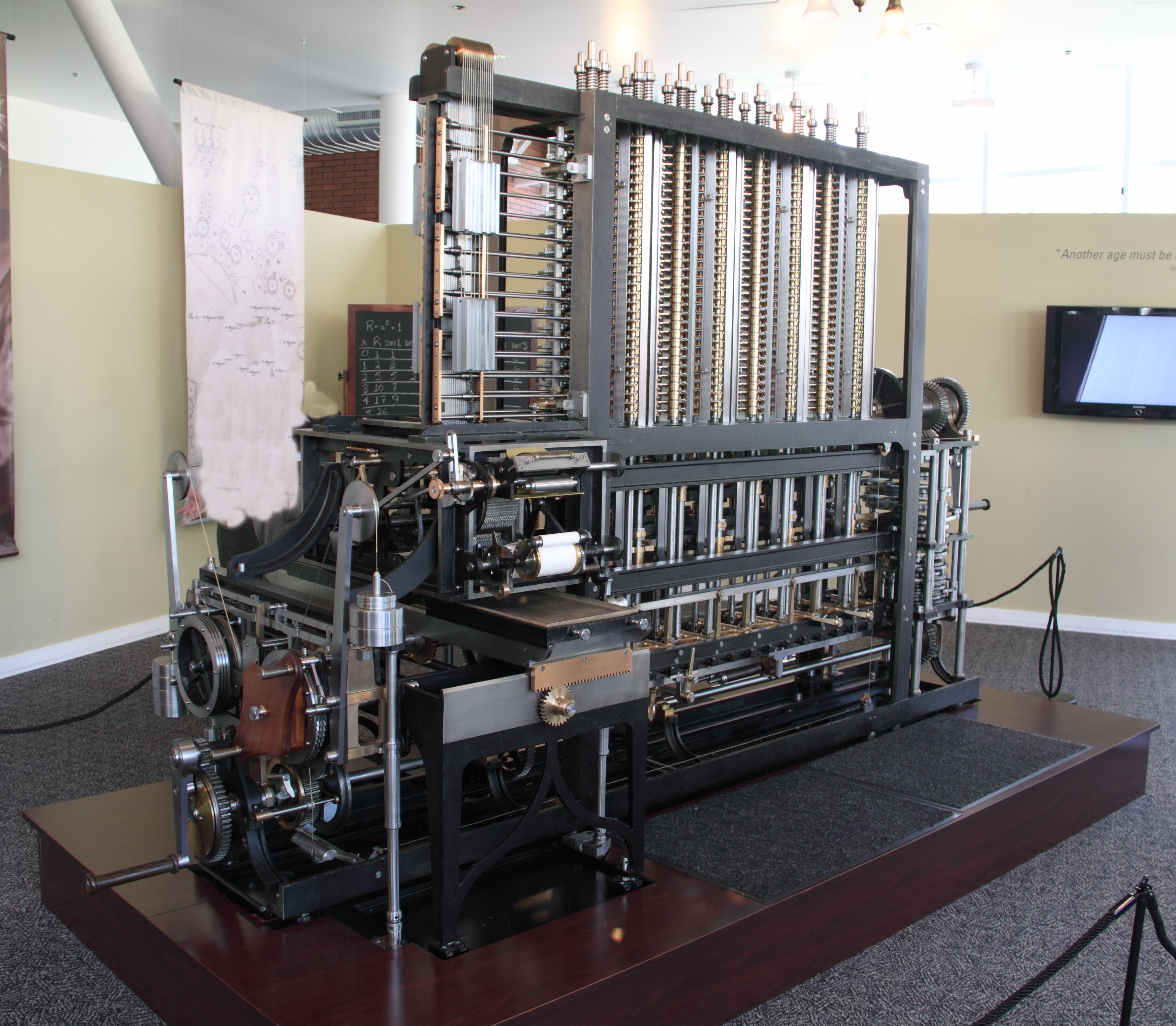
If Babbage’s Difference Engine was the first modern calculator, his 1837 Analytical Engine was the first mechanical computer. Inspired by the punch card system of industrial Jacquard looms, the Analytical Engine was fully programmable, allowing it to perform any mathematical formula. Though neither engine was fully built before Babbage’s death, the Analytical Engine was centuries ahead of its time. It prefigured many of the functions of its modern electronic descendants, including separation of memory (“the store”) from central processing (“the mill”).
In his memoirs, Babbage recalled being asked on two separate occasions by British parliamentarians, “Pray Mr. Babbage, if you put into the machine wrong figures, will the right answers come out?” Babbage confessed himself “not able rightly to apprehend the confusion of ideas that could provoke such a question.”
The Simulation Hypothesis
From Babbage and his electronic descendants flowed the metaphor of the universe as computation. Enter once more Nick Bostrom. In 2003, he published a paper entitled “Are You Living in a Computer Simulation?”—to which the answer was, well, probably.
According to Bostrom, “at least one of the following propositions is true: 1) the human species is very likely to go extinct before reaching a ‘posthuman’ stage; 2) any posthuman civilization is extremely unlikely to run a significant number of simulations of their evolutionary history (or variations thereof); 3) we are almost certainly living in a computer simulation.”
In other words: 1), either humanity will go extinct before attaining “posthuman” superintelligence; 2), a superintelligent humanity might refrain from simulating artificial worlds; or 3), it might embrace such simulation—in which case, we are probably its simulated offspring.

Though mind-bending, Bostrom’s simulation hypothesis is hardly original. More than two millennia ago, for example, Plato’s Allegory of the Cave imagined an artificial world where shadows substituted for reality in the eyes of their beholders. Then in 1999, the blockbuster movie The Matrix dramatized this scenario for modern audiences.
Notably, simulation theory does not require direct empirical evidence to sustain its arguments. Rather, it appeals to more abstract differences of probability. The more we suspect it may be true, the more likely the supposition.
What mathematicians would call a differential is simply the difference between two situations changing the odds of an outcome. If one fisherman casts his net into a pond and another into the Atlantic, for example, the differential is not merely geographical. The sea contains incomparably more fish than the pond, so the likelihood of a successful catch changes accordingly.
By extension, imagine two universes. In the first, intelligent beings resembling ourselves never figure out how to simulate alternate worlds. They are born, live, and die in their original physical world.
In the second universe, these same beings figure out how to simulate not one artificial world, but many millions. Each simulation contains those who live, breathe, and fall in love with the same intensity as those of the original universe, but trapped in the simulation, they are unable to grasp its virtual nature.

The difference is huge. In the simulation hypothesis, the original population may be a tiny fragment, awash in an ocean of artificial minds. Any random individual plucked from the total population will most likely be simulated, therefore, rather than native to the physical, primal universe.
The simulation hypothesis may be far-fetched, but advances in computation make it harder to ignore. Digital technology may not yet have evolved into consciousness, yet it reveals new forms of self-expression with uncanny fidelity. While the machine might not have yet generated the musical power of a Bach oratorio, for instance, or the sublimity of a Picasso painting, the current incarnation of AI clearly transcends the hallucinogenic regurgitations of recent years. Whatever its limitations, technological progress suggests that simulation is not receding but advancing in probability.
Technology demands new ways of seeing, but without history, philosophy, art, and literature, humanity will founder in a strange wasteland. As the hypothesis of an original physical universe accompanied by many simulated versions appears more likely, so too the inference grows that we inhabit one of many artificial worlds. How we respond is what matters in the end.
Looking Forward
The science fiction author Isaac Asimov once lamented that “science gathers knowledge faster than society gathers wisdom.” Whether or not the simulation hypothesis is provable in any objective sense, its value adheres not in the answers it provides but in the questions it inspires. In an age which confounds technological sophistication for civilizational progress, the ability to differentiate possibility from proof, or inference from demonstration, is a critical tool.

Will future generations deride the simulation hypothesis as an intellectual throwback, like the music of the spheres? Maybe they will laugh. Maybe they will weep. Either way, such uncertainty suggests how technology shapes not just our physical world, but our sense of self. In this sense, computation may be the final metaphor with which humanity must wrestle.

Learn More:
Ackroyd, Peter. Blake. Alfred A. Knopf, 1996.
Bostrom, Nick. "Optimal Timing for Superintelligence: Mundane Considerations for Existing People," (2026 working paper). https://nickbostrom.com/optimal.pdf
Kuhn, Thomas S. The Structure of Scientific Revolutions. 4th ed., University of Chicago Press, 2012.
Plato. Timaeus and Critias. Translated by Desmond Lee, revised with introduction and notes by Thomas Kjeller Johansen. Penguin Classics, 2008.
Swade, Doron. The Cogwheel Brain: Charles Babbage and the Quest to Build the First Computer. Little, Brown, 2000.


