
October 2026 marks the 55th anniversary of a fictional anniversary.
In October 1971, Muhammad Reza Shah Pahlavi, the second and last Pahlavi shah (king) of Iran and, as it turned out, the last shah of any dynasty to rule Iran, decided the time was right to celebrate the 2,500th year of monarchical rule in his country.
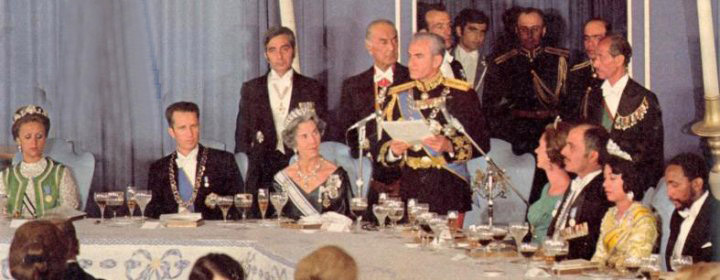
The decision was a matter of choice rather than of a date inscribed on any calendar. By all accounts, the geography that constitutes modern Iran had been governed by a monarch for much less time than the shah suggested.
In the shah’s worldview, his reign stood as the glorious culmination of the noble kingly precedent established by the legendary Achaemenid Empire of Cyrus the Great. In fact, a fudging of these numbers belied the wholesale fudging of the historical record.
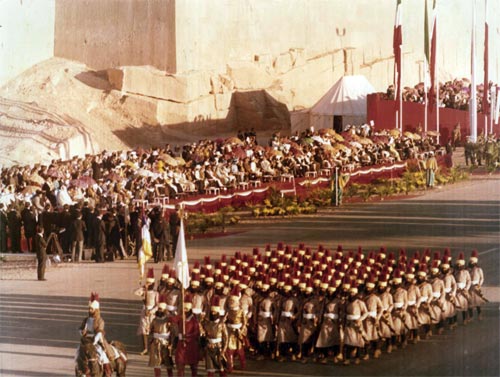
While the anniversary itself was an invention, what was real was the massive blowout the shah staged to mark the occasion. The party lasted about a week and cost over $100 million according to contemporary press estimates, the equivalent of about $800 million today. For comparison, that’s about $200 million more than the projected cost of the White House ballroom.
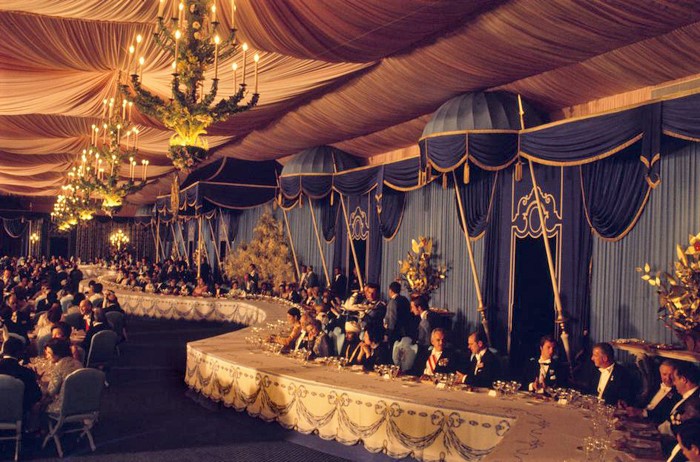
Of that $800 million, $50,000 was spent on costumes for actors serving in the shah’s royal court, each of which required one mile of golden thread. An even larger sum was allocated for a banquet that featured lavish foods stuffed within even fancier foods, such as quail eggs encasing caviar and roast peacock filled with foie gras.
Representatives from sixty-nine states feasted on those delicacies, including one emperor, two sultans, nine sheiks, nine kings, five queens, thirteen princes, eight princesses, three premiers, sixteen presidents, and four vice presidents.
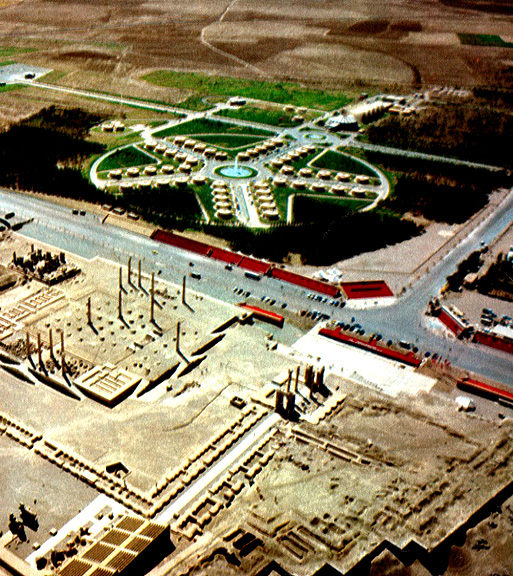
The site of the celebration, the ancient Iranian capital of Persepolis, had to be freshened up to achieve the desired level of grandeur. To do this, the shah transformed a portion of the otherwise dusty desert into a lush oasis.
All in all, Time magazine called the celebration “one of the biggest bashes in all history,” and the shah delighted that it was “the most wonderful thing the world had ever seen.”
Prevented from partaking in the delight were Iranians themselves. The shah generally viewed his subjects with contempt, and the shah’s security forces physically prevented them from getting anywhere near the festivities. In what Time reported as an “ironic coincidence,” the shah’s agents of celebration and repression “arrested exactly 2,500 potential troublemakers,” one for each fictional year being celebrated.
To make matters worse, if Iranians were lucky enough not be sent to prison, they were likely languishing in a number of other ways as a result of the jolting modernization programs the shah had imposed. These programs led to poverty, migration, homelessness, and a host of other socio-economic maladies.
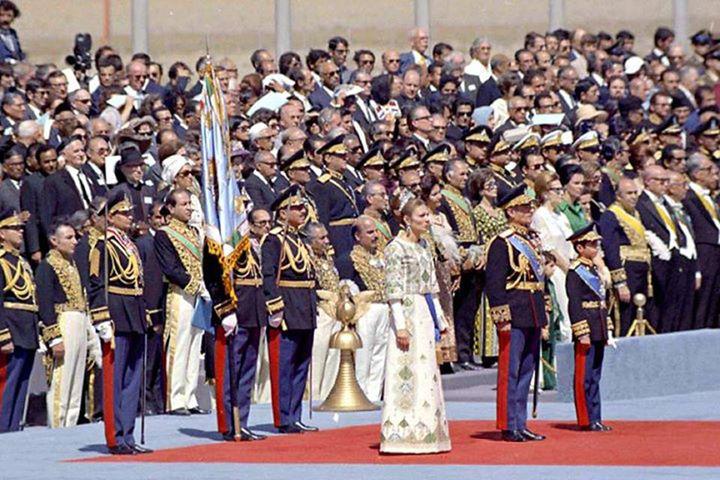
The exclusion of ordinary Iranians was the logical outcome of the shah’s approach to his state and to his people. The shah maintained that he could compel change from above and without debate, insisting that Iranians could be modernized without being consulted.
Perhaps more than anything else, the shah’s Iran was defined by a chasm between state and society, a chasm as gaping as his gala was grandiose. It is in this contrast between the shah’s extravagance and his people’s suffering that his party at Persepolis takes on its historical significance. It exemplified the circumstances that culminated in the revolution that overthrew the shah fewer than eight years after his over-the-top celebration.
Revolution is usually a last resort, especially in the modern era, when the methods of state control are more advanced. In such circumstances, staging a revolution, and overthrowing a dictator, is incredibly difficult. It takes a tremendous amount of work that most people, especially those who are struggling to survive, can not commit to unless they see it as something that’s absolutely necessary.
That is the deepest lesson of the fake anniversary celebration at Persepolis in 1971. States rarely collapse because they throw parties; they throw parties because they have run out of other ways to speak to their people. Spectacle is what rulers buy when they have stopped earning legitimacy, and the purchase, as the shah learned, compounds the debt.
The gap between rulers and ruled can be bridged only by representation, accountability, and rights. The 2,500-year celebration endures in Iranian memory not because of the gold thread or the roasted peacock, but because for one week in 1971, Iranians could see with unusual clarity who their state served.

Learn More:
“The World: Iran: The Show of Shows,” Time (Oct. 25, 1971)
Decadence and Downfall in Iran: The Greatest Party in History, BBC Storyville (2016)
Robert Steele, The Shah’s Imperial Celebrations of 1971: Nationalism, Culture and Politics in Late Pahlavi Iran (Bloomsbury, 2021)
Ervand Abrahamian, Iran Between Two Revolutions (Princeton University Press, 1982)
Lisa Reynolds Wolfe, “The Shah Celebrates,” Cold War Studies (Mar. 7, 2019)
“The Most Expensive Party Ever,” Alimentarium
Hussam AbdelKareem, “The Shah’s Last Party,” Al Mayadeen (Dec. 15, 2021)
“The Party that Overthrew the Iranian Empire,” Medium (Sep. 10, 2021)
Sara Dorn, “Here’s How Much Trump’s Capital ‘Vanity Projects’ Will Cost—As Crews Prepare for Arch Groundbreaking,” Forbes (Sep. 4, 2026)


